
Grace Huang

Biography
Grace Huang is a Melbourne-based contemporary artist whose practice spans more than four decades. Born in 1962 in Guangzhou, China, she trained at the Guangzhou Academy of Fine Arts, graduating in 1986 with a Bachelor of Art in Fine Arts and Art Education. In 1988, she relocated to Melbourne, a move that has profoundly shaped her artistic trajectory and continues to inform the distinctive visual language for which she is recognised internationally.
Huang’s early work engaged expressive figurative and landscape traditions. Over time, her practice underwent a marked distillation, evolving into a refined, minimalist vocabulary that balances formal clarity with psychological depth. Her mature paintings frequently present solitary figures set against urban or coastal backdrops. Structured geometric forms, familiar public signage, and carefully calibrated colour fields hold emotion in check while granting the surrounding space equal psychological weight to the human presence. Symbolic elements appear sparingly, never as ornament. The result is a body of work that explores isolation and interaction, the transient nature of everyday experience, and the quiet poetry embedded in ordinary moments. Viewers encounter compositions that feel simultaneously precise and estranged, inviting contemplation of the contrasts and subtleties of contemporary shared environments.
Critical responses have consistently highlighted the subtlety and technical command of her approach. One assessment describes her as an artist of exceptional insightfulness who communicates ideas with rare restraint, drawing upon and inverting landscape traditions through distillations of time, space, light, texture and colour. Her paintings are noted for their deceptive clarity of purpose, which draws the viewer more deeply into empathetic meditations on the human condition. Urban landscapes in her work are not sites of desolation but places inscribed with overlapping private and public meanings, presences and memories. The beauty of the surface and a generosity of spirit imbue her subjects with dignity, free of sentimentality.
Huang’s conceptual method involves selecting subjects from a unique observational standpoint at the moment of inspiration, ensuring her compositions remain unbound by conventional norms. She has spoken of art as a profound medium for expressing thought and emotion. This journey began at the academy and has continued through sustained inquiry into the silent dimensions underlying perception. Forms and colours, in her view, emerge from cognition and in turn generate new visual expressions, a cyclical process that mirrors life itself. This philosophical grounding underpins the formal reduction that characterises her later work: subtraction intensifies symbolic charge rather than diminishing it, producing rarefied visual fields that verge on abstraction while remaining anchored in lived experience.
Her career has been marked by consistent recognition. She is a multiple award winner, most notably securing the top honour in THE ART WORLD TOUR 2023 (supported by World Wide Galleries and ARTBOX.GROUPS GmbH, Switzerland). Earlier distinctions include Best Urban Landscape at the Herald Sun Camberwell Art Show (2012), the Open Section Award at the Victor Harbour Art Exhibition (2002), and the Herald Sun Camberwell Restricted Award (2001). She has been a finalist in numerous competitive prizes, among them the Bluethumb Art Prize, ARTBOX.PROJECT New York, Cliftons Art Prize Asia Pacific, Brisbane Art Prize, Fleurieu Food & Wine Art Prize, Muswellbrook Art Prize, Hawkesbury Art Prize, Norvill Art Prize, Redland Art Awards, MacarthurCook Art Award and John Leslie Art Prize.
Huang’s exhibition record is extensive and international. Her work has been presented at ARTEXPO New York, RED DOT MIAMI, SWISS ARTEXPO, ARTBOX EXPO Basel, ARTBOXY at Le Carrousel du Louvre and Art3f Strasbourg in Paris, the Palm Springs International Art Fair, the Melbourne Affordable Art Show, and the Ningnan Museum of Fine Art in China, among many other venues. Solo and group exhibitions have taken place across Australia, China, Europe and the United States. Representation by galleries in Australia, China, France, Switzerland, Germany, Italy, Spain, Greece, the UAE and the USA has ensured wide visibility. Research residencies and study visits have further enriched her practice: short periods residenced in China (2006–2008, 2011 and 2016) focused on Chinese Song Dynasty art and contemporary developments, while 2018 included visits to Gerhard Richter’s The Life of Images and Yayoi Kusama’s Life is the Heart of a Rainbow at the Queensland Art Gallery of Modern Art, as well as research into global contemporary art in New York, including the Armory Show.
Publications have documented her contribution. An early feature in Australian Artist (Issue 237, March 2004) presented eleven paintings under the editorial heading “Learn from the Dreamlike Qualities of Work Straight from this Artist’s Subconscious.” Subsequent coverage has appeared in ARTLO – The International Art Magazine, Spotlight Contemporary Art Magazine, Top Investable Artists (2025 and 2026 editions), 50 Artists to Discover: 2025 Edition, Art Investment & Collectors’ Guide 2025, HUG 100 Artists to Watch 2024, and other catalogues and journals. Her paintings were selected for the set design of the 2000 film Blonde (Crawford Productions Services Pty Ltd and Robert Greenwald Films, USA), extending her reach into popular culture.
Works by Huang are held in corporate and private collections across Asia, Europe, America and Australasia. Institutional and organisational holdings include the Guangzhou Academy of Fine Arts, Guangdong Lingnan Art Museum, Brighton Yacht Club, and various corporate and private collections in Australia and beyond. The breadth of this collecting base reflects the accessibility and resonance of her distilled visual language.
Throughout her career, Huang has maintained a dual engagement with Chinese cultural heritage and the urban realities of contemporary Australia. The transition from Guangzhou to Melbourne provided both dislocation and generative stimulus, informing the recurring themes of passage, intermediate states and the intersection of individual experience with collective structures. Her figures often appear as transient presences moving across surfaces rather than fully embedded within places, a condition that feels deeply contemporary while connecting to longer traditions of landscape and figuration.
Huang continues to live and work in Melbourne. Her practice remains one of exploration and discovery, continually testing the boundaries of traditional approaches to articulate a unique perspective on life. Through the fusion of striking aesthetics and understated narrative, her paintings bridge personal and universal concerns, affirming art’s capacity to illuminate the quiet poetry of daily existence. Whether encountered in international art fairs, museum contexts or private collections, the work invites viewers to re-examine the commonplace and to discover greater meaning in the extraordinary dimensions of the ordinary. As her international profile expands through ongoing exhibitions and publications, Grace Huang stands as a distinctive and influential voice in contemporary painting, recognised for both the formal rigour of her distilled visual language and the empathetic depth of her engagement with the human experience.
Artist Statement
Grace Huang’s practice centres on distilling everyday experience into a refined visual language of clarity, restraint and quiet intensity. Working primarily in oil on linen and canvas, she constructs compositions that feature solitary figures set within urban or coastal environments. Bold geometric forms, flat chromatic fields and carefully selected public signs structure these scenes, holding emotion in check while granting equal psychological weight to the surrounding space. Symbolic elements appear sparingly and never as decoration; each component serves the larger inquiry into isolation, interaction and the transient nature of human presence.
Huang’s approach is grounded in conceptual observation. She selects subjects from a distinctive vantage point at the moment inspiration arises, allowing compositions to emerge unbound by conventional narrative or stylistic expectation. The resulting works operate through reduction: by subtracting the superfluous, she intensifies the symbolic and atmospheric charge of what remains. Colour is deployed with deliberate control—often restrained yet capable of sudden luminosity—producing fields that feel both precise and estranged. Light, texture and spatial relationships become agents of time itself, inviting viewers to sense the passage of days into nights, moments of waiting, remembering, hoping or simply watching.
At the core of the practice lies a sustained fascination with the silent dimensions that underpin perception. Huang explores how forms and colours arise from thought, and how thought, in turn, generates new visual expressions—a cyclical process that mirrors the rhythms of lived experience. Her paintings acknowledge the dissonance between surface appearance and underlying reality, seeking to bridge that gap through a visual language that is at once familiar and enigmatic. Viewers are encouraged to re-examine the ordinary, to discover greater meaning in the commonplace, and to participate in an imaginative expansion of what is seen.
Though rooted in the traditions of landscape and figuration, Huang’s work inverts them through formal economy and psychological subtlety. The figures she depicts exist in intermediate states—bodies that move across surfaces rather than fully inhabit places—rendering them both contemporary and archetypal. Urban settings are never presented as sites of bleakness; instead they appear as rich fields of overlapping private and public meanings, presences and memories. Beauty of surface and an underlying generosity of spirit invest the subjects with dignity free of sentimentality.
Huang’s practice continues to evolve through ongoing exploration of time, space and the quiet poetry of daily life. Each painting stands as an invitation: to look more carefully, to feel more deeply, and to recognise the extraordinary dimensions latent within the ordinary.
https://gracehuang.art/
https://www.instagram.com/gracehuangart/
https://www.linkedin.com/in/grace-huang-48479536/
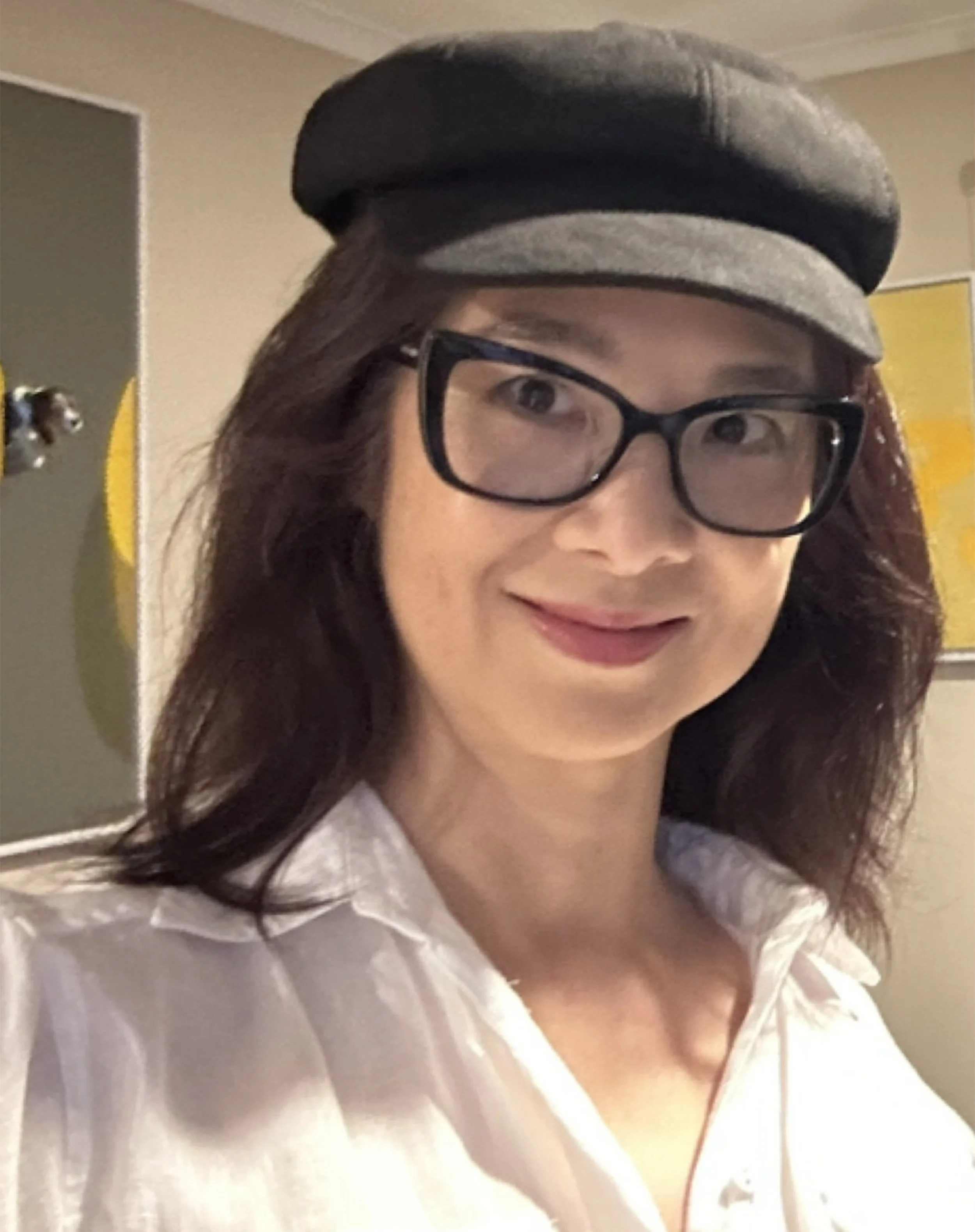
Grace Huang

AFL, 2020, Oil on linen, 116 cm x 144 cm

NO PARKING, 2011-2023, Oil on canvas, 76 cm x 91 cm

No. 6, 2017, Oil on linen, 112 cm x 122 cm

No. 8, 2017, Oil on linen, 100 cm x 124 cm

No. 65, 2019, Oil on canvas, 40 cm x 40 cm

Wi-Fi ON, 2016, Oil on linen, 121 cm x 100 cm
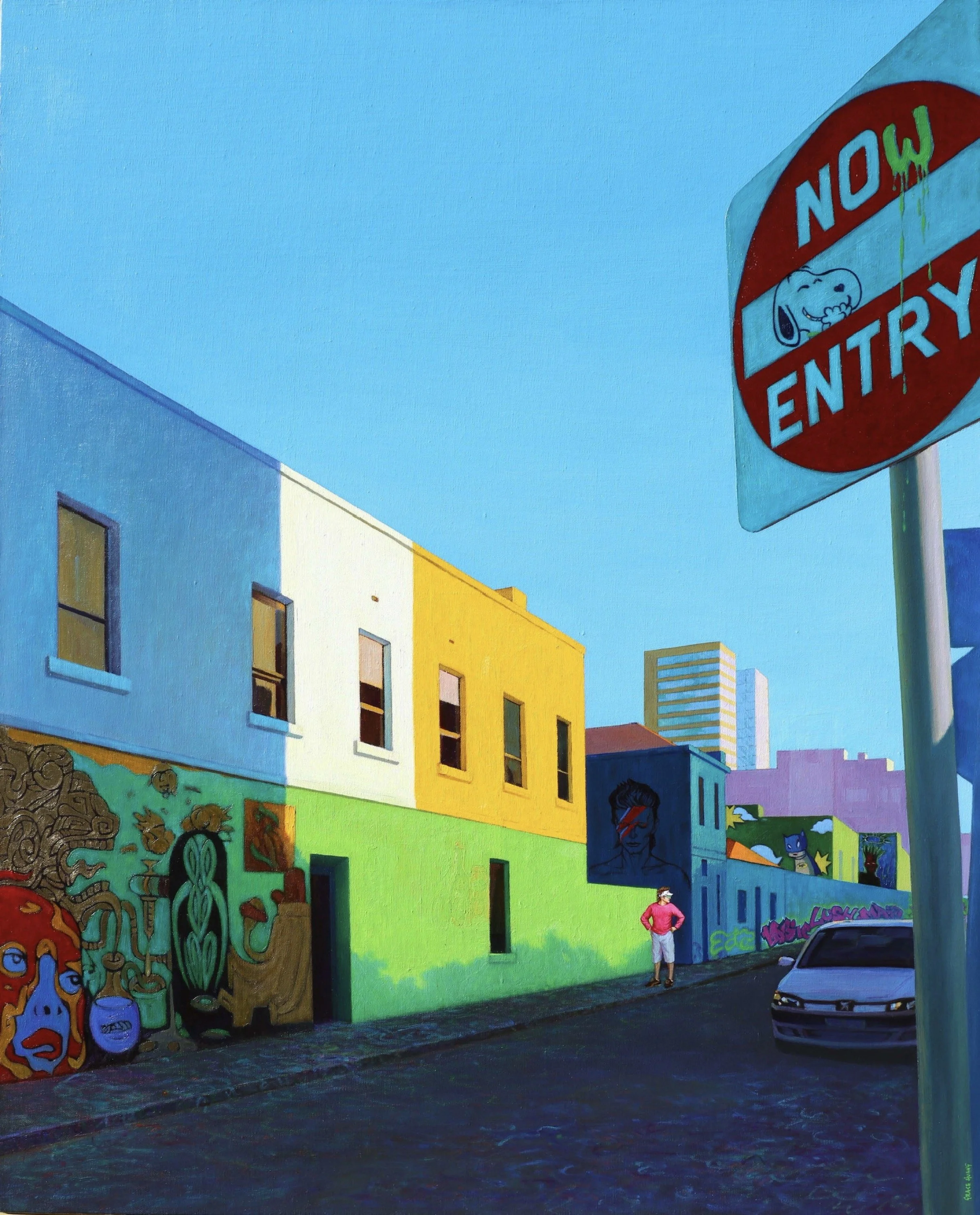
NOW ENTRY, 2019, Oil on linen, 124 cm x 100 cm

NO DIVING, 2022, Oil on linen, 90.2 cm x 115.2 cm

NO RUNNING, 2007-2018, Oil on canvas, 76 cm x 104 cm

Follow Me, 2007-2017, Oil on canvas, 99 cm x 119 cm