
Dany Klotz
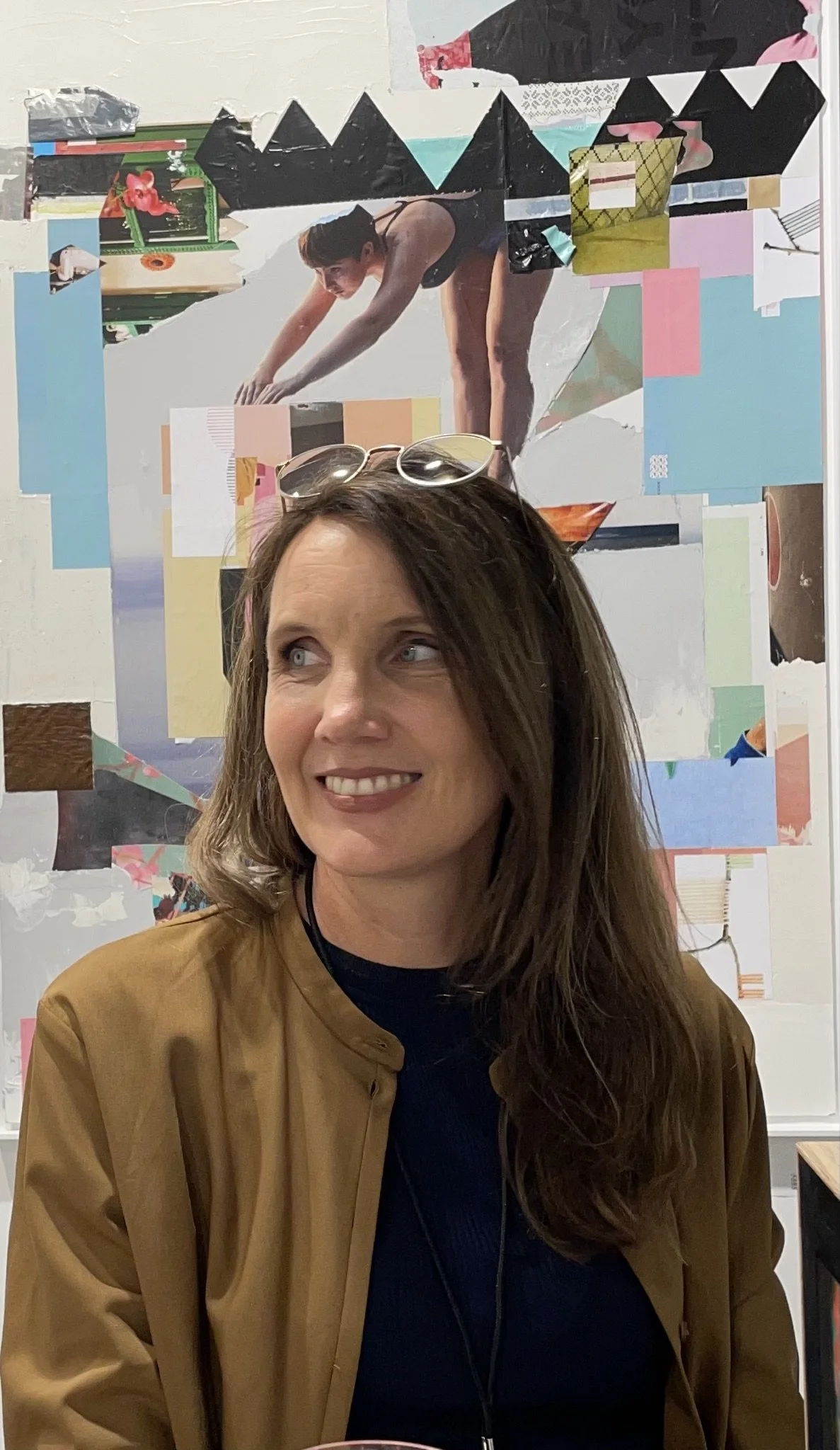
Dany Klotz is a Munich-based collage and mixed media artist. She grew up in the triborder region near Basel, where overlapping cultures and blurred boundaries shaped her early sensitivity to transition and in -between spaces.
Her work explores the poetics of slowness, impermanence, and mindfulness through hand-cut collage, drawing, and found paper.
Using timeworn materials and intuitive gestures, she builds quiet, emotionally resonant compositions from fragments.
Dany, your collages seem to operate in what might be called a field of suspended temporality, where fragments resist narrative closure while remaining emotionally charged. How do you think about time in your work, not simply as memory or nostalgia, but as a material condition that structures the image from within?
It is true that collage inherently plays with a mixture of different times. This is due to the fact that printed materials usually serve a specific purpose and are mostly tied to contemporaneity - they often have an expiration date. Naturally, the same conditons apply to my collages. However, what may differ is my interest in the fragments I choose to use. What fascinates me about printed matter - and about visual material in general - is color, structure, pattern, light, and shadow. It is almost never about the object itself, but rather about what surrounds it: the elements that hold the object and place it into relation. I believe that this approach actually renders the time factor in collage uninteresting, if not entirely irrelevant.
Growing up in the tri-border region near Basel, you were immersed early on in cultural overlap and porous boundaries. How has this experience shaped your understanding of collage as a logic of adjacency rather than synthesis, and do you see your practice as resisting the idea of a unified image in favor of something relational and contingent?
I spent my childhood in a village near Basel, living very idyllically on a hill bordering a forest where one would constantly and unknowingly cross invisible borders. As a child, I spent a great deal of time alone in this forest, moving freely regardless of boundaries. Yet there were always two polarities in my perception: fear and love. Fear of the unknown, of uncertainty, and of course the narrative of the dark and dangerous forest where one can get lost. For me, then and now, trust in Mother Nature prevailed - a deep sense of connection and the protection she grants us. These two polarities - fear and trust - are certainly reflected somewhere in my images, perhaps unconsciously.
Your process often begins without a predetermined plan, privileging intuition, material responsiveness, and incremental decision making. In a contemporary art context that often emphasizes concept-first methodologies, how do you articulate the intellectual stakes of working from inside the image outward rather than imposing an external theoretical framework?
For me, art happens when I live in the moment and allow myself to play and experiment. Collage is naturally a very suitable field for this. Until the moment everything is fixed, anything can be moved, exchanged, reorganized. I love this organic invention from within. There comes a point when the result holds an exciting balance. If, after a week, I still feel that the image does not fall apart and remains compelling, then it is finished for me. As a human being, I reinvent myself while breathing - I do not first make a plan or concept and then live according to stage directions. I approach art in the same way.
Many of your works suggest an imagined reality that feels familiar yet remains fundamentally unattainable. How do you negotiate this tension between recognition and estrangement, and do you see your collages as proposing an alternative epistemology, one rooted in affect, slowness, and partial knowledge?
Recognition probably occurs most strongly at points of orientation. These can vary greatly from person to person. For some, it may be a color combination that awakens memories, similar to a scent; for others, a pattern; and for others still, an actual motif. Points of orientation are connected to associations, conditioning, memories. These places feel familiar, yet they always carry only subjective truth, which is why they appear uattainable. I do not pursue this intentionally, but I am always careful to find an optical balance in the image - for example, among certain dominant colors or structures. I can imagine that this may lead viewers to perceive these elements as orientation points rather than merely as colors or patterns.
The hand-cut fragment in your work retains visible traces of touch, wear, and prior use. In an era dominated by digital smoothness and infinite reproducibility, how do you understand tactility as a critical position rather than a nostalgic gesture, and what forms of attention does it demand from the viewer?
Paper is, of course, a wonderful material. Visible traces make this mass-produced product personally tangible and create boundaries against the cool digital smoothness you mention. In collage, these traces function like stumbling stones that remind the overstimulated eye that these are analog works.
Your recent project “Sending Flowers to my Younger Self” introduces movement and duration into a practice long associated with stillness. How did the shift toward moving image alter your relationship to fragmentation, and what new questions emerged when collage began to unfold in time rather than remain spatially fixed?
Last year, I began setting my illustrations in motion. This was - and still is - quite a challenge for me, one I am still learning to master. The technical aspect plays a significant role, which I must work through step by step. Yet it is exciting to see how stop-motion brings images into movement. For it to function, one must already consider the functionality of the illustration while drawing, so that the movement can unfold coherently. The aspect of storytelling also becomes very important. The moving image wants to tell a story. I had almost forgotten that I actually love telling stories. When my children were small, we had an evening ritual whenever we ran out of books or were traveling: each person would say one word, and together we would invent a story from those words. In my previous collages, I often refused narrative and left interpretation open. The moving image, however, demanded a story from me. The wonderful outcome of working with animation was that the desire to tell stories brought me back more intensely to drawing.
Drawing appears in your collages not as an illustrative supplement but as an equal structural force, sometimes interrupting and sometimes binding the fragments together. How do you theorize the relationship between drawing and collage in your work, particularly in terms of authorship, control, and vulnerability?
At the moment, I am working on a series of very picture-book-like illustrations that are cut out and staged as collage elements against a backdrop resembling a theater set. Playable backgrounds emerge, along with main and secondary characters - much like in theater or in old dollhouses. Without the detour through animation, I probably would not have discovered this path for myself. And who knows - perhaps there will be an opportunity to turn these newly narrative collages into a children´s book, something I have dreamed of for a long time. I could also imagine them as beautiful window displays in the high-end sector. I am open to collaborations.
As you expand into media such as stop motion, type animation, and zine making, how do you guard against the loss of what you describe as the poetic and tactile essence of your practice? Do you see these expansions as translations, extensions, or productive misalignments of collage logic?
I have always loved drawing. It helps me organize my thoughts. Often they are flowers or everyday objects that capure my attention; sometimes they are simply doodles placed at regular intervals. I like patterns and structures. In my collages, they create lightness, space for imagination, and an additional layer in which air can circulate. In my very dense, small-scale collages, such intermediate spaces are beneficial and weave a different energy into the whole. But of course, authorship is also important. My own drawing style makes my collages unmistakable.
I am and remain someone who prefers working analog rather than digital. Through my experience with animation and stop-motion, I rediscovered my love for illustration, for which I am very grateful. Whether I will animate my newly emerging series "small pleasures", in which illustrations function as collage elements on a stage-like background, remains to be seen. My main focus is on analog work, and at the moment I do not want to slow down my workflow with additional animation projects. The possibility exists , however, and it is certainly exciting.
Your compositions often feel quiet yet densely saturated, resisting spectacle while remaining visually abundant. How do you think about restraint as an aesthetic and ethical choice, especially within the context of contemporary visual culture’s demand for immediacy and legibility?
I approach this as I do life itself. There is no right or wrong - only different types of people, or images. I am a very reserved person, and accordingly my images are also restrained. From another perspective, however, a reserved person can be the loudest in the room, because they leave space for interpretation and projection. This is the place where the other - or in the case of collage, the viewer - looks into a mirror. They will see what they seek within themselves, or what frightens them most. That may be chaos or harmonious restraint.
Your work consistently resists resolution, allowing fragments to remain open, provisional, and quietly unstable. In a moment when contemporary culture often demands coherence, explanation, and speed, how do you understand the refusal of closure in your collages as both an aesthetic strategy and a way of thinking through uncertainty, vulnerability, and lived experience?
It may well be that some viewers experience my collages in this way. For me, however, my works are complete. What you describe as "quietly unstable" is, for me, the air that the collage needs in order to breathe.
In my new series "small pleasures," which is very figurative and works with my illustrations as collage elements, your question gains a new dimension, and it is truly fascination for me to become aware of this development through your words. Through the "dollhouse play character" of these works, I indeed refuse a final closure. Everything remains flexible, variable, playable.
Regarding your question about lived experience: as a single mother of three children, I always had to hold everything together. I often wished for more freedom and air - this likely influenced my earlier works and may have created the impression of "quiet instability". It is therefore extremely fascinating that precisely at the moment when my youngest child has become an adult and I am finally able to live this freedom and spaciousness, I am transforming my collages with my illustrations into very figurative and concrete forms, while conceptually moving toward even more unstable compositions. It remains exciting to see how this new series - and my new life without family obligations - will continue to develop.
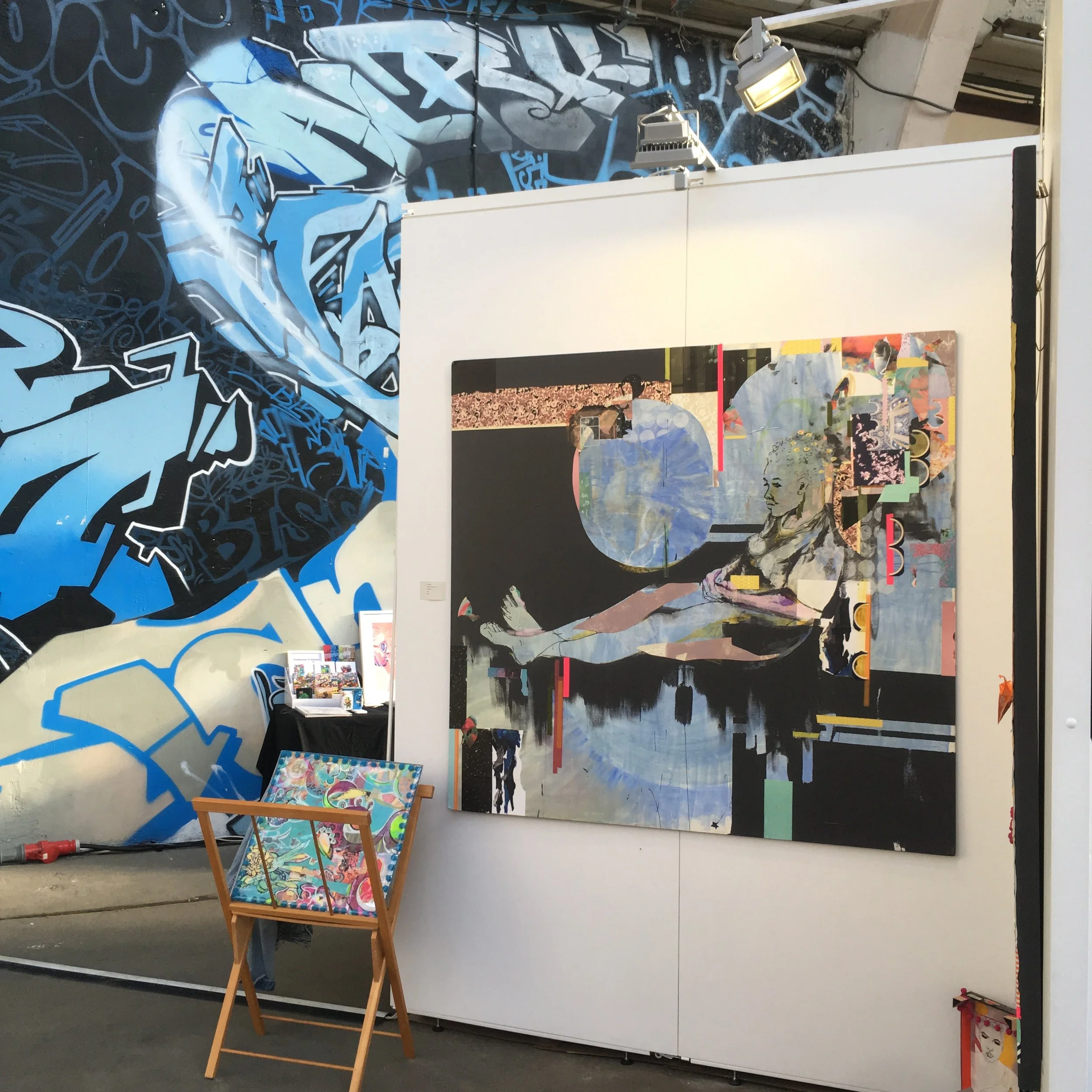
"Waiting for the future", Collage, 170x180cm, 2018 at STROKE art fair Munich 2018
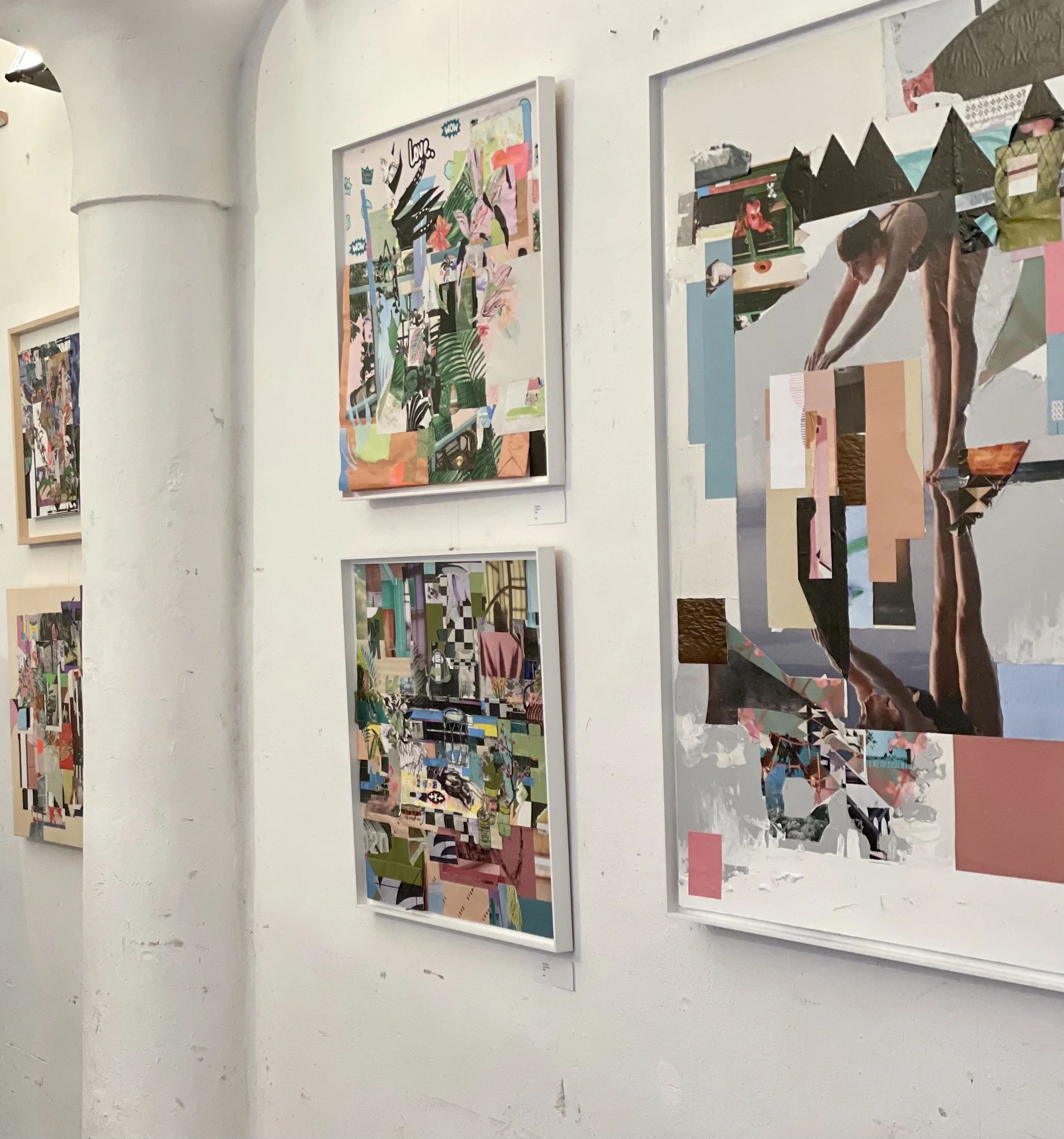
"Jump into new me", Collage, 120x88cm at STROKE art fair 2021
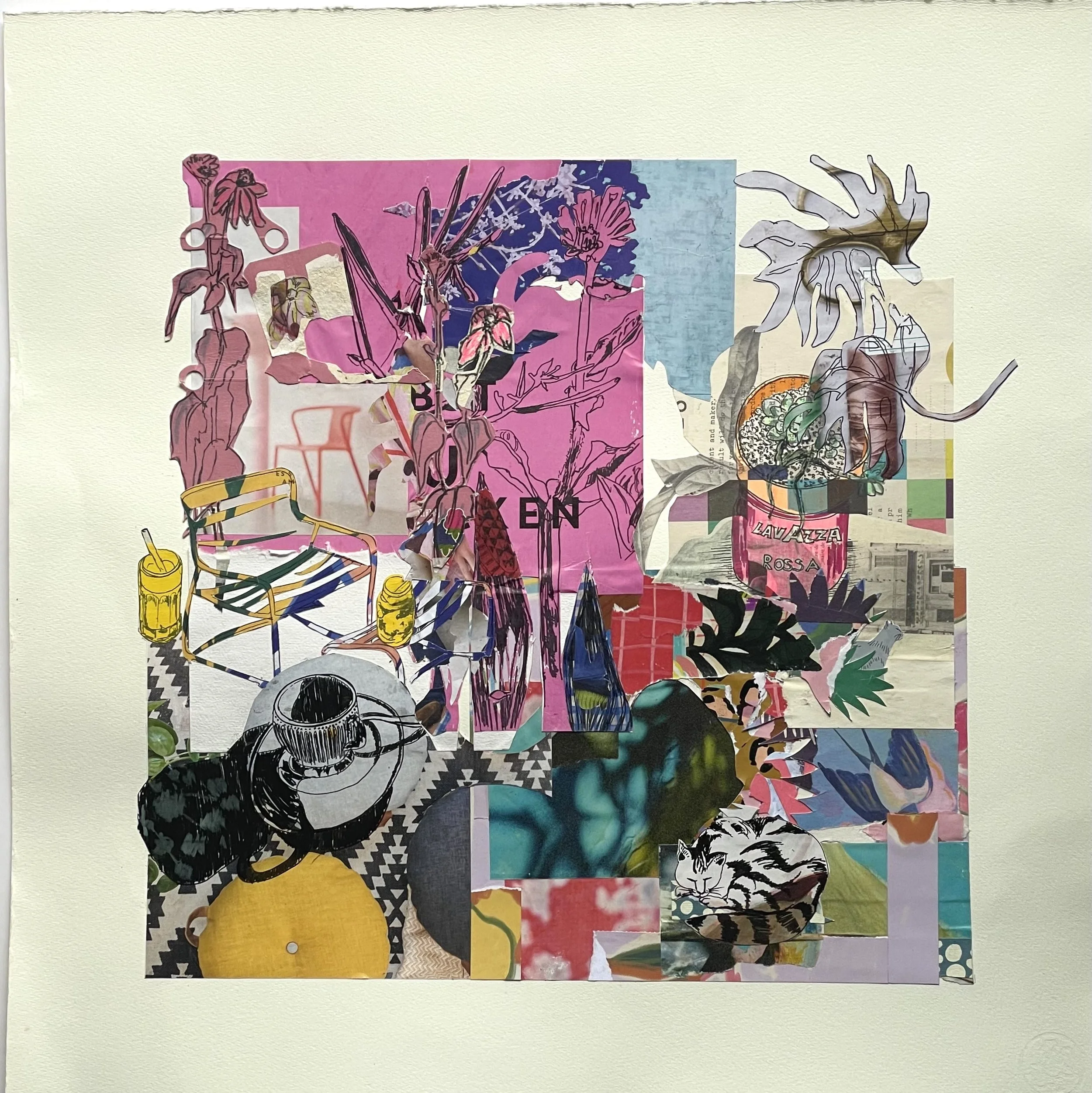
"Lavazza Rosso", Collage, 53x53cm, 2026
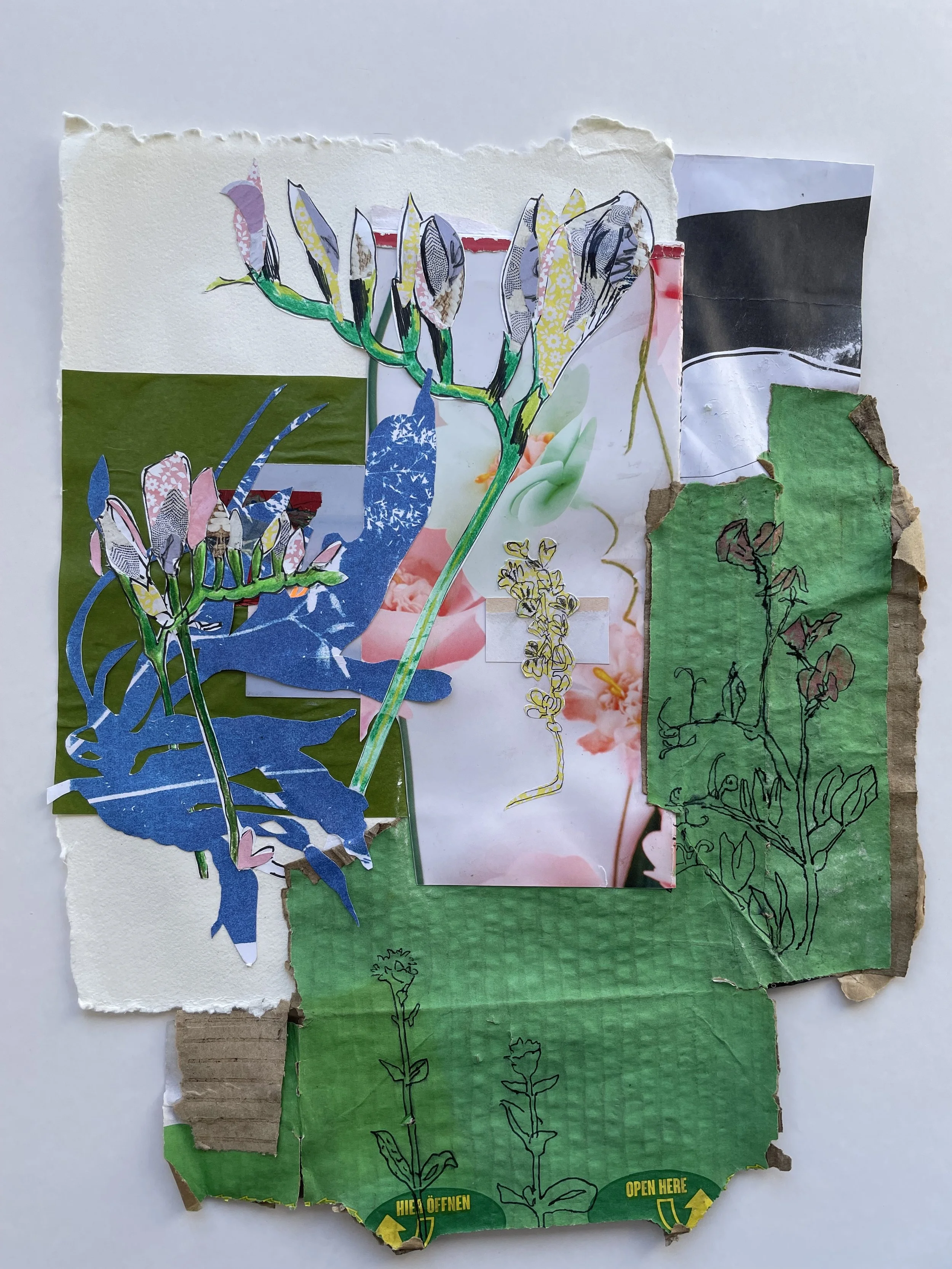
"Hier öffnen", Collage, 42x30cm, 2025
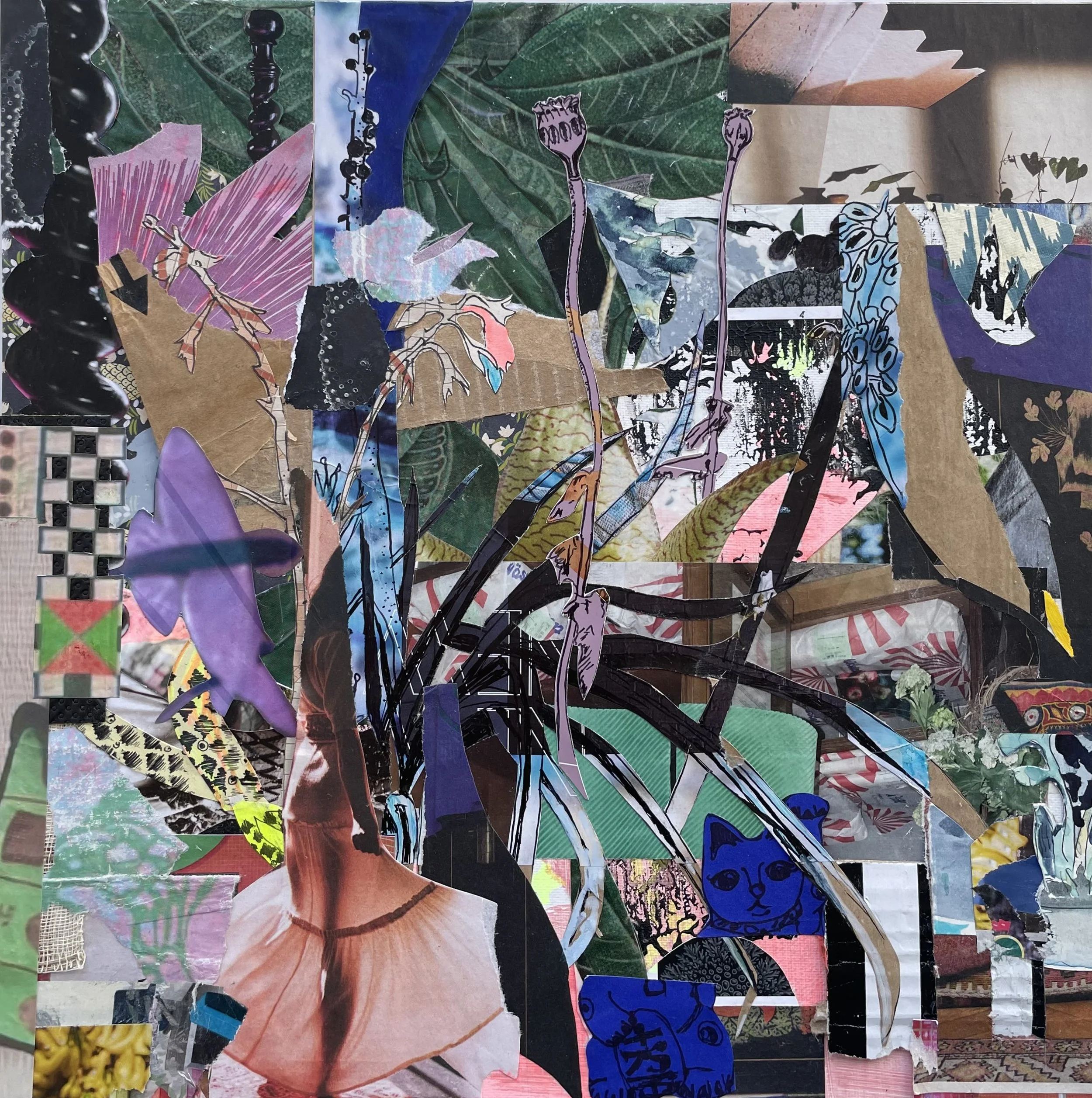
"Dreaming best under an open sky...", Collage, 36x36cm, 2025
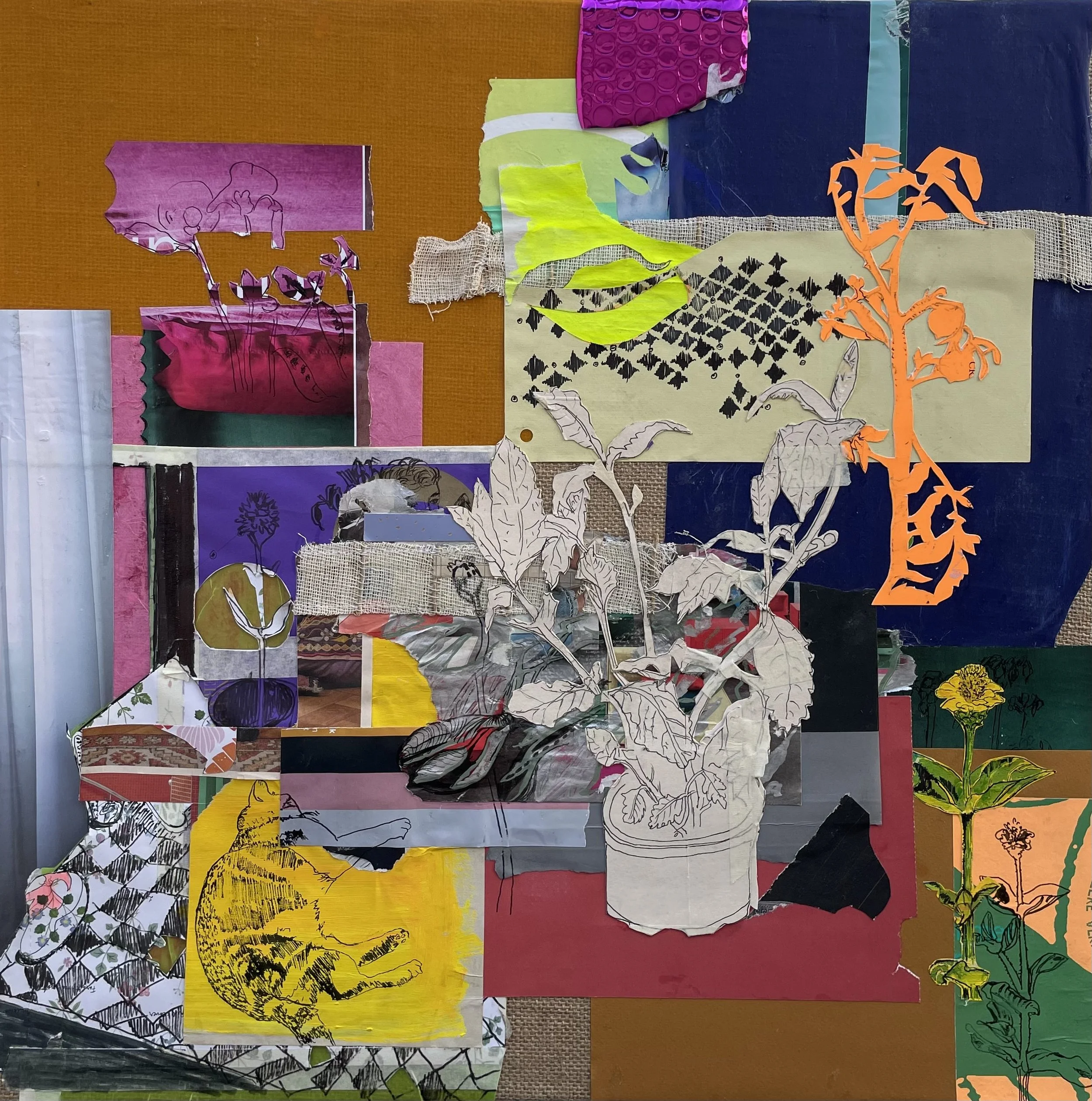
"Calling mama...", Collage, 50x50cm, 2025
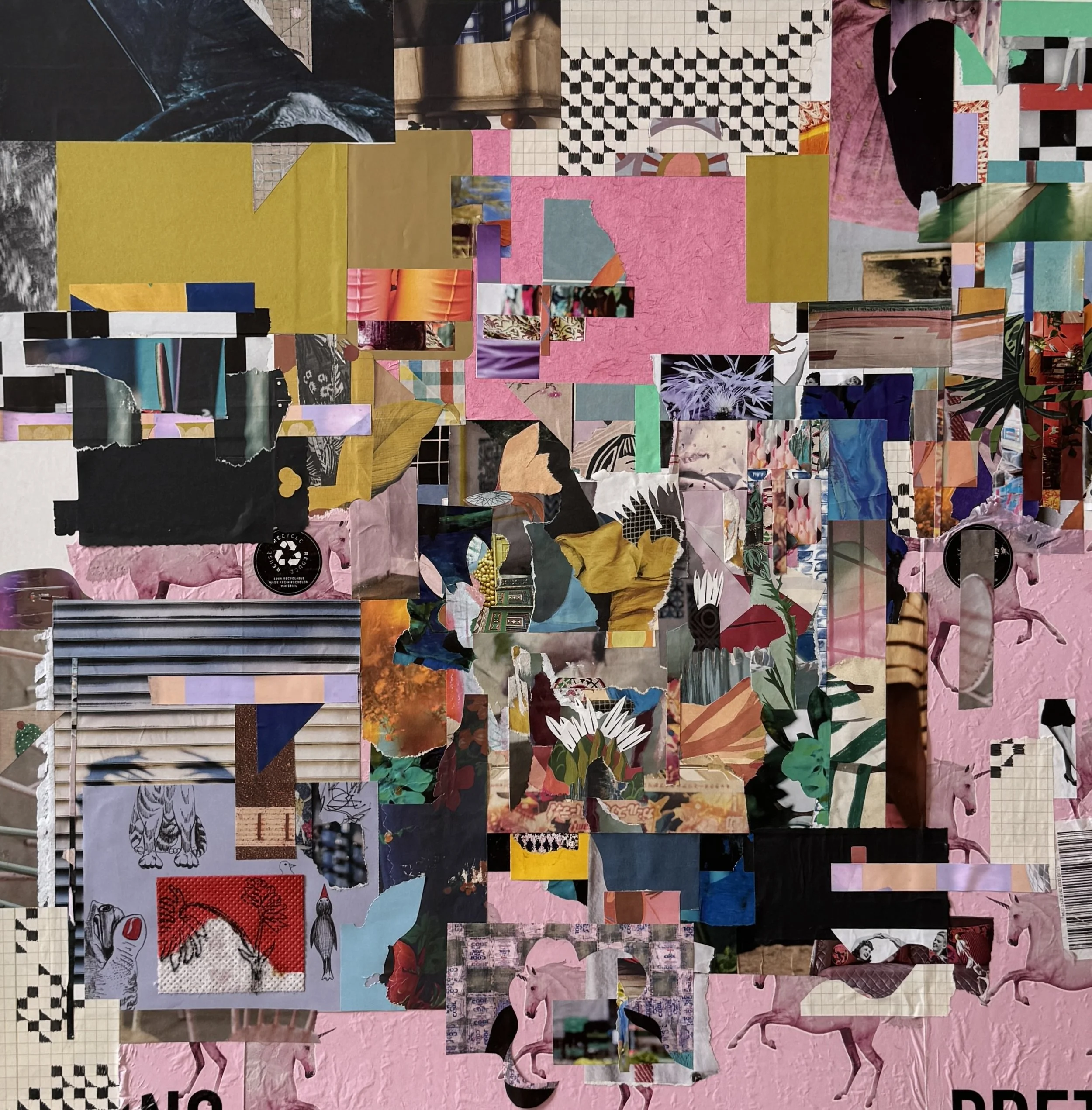
"Nachts träum ich von Fabelwesen...", Collage, 80x80cm, 2025
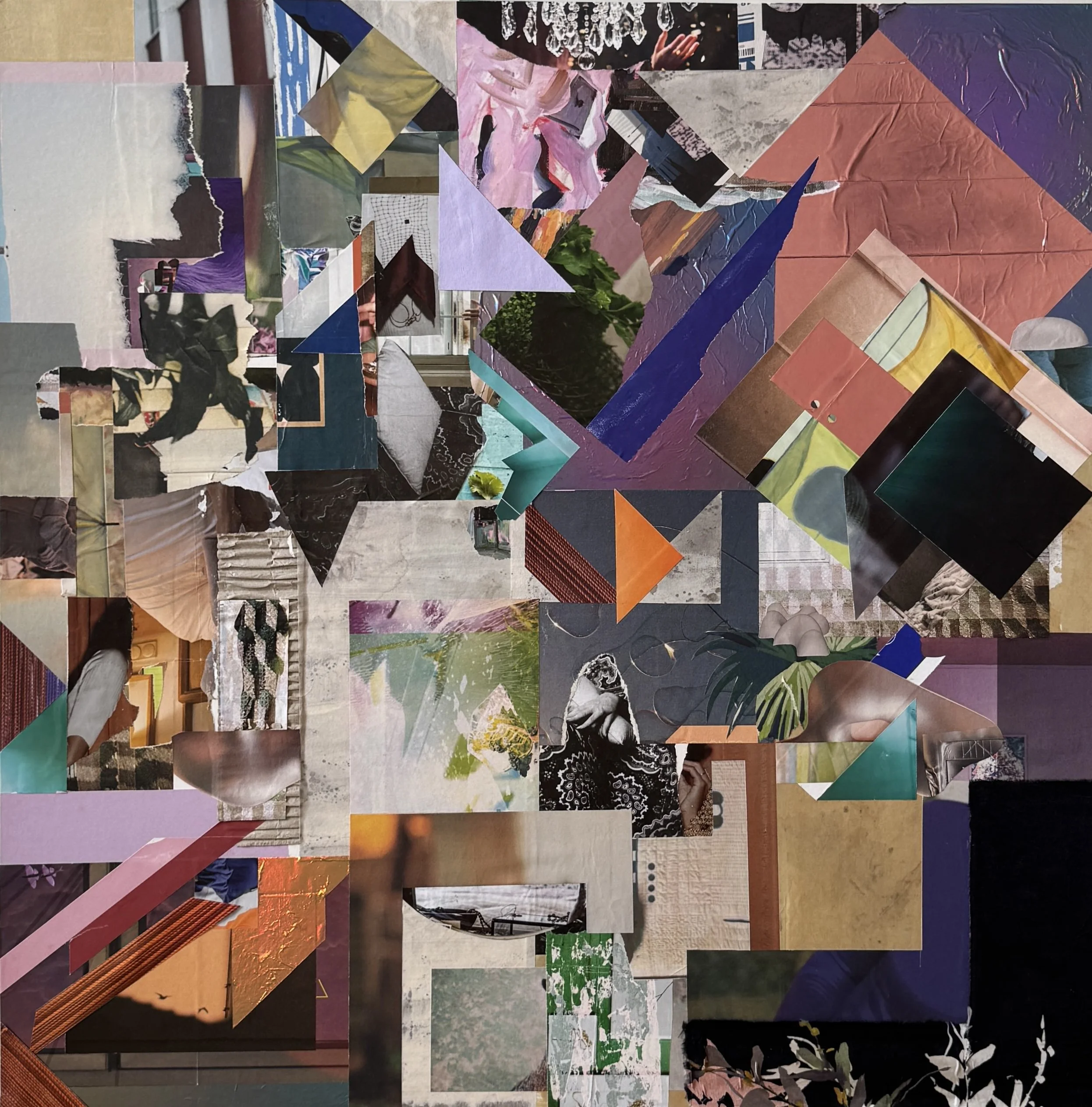
"Wrap up the party...", Collage, 80x80cm, 2026
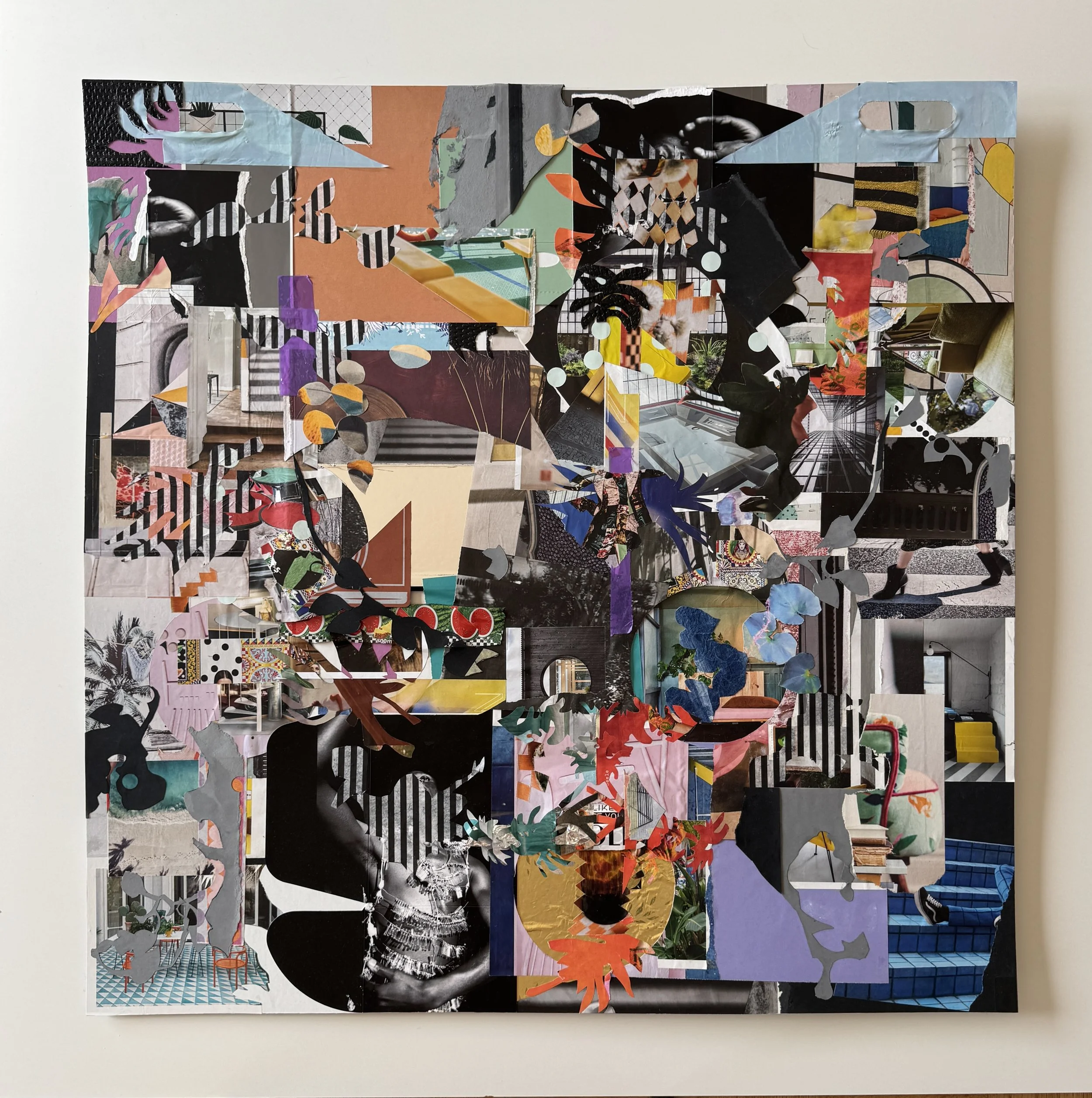
"Urban bloom", Collage, 84x84cm, 2026
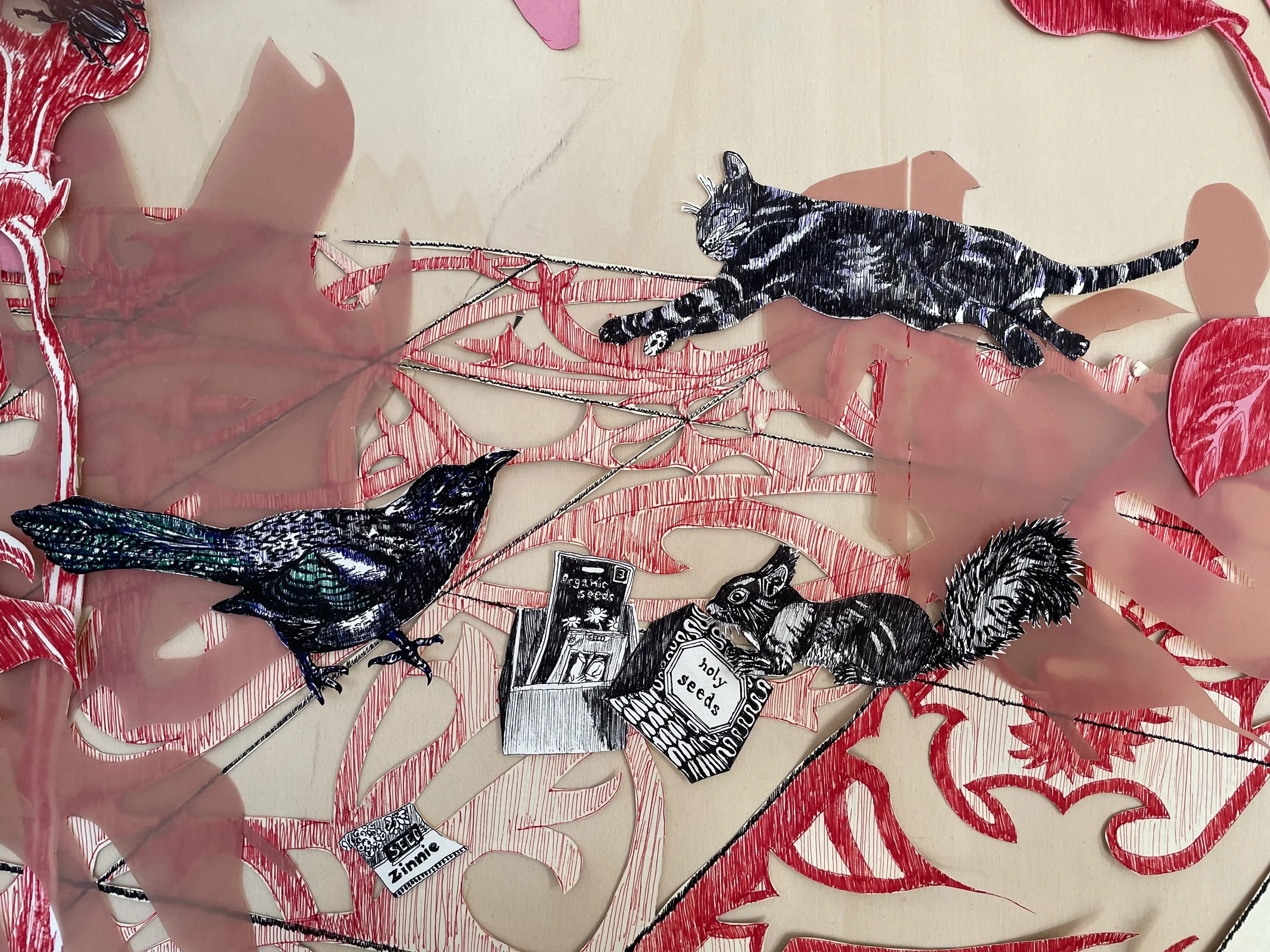
Detail of new series "small pleasures - moving collages", 80x80cm, 2026