
Margot McMahon
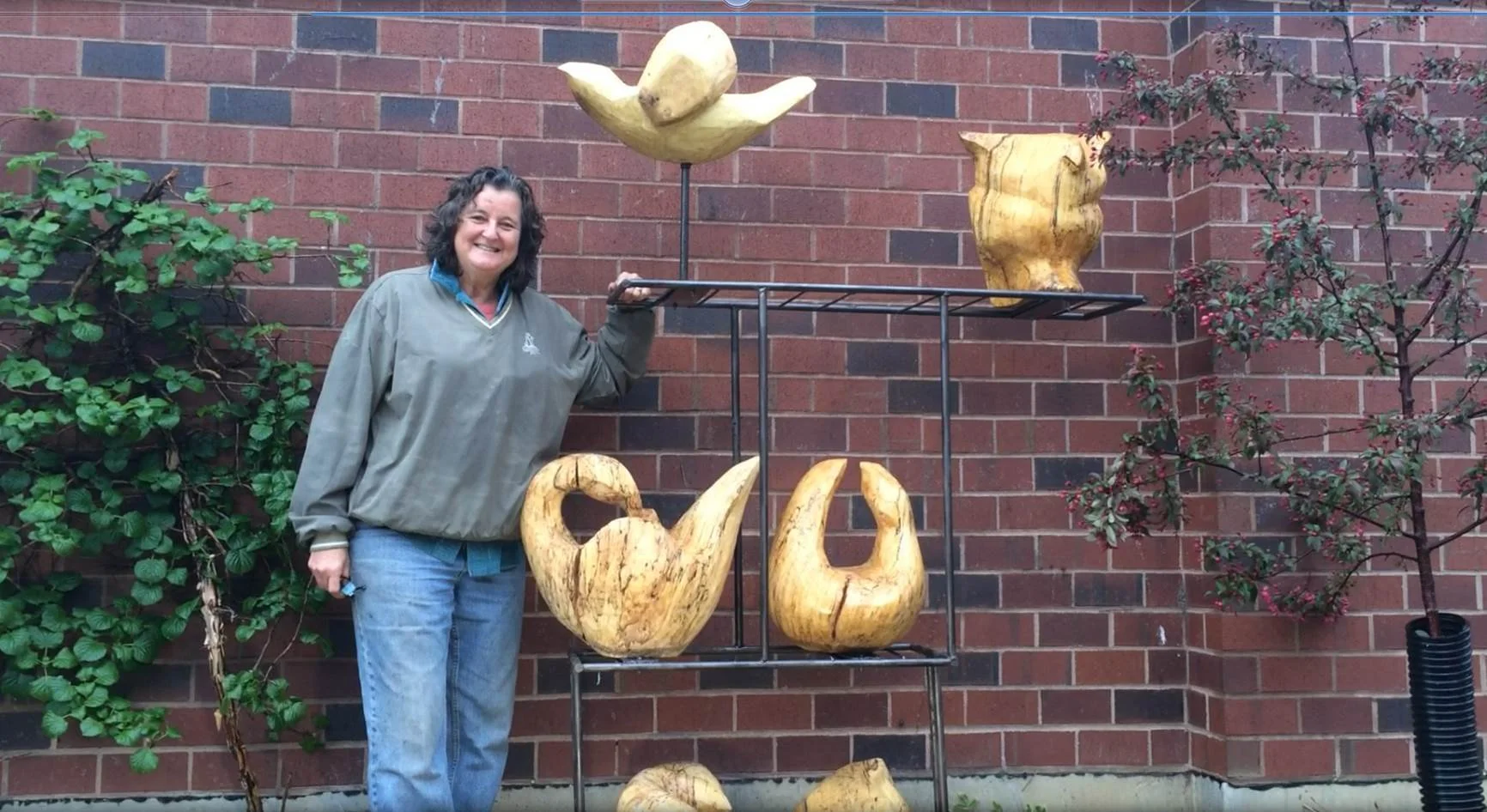
For four decades, as a lifelong environmentalist and internationally-awarded artist, Margot McMahon has sculpted, written about, and painted human, plant, and animal forms to express her hope that decisions be made to support life and social justice. Margot’s sculptures are collected and exhibited by the Smithsonian Museum, Museum of Contemporary Art, and John D. McArthur in the John D. MacArthur State Park. As a nationally-awarded writer, with degrees in Environmental Journalism and Art and an MFA from Yale University, she tells stories about her love of nature. Encouraging public eco-art to be a part of everyday life, Margot serves on boards with Ragdale Foundation, Oak Park Art League, and Yale University-Chicago, Chicago Women’s History Center, and Yale Blue Green-Global. Her husband and she live next to Chicago where she sculpts, writes, and paints in her home/studio.
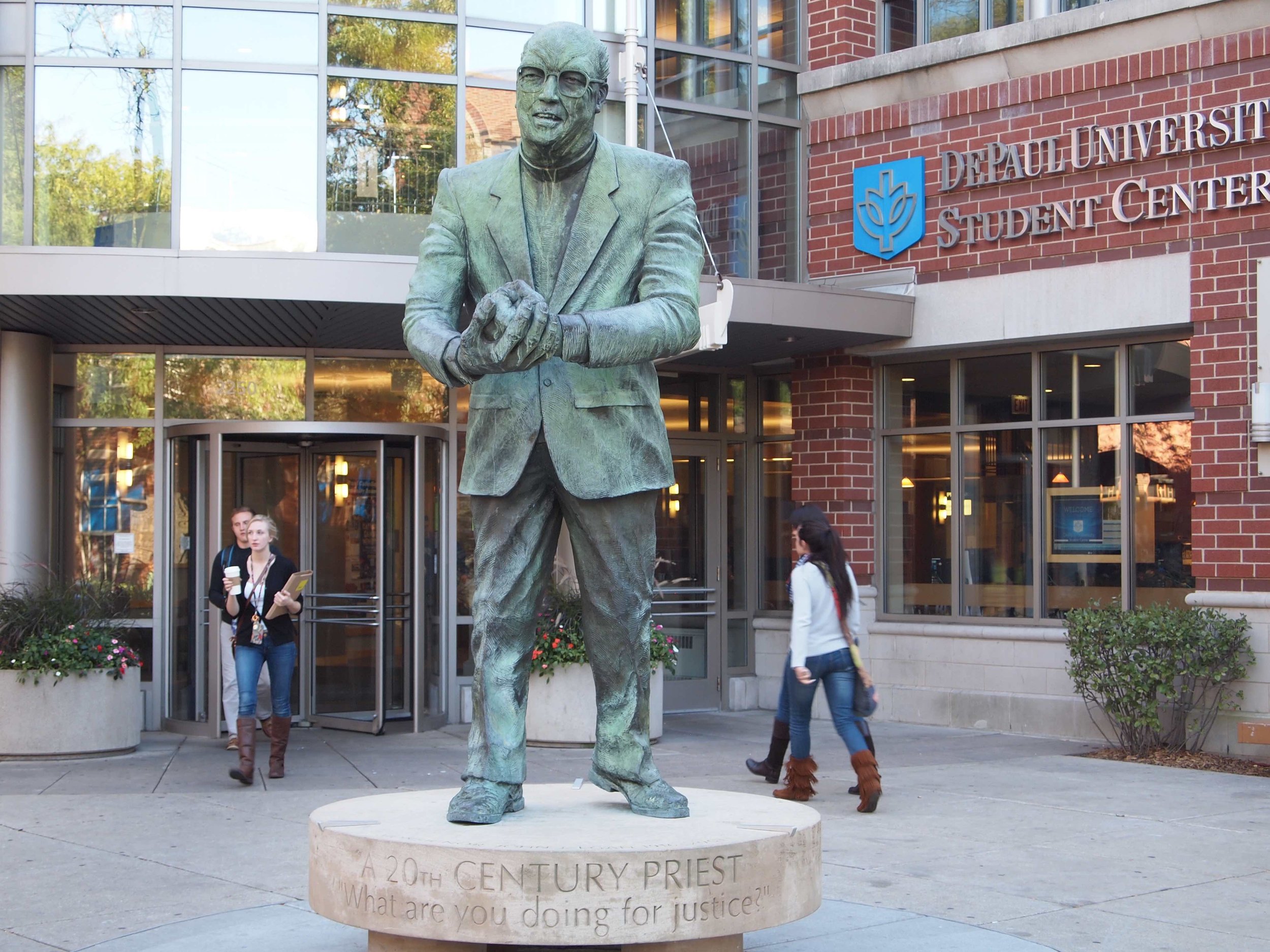
What are You Doing for Justice?: Monsignor John Egan, 2003, bronze carved limestone 3.70 meters high
Your sculptural practice persistently returns to the human figure, yet it refuses academic naturalism in favor of a geometry that seems to metabolize the organic into rhythmic planes and tensile arcs; could you speak to how this oscillation between corporeal specificity and abstract structuring operates as a philosophical proposition about the “every person” as hero, rather than as a mere stylistic synthesis?
Geometric interpretations of organic form conveys a feeling of the subject. Interpreting forms of nature; human, plant, and animal, honors their evolution and consequential variation choices for the rotation of a wrist, the cantilever of a hip and the compression of a twisted spine. Interpreting a person encompasses millions of years of adaptation for survival. Interpreting structural problem-solving is already abstract.
Human form has arrived perfected by necessity. Textures, planes, and thumbprints show the process of sculpting that form in the modeled clay and cast bronze. Surfaces capture changing light that activates, brightens and darkens while inviting the viewer to participate in the energy from subject. Balance, gesture, and motion are evolved and learned individual actions. Interpreting the social activist posture of “Monsignor John Egan: Twentieth Century Priest” in gesturing his constant questioning of What are You Doing for Justice with the solidity of an oak tree trunk; solid, rooted and reaching. An oak supports the widest range of insects, birds, and other wildlife of any Midwest tree. Two “keystone” organisms come together in the symbol, a social activist priest and oak trunk inspiration, in What are You Doing for Justice? My departure from naturalism to interpreting a human presence isn’t reactionary. My geometric forms make visible the depth of an individual’s specific action.
Most humans walk, yet we can recognize a family member from a block away by their particular way of walking.
Rhythms and patterns of light on shapes, highlights and shadows, make sense and give a feeling of unique organic form that refers to the collective species. Processing natural form through drawing and sculpting reveals the beauty, vitality, and wonder into a tangible form that becomes a symbol through my interpretation. Like a human perfects their skills and adapts to society’s challenges to become a hero/heroine, the human form is a composition of structural evolved perfectionism. Yes, we are still evolving towards a new advanced state.
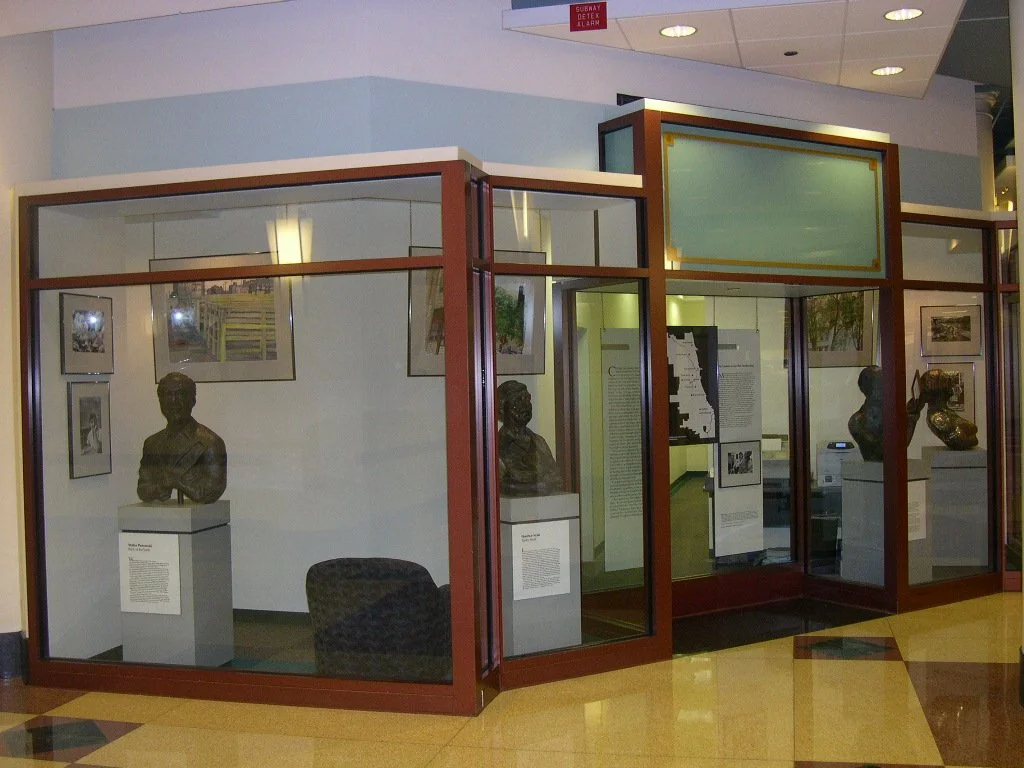
Just Plain Hardworking: Ten Chicagoans Who Have Made a Difference_ 1989, Each of then portraits is Fondu ciment 60 cm_2000
In works such as Just Plain Hardworking and The Oracle of Bronzeville, you position portraiture not as commemorative spectacle but as a social text, a kind of civic syntax through which labor, migration, and cultural memory are inscribed into public space; how do you negotiate the threshold between monumentality and intimacy so that the sculpture resists propaganda while sustaining collective identification?
My humanistic interpretations of everyday people become iconic by their specific nature, gesture, and stance. These individuals I sculpted were chosen by their communities for their activism. For rising above to represent their collective. I look for why them? What gave them the extra energy to lead? My geometric interpretation isn’t imposed, but emerges in the process of discovery while searching for the person’s specific likeness.
The extra energy an activist summons in themselves can be best told by their humanness and their evolutionary uncommon. Humans are differentiated by a honed talent, or utilizing our commonality to surpass the norm. My sculptural vocabulary connects us to the portrayed person with the hopes of inspiring others to refine their talent, hone it, express it, and be one step towards better. Connectedness is not a metaphor, but the individual brightening within the universal. One star in a galaxy.
The “every person” is a potential hero/heroine until the moment arises that calls for their talent to express an extra action towards the better. My sculptural interpretations are a reflection from a sculpted individual for the viewer to search for their “heroic” capacity within themselves. Most people have the specificity to refuse to be merely individual, but an enhanced version of themselves–I’d like to sculpt them all!
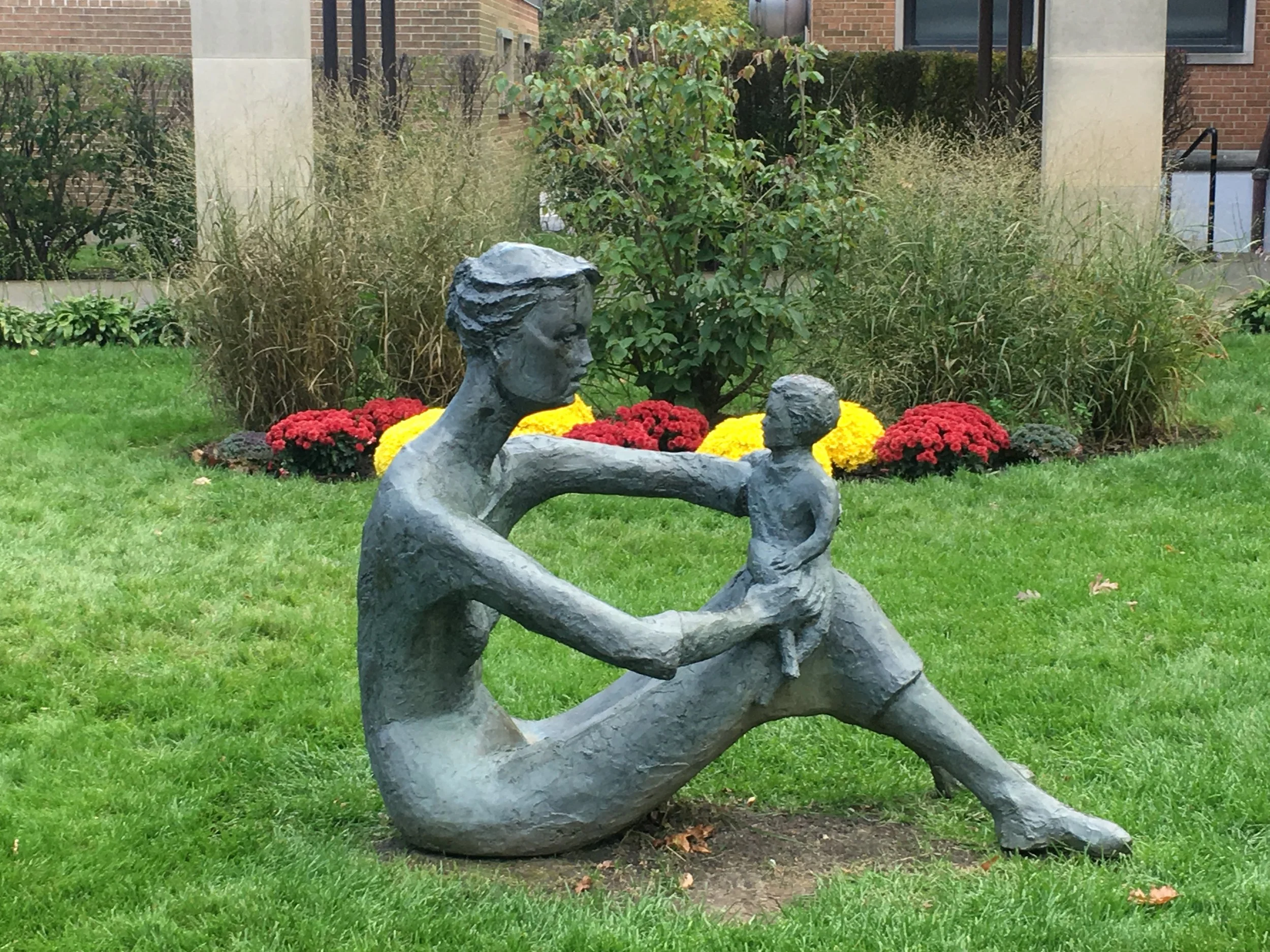
Mother and Child: St. Mary's Parish, 1991 Bronze, Limestone 152 cm L x 150cm h
Your surfaces often hold light in a way that feels almost geological, as though the figure were weathered by time rather than modeled in studio; how conscious are you of light as an active collaborator, and do you conceive of shadow not simply as absence but as a structural counterform that completes the ethical and emotional architecture of the piece?
Light energizes my interpretations in clay as a collaborator to my textures and marks. Years of hiking in mountain landscapes, including my ancestors’ Adirondack homestead, informs my sculptural vocabulary. That scenery is not just a seemingly stationary mountain or range, but activated by the light and shadows moving across it. A high noon landscape expresses vastly differently from its dusk variation. The facets I cut into a surface, the thumb pushed surface, or the cloaked folded stratification are built for light to travel over and activate like a landscape.
My sculpture becomes a sundial for light migrating through time.
Shadow reminds us that the Ocean forms land and defines features by its constant movement. The concavities are remembrances of trickling streams, carving rivers, and scraping glaciers. Geological processes include a collision of tectonic plates that lift and bend stratified planes vertically and make deep overhang recesses. Shadow is the record of the force of action that made it. Seeing that in a landscape helps me to find it in the human form.
Ocean drives the atmospheric wind that carves rock, drifting sand, and landscapes into sensual forms mirrored in people, plants, and animals. When I sculpt a brow’s shadow, or an elbow’s crease I incorporate my visual vocabulary of magnificent monumental form bent and smoothed by natural processes. When I sculpt an evolved person of exceptional talent the form will always changes with the light, shadow, and breeze. That person cannot be fixed with the decisions I made one year into a single illuminated statement. The portrait is both stable and in flux which holds true for any human, plant or animal life.
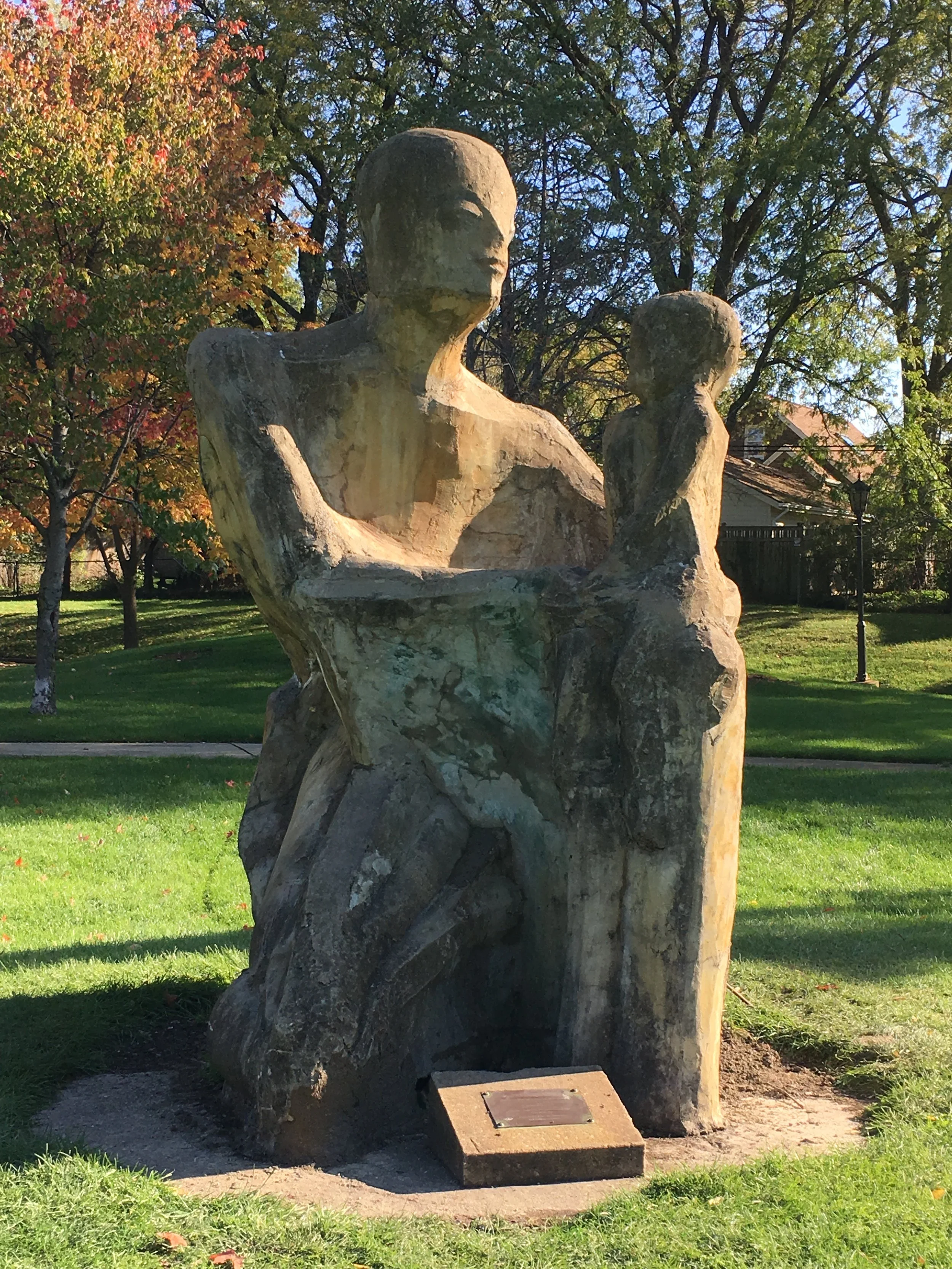
Formation: Father and Child 1990 Concrete, steel and 245 cm h x 150 cn h
You have described your process for public commissions as a fourfold movement of listening, researching, intuiting, and interpreting; might we understand this methodology as a sculptural analogue to ethnography, and if so, how do you safeguard poetic transformation from collapsing into documentary illustration?
The fourfold process you describe is ethnographic in its structure except for one divergence where sculpture differs from documentation. Ethnographers render a community legible to visitors. I sculpt a symbol or totem for the community to recognize itself, its collective beliefs. My Formation sculpture in Homewood condenses a sense of family with the contemporary imagery of a father caring for the child.
Formation is site specific–the physical landscaped mound in Irwin Park with surroundings scaled for a skating pond. I worked in situ for a summer, modeling concrete on lawn over an armature embedded in four-foot deep concrete pilings. I was learning from the community– the man who let me hook my hose to his outdoor faucet, the parents and care providers who brought children to the play area, the vandals who scarred the gazebo, but not the hand-made sculpture. The wide-open space, filled with very loud seven-year-cicadas, allowed the eight-foot-high kneeling father to have an appropriate intimacy with his supported son. The site collaborated with the son and the geologic form symbolizing the importance of fatherhood.
The poetic transformation, dives beneath illustration, emerges from intuition of a lived experience. Sam Keen’s Fire in the Belly, a reaction to tiny feminists’ steps, was my gift to my brothers for Father’s Day. Those steps redefined what their fatherhood could look like. I carried my own inherited layer to my sculpting: my father’s Greatest Generation stoicism, my brother’s generation caught between traditional roles and more shared-parenting. I stood at the threshold of beginning a family. The interconnected frustrations, yearning and unresolved feelings gave the sculpture its resonance. In geologic terms, the resonance is pressure that bends, erodes and melts rock. Father and child in Formation is a timeless subject. My modeling in concrete is entirely of its moment. Resonance is the tension between timelessness and my historically specific emotions. This addresses your question of sculpture evading the documentary or illustrative by a symbol that can be reinterpreted by the viewer as more than it depicts.
My intuition is accountable to feeling rather than messaging. My challenge of not understanding the change I was experiencing keeps Formation alive. I was sculpting to discover my family’s meaning while grappling with the complexity. Listening to and absorbing the collective’s actions provide fuel for my statement.
The integration of plant, animal, and human forms throughout your oeuvre suggests not a metaphorical alignment but a kind of ontological continuity; in what ways does your environmental commitment shift the figure from an isolated subject into an ecological node, and how does this repositioning complicate traditional hierarchies between nature and culture?

Enlighten 2010 Bronze, Granite 304 cm h
The alignment is ontological rather than metaphorical. It begins with conviction of living beings being more connected than not, more interdependent than not. Animals, plants, and humans all share the same carbon, the same evolution from and connection to the ocean, and the same endings as soil that will feed the next growth cycle. Combining forms of nature into one sculpture is making a statement about our oneness, our integrated continuity.
The figure intersects with the natural world rather than moving through it. I include ecological knowledge for reference while discovering shared geometries in clay to reveal continuities between life forms visible through observation rather than description. Enlighten embodies two boys, one white and one black, who are playing ball with willowy, sapling-like limbs. The negative spaces are lotus-bud shaped, a symbol of new beginnings. Surrounded by collaborative waterfall, pool, garden, and a tree’s canopy giving dappled shade, these sights, sounds and smells energize the bronze and granite. Enlighten lives on in Lincoln Park’s Peace Garden. The boys sculpted were neighbors and schoolmates. They mean something is renewing through the various seasons, to the passing annual Gay Parade, to the Soka Gakkai International Buddhist community who commissioned this as a work for and hope that social injustice will be eradicated globally.
In an ethical reading intertwining lithe human limbs places people integral to natural forms. Not domineering.
Interdependent and respectful. As representative of fused life forms and spiritual symbols Enlighten exists for the viewer to interpret from their experience. A reorientation can emerge from the individual seeing what I sculpted during President Barack Obama’s term. Without words, we don’t argue but feel the imagery.

Ecosystem No. 1 2015 steel, aluminum, 305 cm h
In Ecosystem No. 1, where viewers are invited to participate in sustaining a living system through water, sun, and wind, the sculpture extends beyond objecthood into relational process; would you say this work marks a departure from modernist autonomy toward a more interdependent aesthetic, and how does that shift recalibrate authorship?
My experimental authorship is intentional. I designed Ecosystem No. 1, a self-contained constructed eco-system dependent on human interaction, with a written request to add water. A solar pump lifts that water onto the dancers who are blown by the wind to distribute the water onto sedum, a rooftop garden plant. If people, the sun, and wind work together the sedum will thrive. My intent is to believe the process will work though I have no control. The viewers decide if the system is supplied with water. The sun and winds are collaborators dependent on signals from the ocean–another lack of control. The system works or fails in real time for the sedum which has no control at all other than its own talent of absorbing water when available and storing it for times of drought or idleness. The sculpture requires cooperative action of various ecological forces to sustain the sedum, a living system.
The welded aluminum and steel are painted green for the basket of plant life, and blue for the system of water distribution. Constructive sculpting is a different thinking and process that modeling in clay or carving in stone and wood. Designing and welding metal is structural rather than additive, relational in an architectural way. Constructive sculpting is a system of relationships that becomes a metabolism, not an object. Similarly in my divergence from sculpting in clay and casting, carved Hawk and Dove, a dichotomy of vertical to horizontal and contrasting symbols of war and peace, are subtracted from blocks of granite. I carve the birds from a block of stone birds releasing chunks and chips that are not relevant.
My shift to constructive or subtractive processes doesn’t; complicate my traditional object-based definition of sculpture. I like that the object is solid yet always changing in materiality, imagery, and perception. It is a constant that emerged from my experience to be a marker of our time while remaining an objectl for reinterpretation. The viewer is just as responsible for bringing their experience to remake the object as I was to create art with integrity, challenge, and meaning.
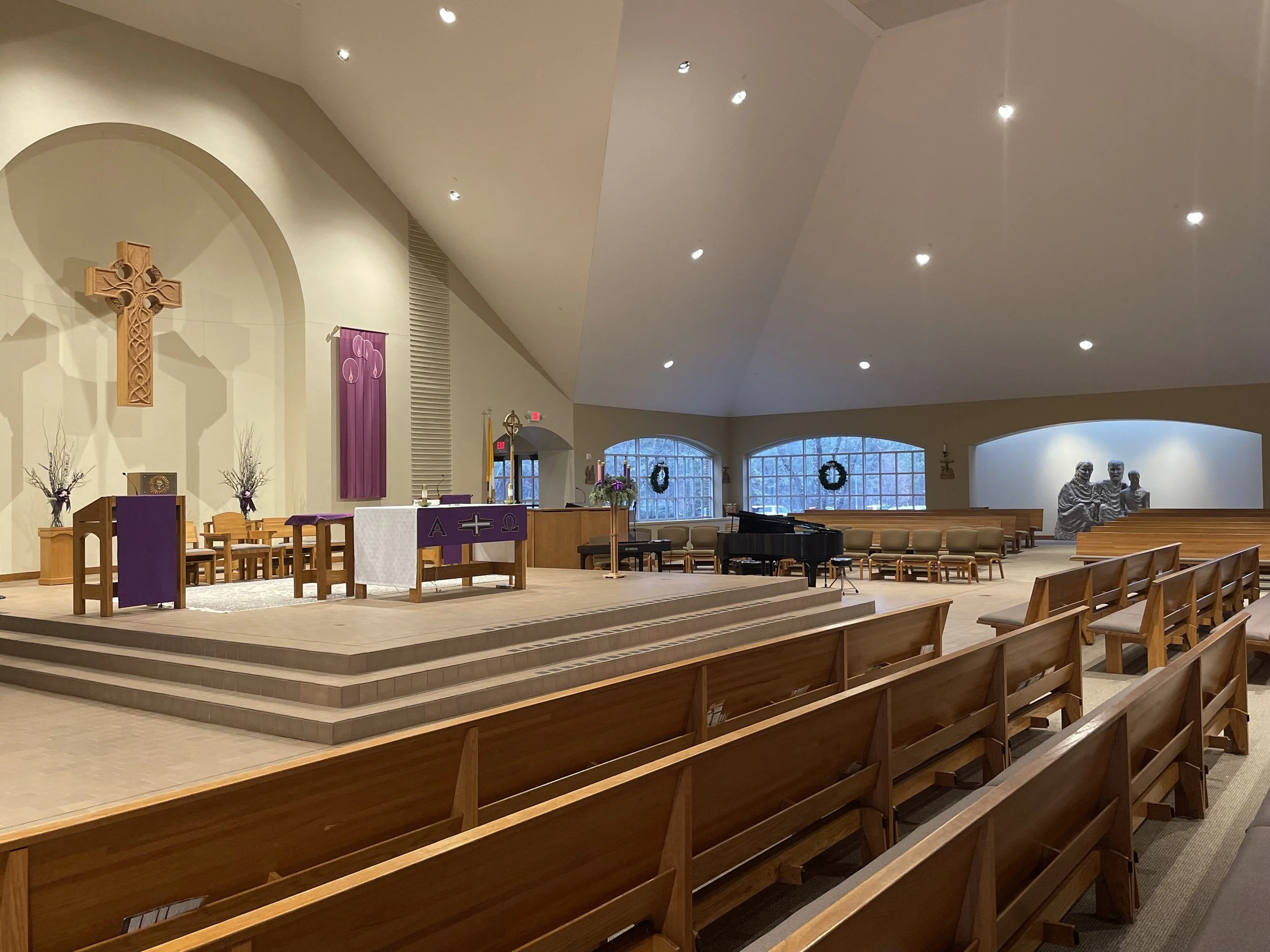
Celtic Cross_Holy Family: St. Patrick's Parish 1993 245 cm h
Your long engagement with Irish Catholic iconography at St. Patrick’s Church introduced stained glass, granite, wood, and mural into your sculptural vocabulary; how did negotiating sacred space transform your understanding of material as bearer of transcendence rather than merely mass and volume?
Sculpting the spiritual objects for the newly constructed St. Patrick’s Church fundamentally changed the way I continued to identify being and Irish Catholic artist within my predominantly Presbyterian town. I learned the Irish were the second settlers in Lake Forest after the 1832 Illinois’ Trail of Tears. This parish was the first and longest continuously active parish in my village. Working within an ancient spirituality of a saint who unified Ireland’s warring clans to evoke a sacred space encompassed my catholic upbringing and challenged me to reach for a deeper understanding of my heritage. In the parish where my parents were memorialized and my children baptized, I reckoned with a variety of materials and processes to make long lasting objects that would connect parishioners to their natural environment. I found guidance in John O’Donahues Anam Cara to sculpt a Celtic way to be catholic. To better bridge religious or other differences in any village that I reside.
John O’Donahue’s Anam Cara is a concept of a soul friend. I embraced that we are soul friends with nature, that the natural world is not a backdrop to spiritual life but very integral. My materials and processes and beliefs were deepened in the seven years of sculpting with this interaction and journey. Materially, the local beach sand transform by melting into glass for the stained-glass ambry. Light activates the stained glass more than a manufactured transparency because it is from the earth. Granite erupted and was shaped by glaciers to be our villages’ bedrock. With heating and freezing to crack off shards as my carving process, then polishing pools as water will over time, my baptismal stone pools, flows and pools again. The Irish settlers might have cleared this bedrock stone from clearing the prairie for their farm. The water falling and slowing granite font came with an omnipresence of having been formed over millennia dwarfing our human tenancy. My oak Celtic cross, carved grandest wood in the local forest, dissolves the boundary between the living and the sacred. In some traditions wood never dies but lives on in its transformed carved and carpentry state.
While sculpting, I stopped thinking of the materials I change and begin understanding I am collaborating with the materials of wood, stone, and glass to allow them to take on sacred meaning through artmaking. Working with the materials that took centuries to become are symbolic for our time and the future viewers. The insistence of respecting and allowing material to take symbol form is demanded by our tradition. The congregation wills it, wants it, and feels its presence. The oak, granite, and glass insist we honor them. This Celtic way of being catholic carried me into my changed way of sculpting secular and sacred art.

Symphony in Blue, 2024, Oil on Canvas, 50 cm w
The children’s book Coral: Is It an Animal, Plant, or Mineral? employs narrative voice and painting to articulate ecological fragility through the perspective of a polyp; how does the move into literary form reconfigure your sculptural thinking, particularly in terms of temporality, sequence, and the dramatization of environmental crisis?
My shift to literary form felt an extension of art making. Before graduate school my day-job was at World Book Encyclopedia’s editorial department publishing Science Year and Medical Update. I had degrees in Environmental Journalism and Art. I learned then that sculpture occupies space and endures while narrative arts occupies time and expands geographically. I returned to publishing during COVID-19 lockdown when the environmental messaging escalated in importance. Coral allowed me to emphasize an ecological fragility that dies after a sequence of events. An inquisitive single polyp shares its perspectives of attaching to a boulder it didn’t choose in water that it can’t control–during the climate crisis specific gravity on its being.
I recognized that coral’s struggle has some similarities to the build and destroy bronze casting process that I’ve worked with for decades. Likewise, coral’s cycle of creations, destructions, and struggling revivals depend on action. What started as an analogy had become all too soon a tragedy? Reefs denigrated in 2025 to be the first global eco-system to collapse announced by the Tipping Point Report. Consider the parallel sequence: an armature is built, not unlike ancient mineral boulder. Clay is built over the skeleton like the colorful polyps colonizing a reef’s surface. To transition the pliable to permanence, a mold is made and the clay destroyed similar to bleaching or stripping the algae. Without its algae partner, polyp, the animal tissue of coral, bleaches. Wax is cast in the mold and resculpted, like the reef rebounds if the water temperature cools and algae returns. A ceramic shell coats the wax inside and out for a second rebirth and restored reef. Molten bronze is poured into the ceramic shell where the wax was and cools while breaking the shell. Coral again bleaches before completely healing. The bronze casting is then welded together and patinaed before it stands in a community space. Will a regenerative solution revive reef?
The tipping Point Report announced in 2025 warm water coral reefs have collapsed beyond recovery. The destruction and creation cycle no longer holds for coral. Since the massive several year bleaching event ended in 2017, there have been bleaching events every three years. Each one finds the reef further weakened. Similarly, bronze is not permanent. It can be moved, melted, or broken.
The Coral book gave me the opportunity to portray poly as a true hero. Reefs, protect shorelines from stronger waves, feed 25% of ocean life, provide medicines for people, store carbon, and create oxygen–oxygen we breathe. Coral is a true essential building block of ocean life and worthy of being memorialized. Polyp is a worthy entity to tell its own story and struggle. My paintings of coral that accompany the text are colored glazes over black and white tempera foundation. Like the phantasmagorical colorful polyps coating the mineral skeleton, this process results in an underwater feeling. In this painted organic form, I strive to convey the diversity of textures, and colors in a similar formal language developed in my sculptures. My polyp portraits are another version of an entity of enormous consequence that sustains a system far larger than itself. It is vulnerable to forces it did not create and cannot control while showing heroism in the form of persistence.
Climate Fiction is a genre allowing entities to not be personified, but speak for themselves from their own capabilities. The polyp entity has its own perspective, felt experience, narrative arc. Stepping away from sculpting to write and paint confirms for me that my sculpting has been encapsulating invisible forces that act upon living form that is visible, tangible, and impossible to ignore.
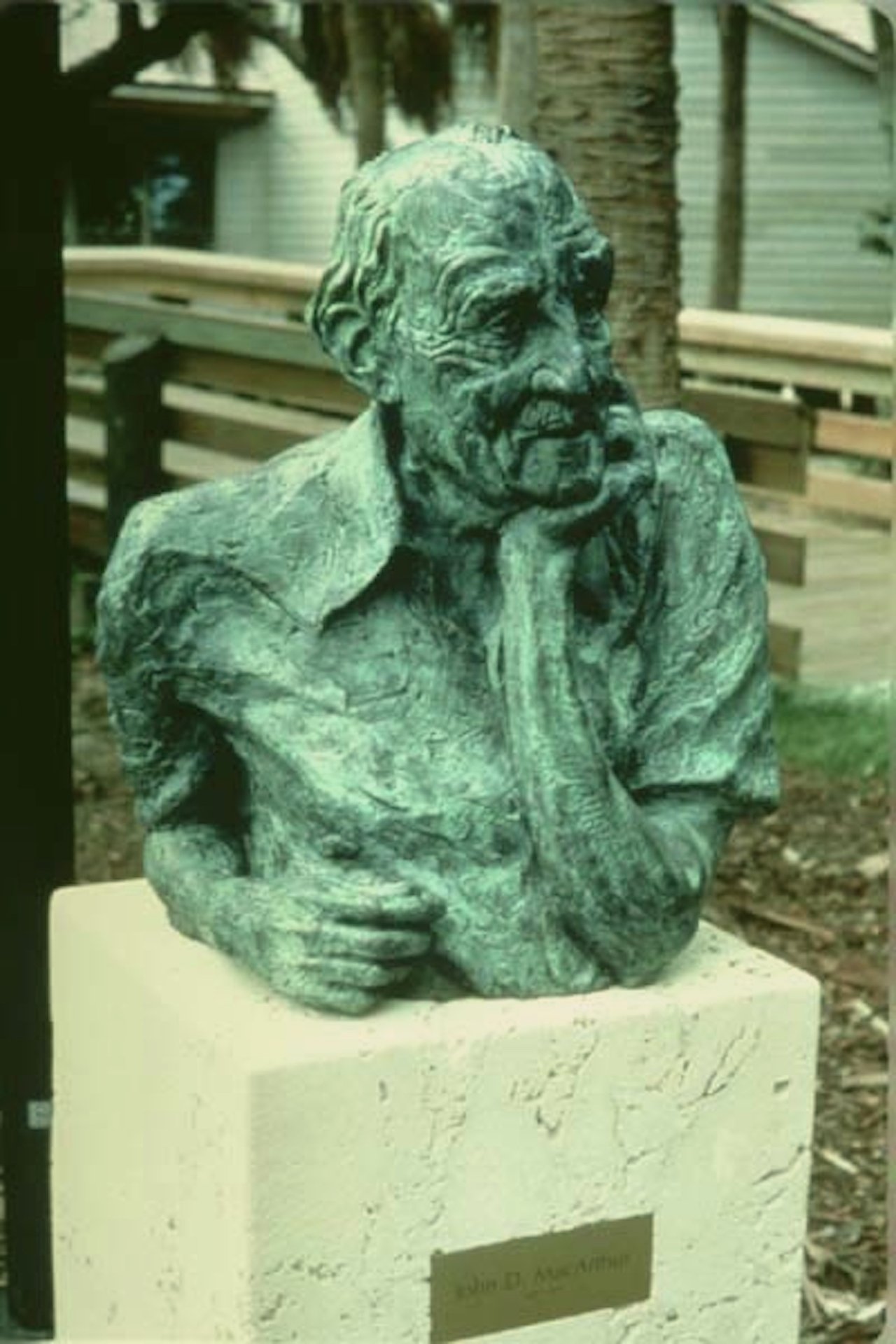
John D. MacArthur, 1989, Bronze, Keystone 182 cm h
In projects such as RESIST! A Visual History of Protest, you enter the terrain of political urgency; how do you reconcile the durability of bronze and stone with the ephemerality of protest, and can sculpture adequately hold the volatility of dissent without neutralizing its force?
My commitment to the human figure and natural form was itself a political act before I engaged with protest as a subject. After the Second World War, the human figure was largely dismissed from serious discourse. The war made human imagery unbearable for many. The human body had become the waste of industrial scale destruction. The artistic response was to turn toward interpreting manufactured objects of commodity: soup cans, baseball bats, and twisted balloon animals. Art turned to abstraction and the aesthetics of the industrial revolution the war escalated. Humans further disassociated with their connection to nature.
Maintaining my nature-based hand-made resistance to reproduced capitalistic commodities helped me persist in making statements about the beauty, vitality, and ecological integration of the human form. Symbolic sculptures of humans, plants and animals combined refers to ancient times and a solution for our future. Industrialization encouraged domination over nature, not communion with nature, separation from nature not interdependence with nature. We have evolved to our highest level that deserved recognition and an anthropological marker for our time. I prefer to scale my work to nearly life-size.
I believe sculpture can hold the volatility of dissent and neutralizing debate while carrying genuine risk. Object sculpture is a contrast to protesters with bodies in motion, by raised voice in opposition, and knowledge of an unknown outcome. Interpreting contemporary revolution and tension in sculpture preserves the energy of the collective pressing against the oppressive forces. The gestures, textures, thumbprints of making, beveled planes that captured moving light and convex form pushing against the very atmosphere around it. The tension compels the object to be vital and lively.
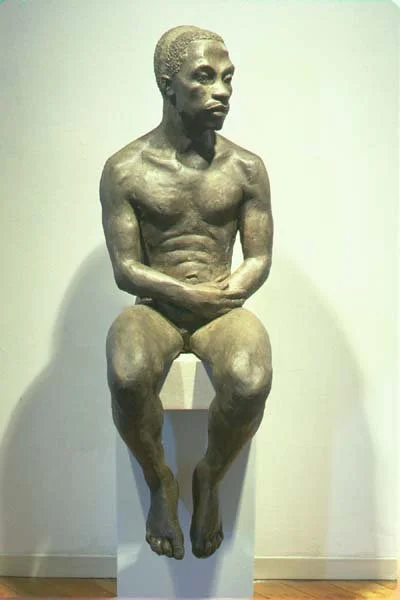
Vince, 1989 Fondu Ciment, Limestone 122 cm h
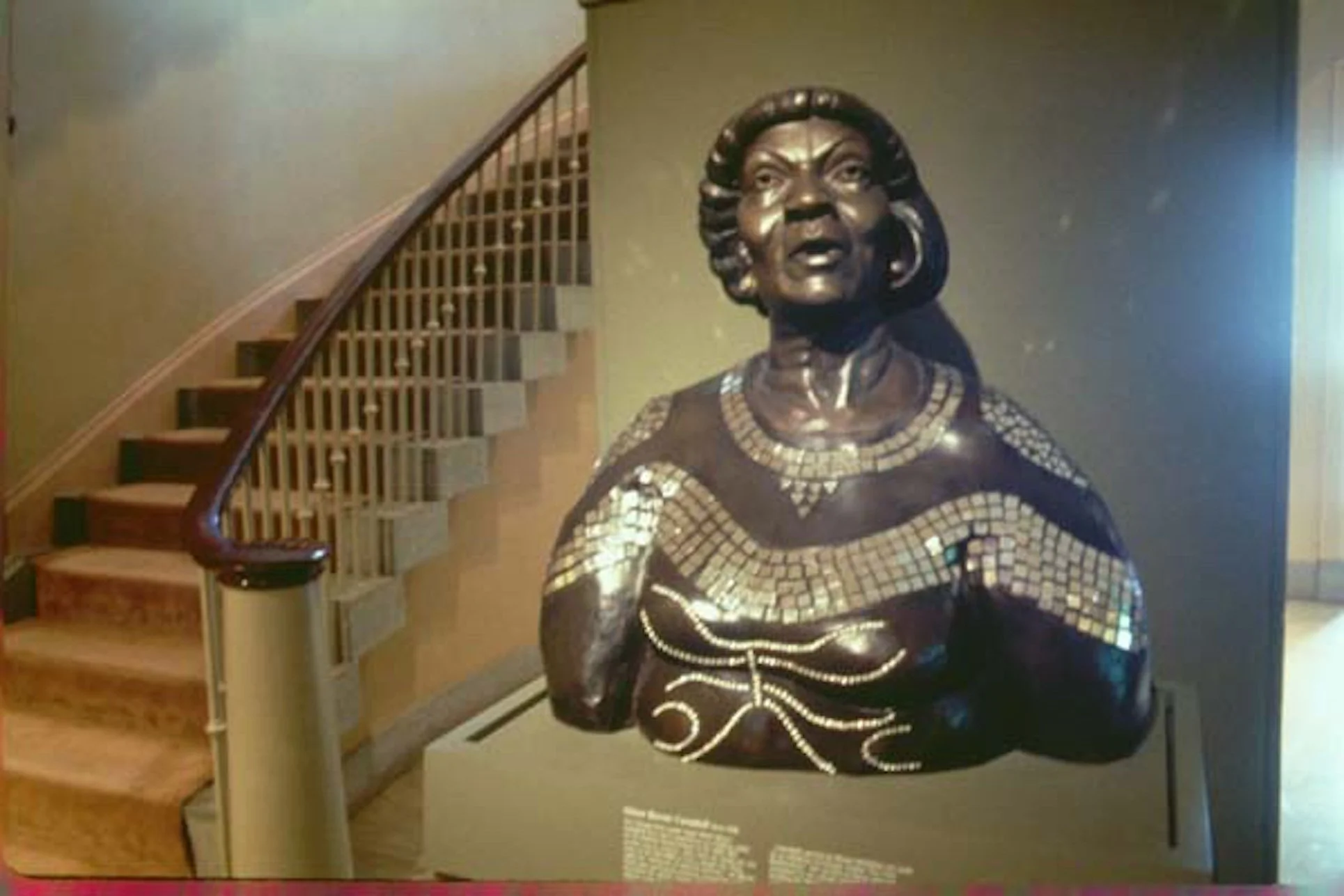
Delois Barret Campbell, bronze, 2002 and green 60 cm h
You have been called the Studs Terkel of the sculpting world, a comparison that invokes oral history and democratic attention; how do you translate the cadences of lived testimony into volumetric form, and what formal decisions allow a sculpture to “speak” without resorting to literal narration?
Your comparison means a great deal to me. Studs Terkel was a formative presence in my parent’s home, they shared his passion for social justice, then through reading and listening to his interviews and working beside him at Chicago magazine-WFMT. I absorbed from him the discipline of listening for the significance of individual stories. With industrialization, the institutional culture has decided personal histories don’t matter. Simultaneously, tracing family roots through DNA is making ancestral connections we didn’t know we were missing. The last time I spoke with Studs, one of the greatest listeners of all time, he told me he could no longer hear what I was saying. I have thought about that often. There is much to sustain from that kind of witness. If I have the tools and practices to carry what he actualized forward, then that is my responsibility.
Studs made his own set of rules. What unified his work was cadence. He understood that how a person speaks, with hesitations, repetitions, accelerations and stutters, is a truth is reached. How they say it carries their history as much as what they say. He captured the rhythm of testimony. I am trying to translate that individual expression in volumetric form. I converse with the subject over time channeling the cadence of their gesture of the hands, their stillness before hearing what wisdom cost them dearly to learn. It’s their energy and presence I search for in the clay by scraping, pressing, and adding until their essence is reveals itself.
Knowing when to stop is the main formal decision. The goal is to be a conduit of the energy in the room until the portrait comes to life. That the sculpture is not finished is irrelevant. That it has a life of its own that emulates being in the room with that life force is essential. Any polishing, blending, smearing dissipates the spirit of the sculpture. What is left to finish is for the viewer to finalize in their own vision from their own experience. It means they have to bring themselves into a relationship with what I may have left undone and complete it for themselves. Studs led his subjects speak in their own rhythm and cadence untarnished. He didn’t attempt to summarize their thought into a coherent oblivion.
Justice is a great motivator. The everyday person will rise up for undelivered promises, contracts, expectations. There is a quality of an activist to strive for perfection to nudge society in the right direction. They have a particular mark of struggle, forged in the furnace, and commitment that does something to their body language, gestures, stance. I look for that feature to capture in clay. The portrait become iconic by being made more fully of them, not by being made larger than life. The specificity of my subject and the tension they carry with them creates the tension of the object within the space of the room. My unsung heroine in permanent form is Studs’s everyman/woman that takes up space in the room again with volume, weight and durability. I want to say, this life and this story matter. Their choice to struggle for justice reached a conclusion or moved the needle.
The recurring motif of seated or walking figures in your work suggests a choreography of pause and passage; are these postures intended as existential states, as social archetypes, or as compositional devices that anchor the viewer’s bodily empathy within the spatial field?

Bloomsday: Leopold and Molly, 2013, Fondu ciment cm h

Hawk and Dove 1998, Granite 152 cm h
I agree with all three of your definitions of seated and walking figures being existential states, social archetypes. and compositional devices. When all three function together they have power. They become the person’s posture. When I meet a new person I often miss their name because my bandwidth is watching, measuring, reading their posture, gesture, and stance. Often the words allude me which can be taken as very rude or aloof. I am practicing. When I sculpt those social cues, I want to capture their arc of becoming themselves. If they carry a tool of their trade or symbol of their work, we reach their true posture sooner.
Vertical in contrast to horizontal, motion in contrast to stillness are dynamics that energize each form. The walking figure condenses a vast past in the process of taking a first step. The first step a child takes and courage to calm the imbalance. Or a man’s iconic foot on the moon is more memorable than the words spoken. The step is never about locomotion. It is decision, declaration. A step is moving towards something from something. A step is a narrative arc. I sculpt the step with the weight on the back foot and the weight on the front foot, so the action takes place in the time the viewer moves past the sculpture. The sculpture is activated by the viewer’s motion. The balance, contrasting tension of motion from the outer hip to the inner knee and the outer ankle to the big toe. The viewer feels their own body to walk from the front to the back, empathizing with the sculpted form.
The seated figure is the opposite. It is the pause before the action. Mandela in his cell on Robben Island. King finishing his dissertation before the bus boycott, Gandhi in meditation. Jesus in the desert. These still figures are not passive. Their interiority is vibrant in preparation of the slow arduous walk towards justice. This reflective pause is not an absence of action it is a precondition. It is a moment of forging the will to sustain the fight. In their solitude, a centering of the soul gathers their strength to lead other into resistance. These moments are as heroic as any march and worthy of sculpting into permanent form
I’ve seen that the sculpture itself acts with this same alteration of pause and journey through its environment. The object is set, but it is never static. Projected lines in the sculpture extend from the figure into the garden, plaza, or architectural geometry around it, making a spatial dialogue that changes the place. Light migrates throughout the day highlighting and shadowing shifting planes and crevices. The surrounding atmosphere alters the patina, eats away edges in fog, reflects a blinding sun. The sculpture changes the place it inhabits and the place changes the sculpture. We are all postures in relationship to each other in a continuous process of becoming. The pause and journey are the rhythms of a single life moving through time.
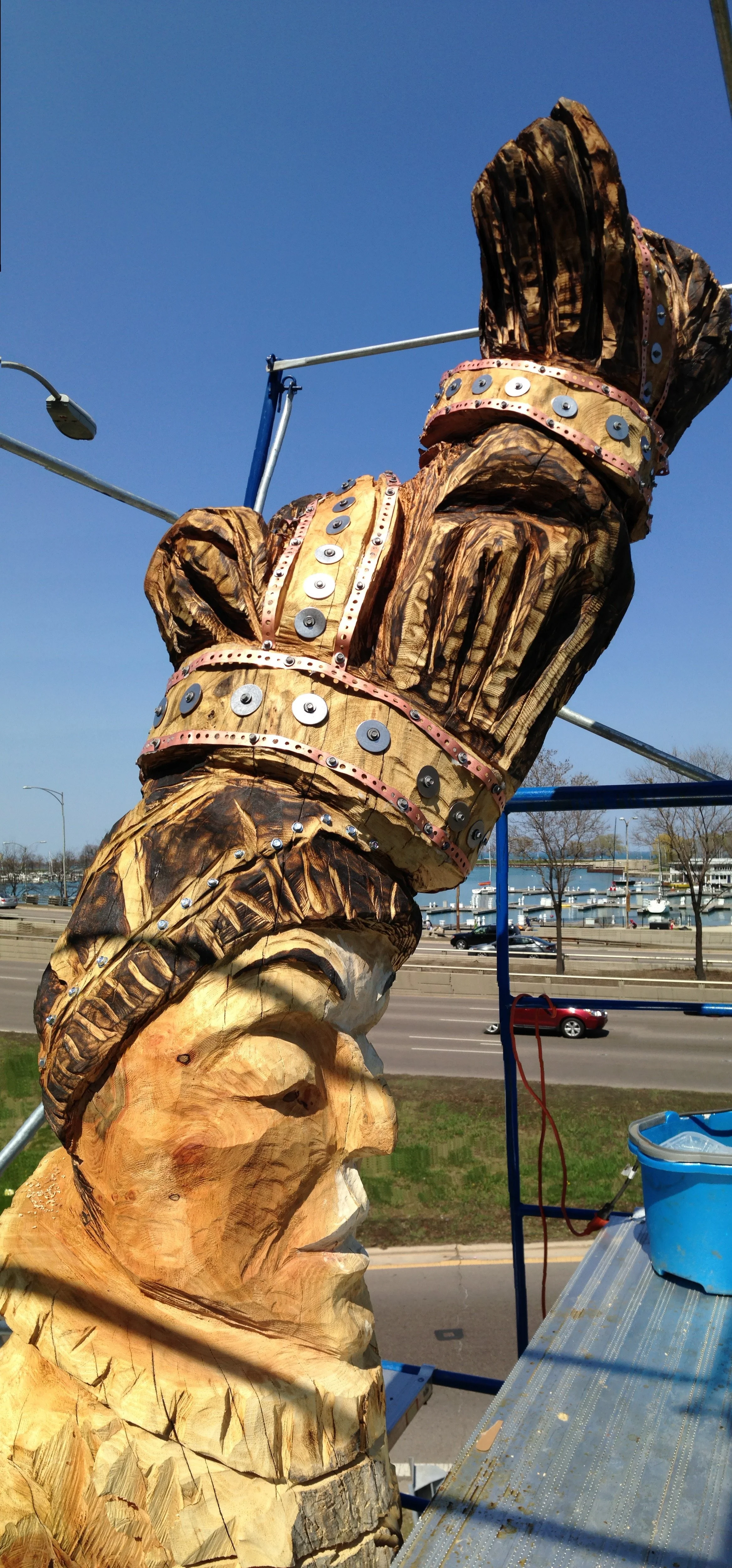
Checkmate: Queen, 2018, Ash tree trunk, hardware, stain, 609 cm
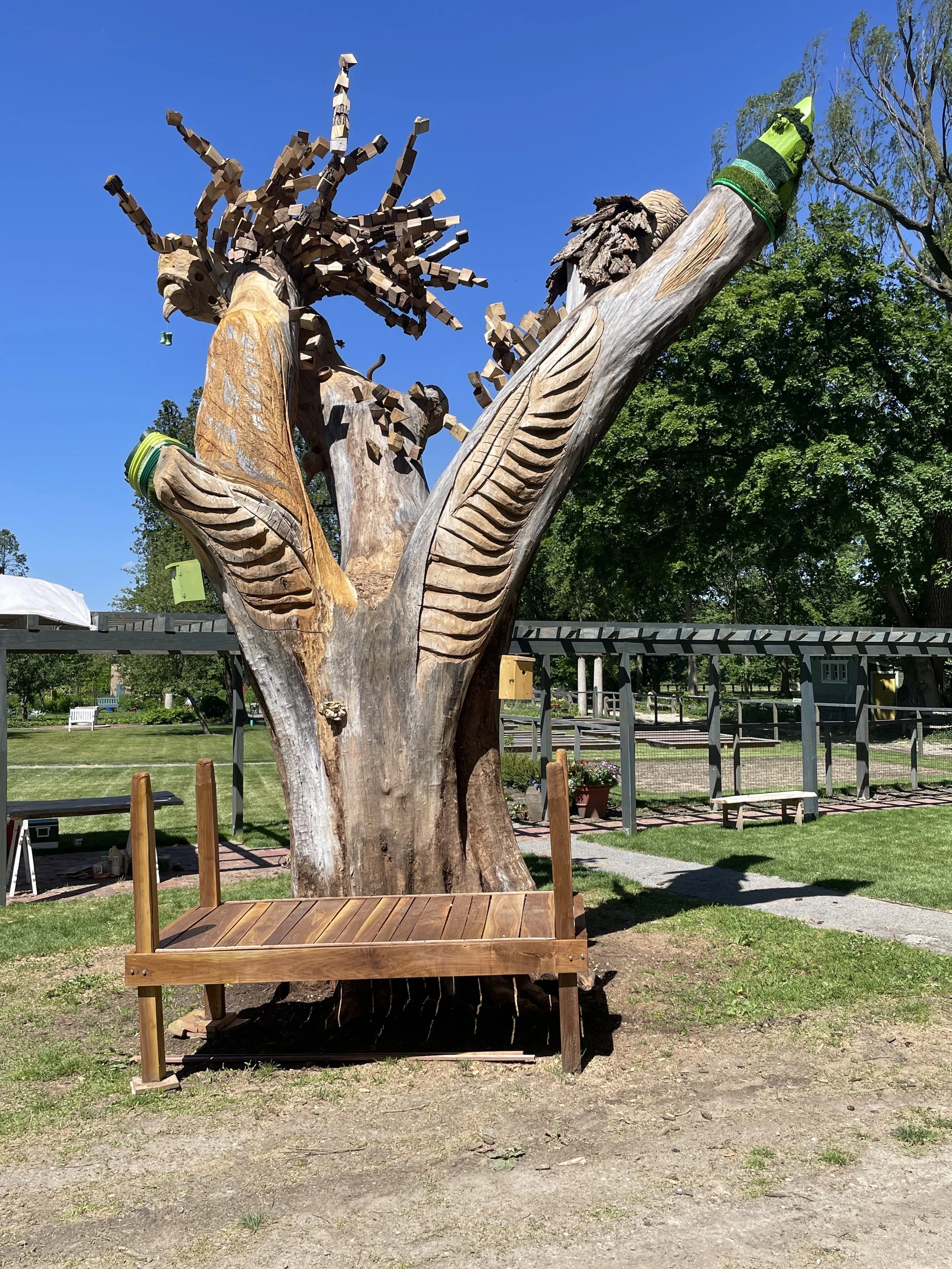
Diversity of Birds: Ragdale Tree Project, 2023, Elm tree trunk, 762 cm
Your engagement with the Chicago Tree Project and with botanical institutions positions art within urban ecology; how do you understand the city not as backdrop but as a living organism, and in what ways does your sculpture attempt to heal or at least render visible its metabolic stresses?
The Chicago Tree Project fundamentally shifted my understanding of art, ecology, and urban life. My relationship with urban nature was reoriented by working in neighborhood parks carving a dying tree while neighbors gathered below.
Urban nature is a metabolism. This system of flows of energy are interdependent: water, carbon, and human activity is under stress or in fairly good health. The 150,000 ash trees removed from Chicago parks because of the emerald ash borer, an invasive species, altered a century old canopy. Our loss of trees was mourned. We shared the visible symptom of a deeper disruption in urban ecology, a collapse of a city’s canopy means loss of shade, loss of carbon consumption, loss of habitat for migrating and nesting and hibernating life as well as citizens losing a companion.
Sculpting trees addressed art deserts in neighborhoods underserved.
What I came to was a deeper understanding by doing. That the dead tree doesn’t need to be a loss. By sculpting a symbolic totem in situ, we gave the tree a fifth season. A continuation of its slow decay to nurture while making a cultural and communal sense of belonging. The root system remains in communication with other trees, sharing nutrients and information through fungal networks. The decaying trunk fosters insects and birds feeding and nesting. The sequestered carbon is slowing released into the soil to feed the next generation. And people feel connected to each other through an art object they share.
While enveloped in a hard hat, ear muffs, goggles, chainsaw chaps, steel toed boots, vibrations gloves, and wielding a chainsaw twenty feet up on a scaffold, I carved a detail in the Queen’s face of Checkmate, a two-tree statement. Below, an impromptu block party formed. Neighbors spontaneously came together by the act of something being made from their own loss of their neighborhood tree and a resilience to adapt. The gathering emerged from the neighbors finally seeing what I was carving-–the face of the Queen of Hearts, or is it the profile of Queen Elizabeth? It’s both. It was like a truth was said in a room and everyone went silent. In this case, every recognized their neighborhood and community–they gathered.
The city is a living organism rather than a stagnant stage. Art can intervene in various zone of stress or vitality of the metabolism. Art can make the loss of the tree visible and it can give the material for a community to come together. The artist’s totem does not heal the loss of an urban forest. It can render the loss legible, honor the tree’s life, sustains the ecological function, and create a place for people to pause, talk, meet and be healthier. A totem make a neighborhood unifying symbol of resilience through community. The resilience is people being part of an urban ecological forbearance.
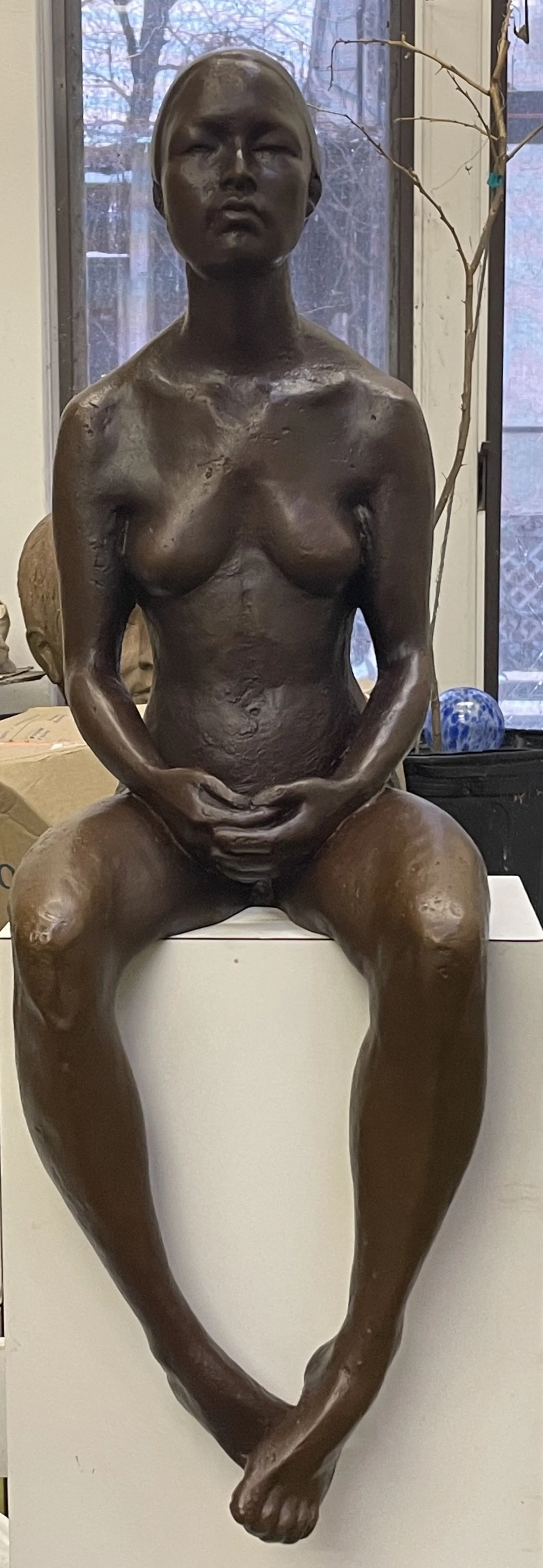
Julie, 2025, bronze, 61cm h
Having taught at institutions such as Yale and the School of the Art Institute of Chicago, how has pedagogy informed your sculptural ethos; do you consider teaching an extension of your humanistic practice, and does it alter the way you conceptualize form as a shared inquiry rather than a solitary declaration?
Teaching and sculpting have never felt separate. They are the same discovery in different conversations. When I’m in the studio alone, I’m in conversation with every teacher who stood beside me, every formative conversation that guided my path or shifted my insights. Likewise, the conversation persists forward with every student I stood beside. Pedagogy is passing the baton with sharing tools, materials, philosophies, and techniques. It is extending gathered knowledge by seeing a way for the student’s next steps.
What I’ve gathered from Yale University, Hamline University, and the School of the Art Institute for my own teaching practice is to meet the student where they are and from that place help them find their way to make their sculptural and drawing statements their vision. The figure is a good beginning because every student creates a likeness of the model with their own experience. In a classroom, they see how their piece is unique from the others and accurately representative. I want to give the students process not conclusions or answers. My process is of creation and destruction and creation again. Working the material until the statement emerges. Often I do not know what I have made for years. Teaching honestly means that uncertainty is a constant of making. Unsureness is a mode of becoming. This is the condition that allows for discovery.
Shared inquiry is more dynamic than a declaration. My making is a past and present conversation with read and heard advice in dialogue with the subject in my studio, the community for place, and the materials themselves. The installed sculpture becomes when the viewers reinvents it, or completes it, with their perspective. They find what is needed to finish the object. This communication is its purpose. Similarly, the gap is closed between what can be taught and what the student can discover by taking the responsibility of making. The studio and classroom are, for me, the same room.
The material range of your work, from welded steel to carved stone to cast concrete, suggests an ongoing dialogue with weight, resistance, and permanence; do you select material in response to conceptual demands, or does the tactile intelligence of the medium itself generate the thematic trajectory?
My relationship between concept and material is a continuous negotiation with each informing the other. I don’t arrive at a concept and then select the material. I also don’t look at a material and let it tell me what to make. Both enter the inner conversation simultaneously. The drawings and sculptures emerge from that process.
I come to each material through the process of making. I began in my childhood carving wood in a process of finding the image I imagine by subtracting what was not necessary. I learned about how convex form pushes against the surrounding space making a powerful tension. The material and I collaborated with the grain of the wood or strength of the stone guiding me. Clay modeling, welding, and filmmaking followed in high school. Each one added a different relationship to sculpting. By college I was well versed in the five ways to sculpt: additive, subtractive, constructive, time arts, and collaboration. I looked for a sculptor who could teach me to cast in bronze in college. My first semester I modeled a portrait in clay and cast it in bronze. Next semester I did the same with a full figure. By the time I graduated I was commissioned to sculpt a bronze for Northfield library.
With more public sculpture commissions my decisions of which process to use included weather, outdoor climates and permanent installation processes. My concepts extended in a full environmental reality: will the installed sculpture hold up to weather, how will it be secured, and how will the public treat the sculpture. Granite, steel or bronze are usually chosen over marble, wood, and cement. In temperate zones the freeze-thaw cycle demands four-foot deep pilings to keep the ground from shifting the sculpture’s stance. In tropical regions, a large pad of concrete is attached to the sculpture to prevent hurricane damage.
In graduate school, at Yale University, I was introduced to Fondu Cement, an industrial material used for foundry floors and refrigerator walls. I developed my own casting process using a chemical bond to a clay powder rather than a crystalline fiberglass. This was healthier and decomposed. Cold-cast sculptures lasted outdoors for many decades, maybe a century? I’ve tested it successfully for 40 years of Midwest weather. I can finish Fondu cement to look like cast stone or metal. Being a concrete it will eventually dissolve into the earth making this material environmentally advantageous.
The material itself expresses its own permanence. Bronze, Corten steel, and carved granite make implicit claims to durability–they will outlive us. That makes it even more important to match it to the concept. And to choose what will withstand the forces of nature it will face: climate, interaction with the public, the architecture, geologic and natural landscape, and history of the population. When these elements are well aligned, the material marries the concept to become more than its parts. This convergence is what I am working towards. It reminds us who we are.
In the Ring of Fire series, where coral and volcanic landscapes evoke planetary precarity, the palette shifts toward chromatic atmospheres that verge on abstraction; how do these painterlyinvestigations converse with your sculptural vocabulary, and do they propose an expanded field in which landscape and figure become interchangeable sites of vulnerability?
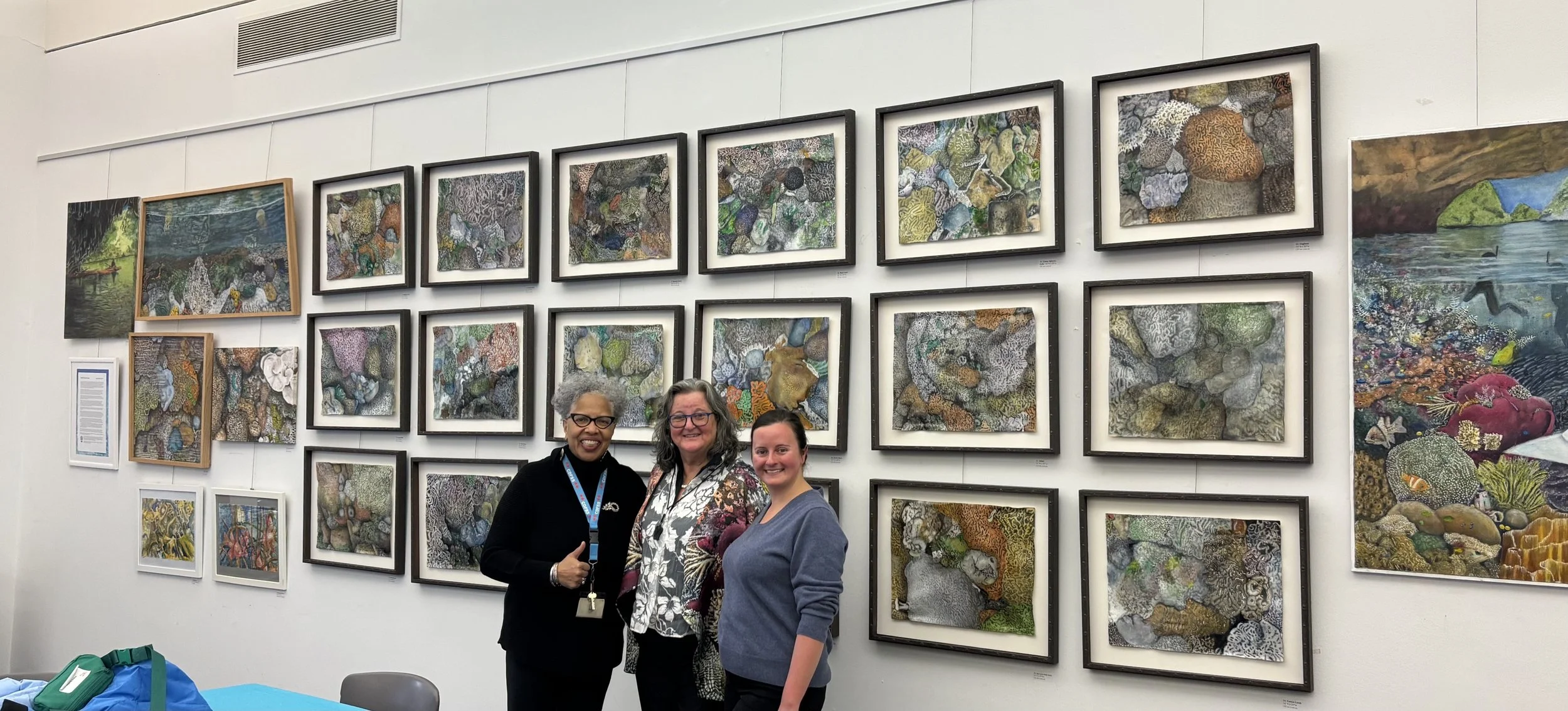
The Ring of Fire: Chicago Cultural Center Exhibition 2026 oil on canvas and panel 1066 cm w
My two-dimensional drawings and paintings have always been exhibited with my sculptures. Before Covid-19 lockdown I had already painted half a dozen coral portraits utilizing Technique mix; a process Leonardo DaVinci learned from Anthony Van Dyck for his Monalisa. A foundation of black and white tempera is painted to establish textures and depth. This parallels the stony boulder skeleton below the polyp layer of coral and looks like bleached coral reef. Colorful glazes are applied to recreate the vibrancy of restored coral polyps. The white tempera reflects light through the glaze as if the coral painting is underwater. In sculpting I move the specific subject to the geometric interpretation. The Ring of Fire paintings move from being observed as the other-worldly abstract imagery that seems like pure painterly invention to is actual realistic representation. I faithfully render the phantasmagoric vitality that exists in the reef system at a level of complexity and color that exceeds what most people will venture to see. Processed like a royal in portraiture seems fitting.
On an ocean planet most species live in the sea and are unknown, unseen, and only recently discoverable. Underwater is our origin and our new frontier.
What the Ring of Fire paintings share with sculptural practice is my search for the relationship between repetition and differentiation. I explore in artmaking the way small and large forms rhyme in the composition, the way open spaces and solid forms have a rhythm that makes sense of the entire piece. I am enthralled with the balance of realism and abstraction in a human face and a polyp portrait. My polyp portraits depict various colonies competing for light and space, each species differentiated in color and texture while forming an ecosystem whose diversity gives it resilience. Biologically, this essential building block covers 1% of the ocean floor while feeding 25% of ocean life. The struggle for space in the sun is evident in the paintings.
Your question about landscape and the figure becoming interchangeable sites of vulnerability is right. The reef and the human figure are living organisms and interdependent. Both are pressured by forces larger than themselves, both have remarkable resilience, and are threatened by thresholds of recovery being impossible. Both insist on their continuity ontologically in the sense I’ve tried to articulate throughout my body of work. Polyps and people are made of carbon. We evolved from the sea. Billions of people are reliant on reefs for their livelihood. Reefs protect shorelines and feed fish. Reefs provide medicine for people. The ocean can feed our increasing population but not human greed. Coral and humans are the alike subjects for me, different looking life forms. By painting coral portraits in the same process as the Monalisa I strive to make the continuity felt before it is argued. If the viewer can see our oneness, the vulnerability of the reef is indistinguishable from our own. Will the destruction of reefs be the wake-up call to save humanity?
French surrealist, André Breton chose John Williamson’s photograph, first underwater filmmaker (1919), of a staghorn coral reef as the symbol of Surrealist Movement and, with it, declared the center of his artistic movement in the middle of the Pacific Ocean. He published John’s photograph internationally with his hand-written title, “Treasure of the Great Barrier Reef.” John Williamson lived, photographed, and filmed in the Bahamas. André Breton saw the realistic underwater coral ecosystem as surreal; strange, weird, dreamlike, or bizarre. He may have imagined the science of coral offspring from the South Pacific being transmitted to the Bahamas by ocean currents. His definition of a coral boulder drew attention to how little we know of the sea, then or now.
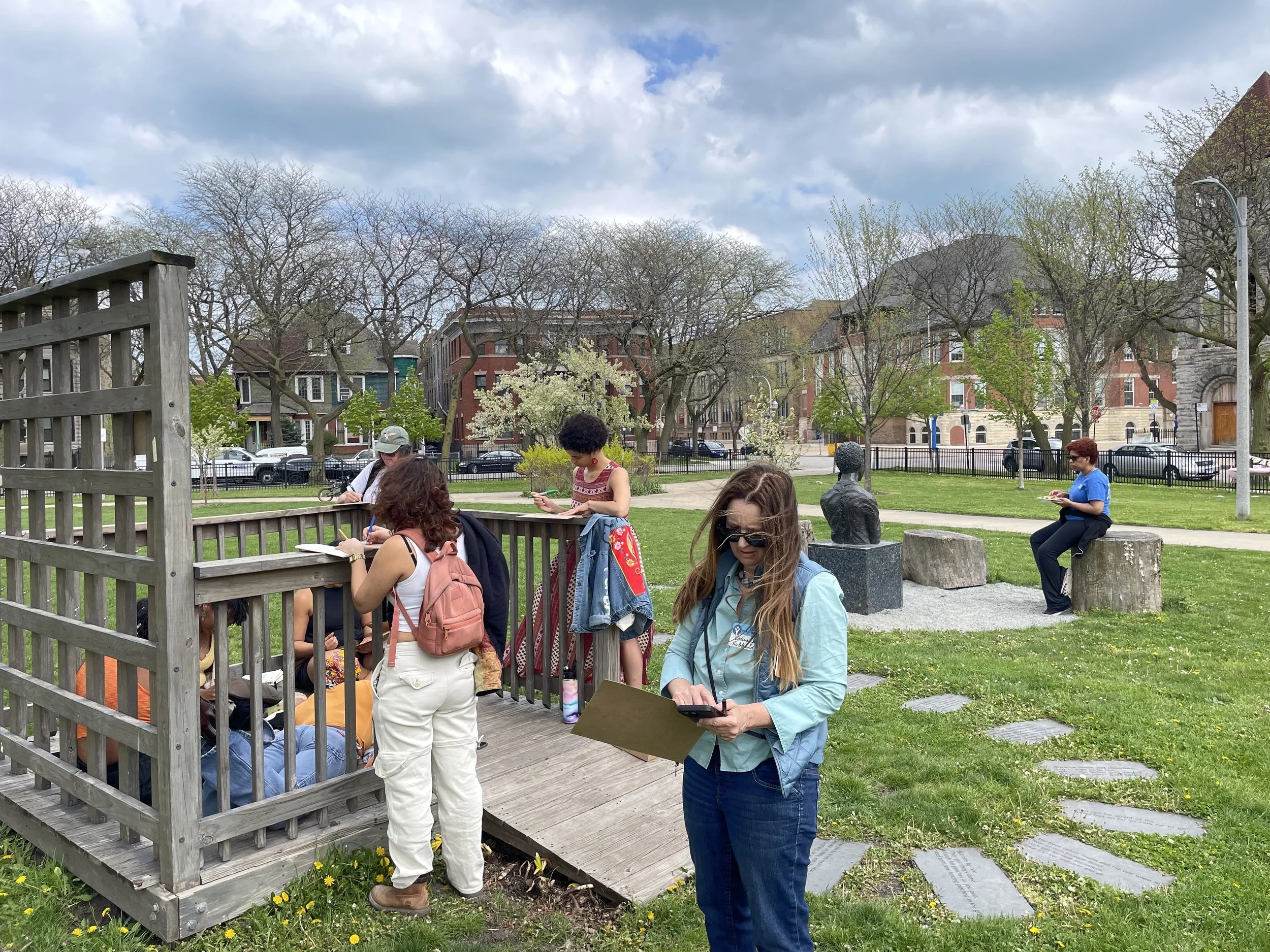
From the Porch Poetry Workshops, 2018-2025, 609 cm w

Gwendolyn Brooks: The Oracle of Bronzeville monument, 2018 bronze, granite, bluestone, wood, metal clips 609 cm w
Your monuments to cultural figures such as Gwendolyn Brooks operate within contested histories of representation; how do you approach the ethics of embodying another’s intellectual and poetic legacy in bronze, and what formal strategies prevent the figure from hardening into a singular narrative?
Gwendolyn Brooks: The Oracle of Bronzeville Monument required me to confront your question–I am a white woman with an advanced degree paying tribute to an internationally recognized Black poet who grew up in Bronzeville. Her life’s work gave lyrical voice to a community that suffered from systematic oppression rendered invisible for generations. I did not see it, our differences, as a problem, but an ethical condition that would shape my decisions. I had already sculpted Delois Barret Campbell whose portrait is now in the Smithsonian, which gave me some understanding of embodying a Black woman’s legacy.
The invitation to make a monument in a park came from Nora Brooks Blakely, Gwendolyn’s daughter. Nora’s endorsement matters significantly. My artmaking began in relationship rather than presumption, in listening and responding rather than imposing. Nora showed me her mother’s mannerisms, her characteristics, gestures, hair styles, and the specific qualities of Gwendolyn’s presence in the room. Gwendolyn Brooks is irreducible in her being the first Pulitzer Prize awarded Black writer of any genre. The Oracle of Bronzeville is a woman who spent her life listening to young poets and insisted that their stories matter. To sculpt her was to take on an obligation to her and everyone who voice she amplified. Yes, I had moments of anxiety.
Nora and I discussed the gesture of Gwendolyn’s hand at her temple as if divining the next line. It is a quiet gesture of interiority and action simultaneously. It shows her practice rather than her achievement. It refuses to embrace monumental conventions of a triumphant pose while confirming she knows her importance and invites the viewer to join her. Gwendolyn’s portrait engages in a quizzical encounter–both wondering and knowing at the same time. I recognize this quality from my own mother, who was Gwendolyn’s friend. They smiled that way to say: I know your story, but I want you to tell it to me in your details. That opens the portrait against being stagnant but ongoing and inquisitive. A portrait that is listening allows the viewer to be seen, rather than simply to see. At the dedication, I felt I had arrived when a Black man said she looked like Rodin has sculpted her.
The monument’s formal language extends an ethical proposition beyond my portrait. I was aware of the historical context embedded in the European classical tradition of cast bronze on a pedestal– an exclusive tradition of commemorating white men of business and political power. To place a Black woman poet from the Southside within the formal vocabulary of without contesting it would have been capitulation to the power source her poetry challenged. My site design was my contestation. The path begins at From the Porch– Gwendolyn’s childhood writing space, her family’s back porch, and her first room-of-one’s-own. The viewer walks from the porch over a path of granite pavers etched with excerpts from Annie Allen, sonnet form poems, of a girl growing up in redlined Bronzeville. This collection earned her a Pulitzer. Her world expanded by receiving the Pulitzer Prize, as symbolized at the wide bluestone circle. The viewer reads her poetry before meeting The Oracle of Bronzeville. Her portrait is my argument that offers the experience to see how a life should be approached from the ground up. The community from which she emerged forged the activist writer rather than propped her high on a towering pedestal.
Tree trunk seats placed around the humanistic portrait of Gwendolyn carry their own weight. Those trunks have lived through three hundred years of American history, centuries of Black oppression in this country. Children are rough with the seats; hitting them with sticks, stomping, poking at their rot. I replace them as needed. I replace the bluestone in the circle annually. I repair the vandalism. My annual maintenance in itself is a statement about what a living monument requires. It is a continuous labor of tending what is given to the community and its children.
From the Porch workshops make this living monument literal. For Earth Day, groups tend the over fifty saplings in Gwendolyn Brooks Park-caring for a fraction of the Southside’s sparse tree canopy. Professional poets guide the tree tenders in writing about the experience and reading their work out loud From the Porch. Their poetry is clipped on the back wall of the porch–a publishing wall– so visitors can read or take the poems home. This is Gwendolyn’s pedagogy enacted in her sculpted presence. The monument is a gathering site where her practice of listening insists on young voices being heard and continues to generate new written words. The bronze figure on a granite cube is permanently invoking an impermanence that has continual renewal and creativity. The monument is not hardening into a past and singular narrative, but left to the tendencies of risk becoming.
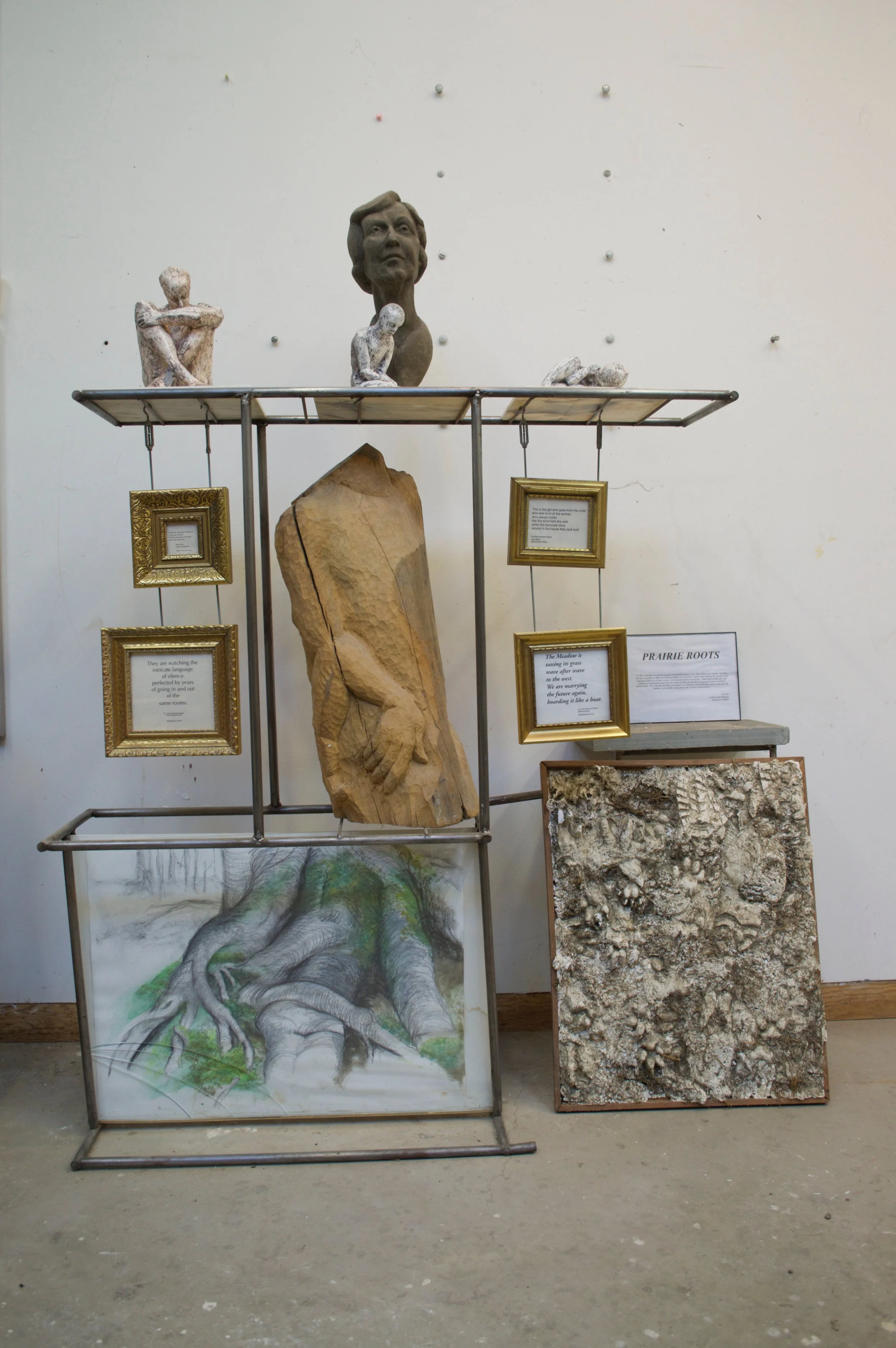
Prairie Roots: Shaw Family 1995 wood, steel, gold leaf frames, plaster, Fondu Ciment, multimedia drawing, plaster earth casting
The notion of sustaining land across generations, as explored in Sustaining the Land, seems to imply time as a sculptural medium; how do you conceptualize duration, ancestry, and inheritance within static form, and can sculpture enact a temporal continuum rather than a frozen present?
My Prairie Roots family portrait includes a metal frame representing Howard Shaw’s Ragdale Home (now a fifty-year old-foundation), a single portrait of daughter and mother, Alice Hayes/Sylvia Shaw, on top, a mantle with four sculptures of babies and children connecting to the earth, Alice Hayes’ poems in gold leafed frames hang in the house structure, and my drawing of the elm tree roots entangled above the ground, and a matrimonial male/female carved log. I made the sculptures from what sculpting skills Sylvia Shaw taught me in her Ragdale studio.
Sustaining the Land proposes that the most radical thing sculpture can do with time is refuse to treat it as the enemy of form. The conventional understanding of the monument is that it defeats time — that bronze and granite persist where flesh does not, and that persistence is the point. What this work states instead is that time is not what the sculpture resists but what it holds: the accumulated decisions of specific people across several generations that kept a particular piece of land alive when every economic and cultural pressure of the past two centuries was pushing toward its destruction.
The double portrait of Sylvia Shaw Judson and her daughter Alice Hayes is two profiles of a mother and daughter, facing the same horizon. They made the decision to preserve fifty acres of Illinois prairie and make their home an artist residency program called Ragdale. My portrait is formally an image of inheritance. Inheritance as the active renewal of a commitment: the decision, made again in each generation, to sustain what could easily have been lost or sold. Shaw Prairie carries that history in its soil. When Sylvia’s grandparents, Howard Van Doren Shaw's parents, purchased those fifty acres in the late 1890s from a farmer who had grazed livestock on it without fully breaking it, they were, without perhaps knowing it, preserving a fragment of what had been Potawatomi land until 1832. Virgin prairie exists from what was already almost entirely gone. Of the twenty-two million acres of original Illinois prairie that covered over sixty percent of the state in the 1800s, fewer than 2,500 acres remain today. Shaw Prairie is among the highest quality of those remnant fragments. To stand in it is to stand in a continuity of ecological time that society has nearly erased.
My own relationship to this history is itself temporal and layered. In 1978, with Robin Moran, I introduced Natural Conservancy naturalists to Sylvia Shaw Judson, who was my sculpting mentor. That introduction led to the decision by Sylvia and Alice to preserve the family's beloved prairie — a decision whose consequences are still unfolding. Since Openlands-Lake Forest now stewards preserved land. A Shaw nephew and I both serve on Ragdale Foundation’s board. My sculpture is part of a continuum that includes ecological advocacy, institutional stewardship, personal mentorship, and the love of a family for a piece of ground they understood to be irreplaceable. To make a portrait of that continuum is a statement of all of those threads — the ecological, the familial, the activist, the aesthetic combined are more powerful than its parts.
My formal challenge of making sculpture enact historical continuum rather than stationary present is a challenge of what the form implies. A double portrait of mother and daughter already contains time structurally — the two faces in profile, the generational rhyme and difference between them, the shared preservation that neither of them alone could have sustained. But the work extends beyond the portrait into the land itself, which is the largest and most permanent element of the piece. The prairie that Sylvia and Alice chose to preserve is itself a sculpture of time: a living record of ecological processes that predate European settlement. While Sylvia taught me sculpture skills, I learned to maintain the prairie through continuous human attention and care. Watch it become more itself with every season while remaining, in its deepest structure, what it has always been. To place a portrait within that context of home and land allows the surroundings to be the worldly medium that the portrait alone cannot provide.
What I mean when I sculpt is that duration, ancestry, and inheritance can be actively held within the objects. The form positioning itself within a larger landscape and history acknowledges their vision and decision. The sculpture says: here is what was allowed by people deciding. The prairie says: here the Shaw’s decision that has been sustaining for more than a hundred years. The viewer is invited to challenge themselves in the context of their decision. The next generation is a continuum that will require an active preservation. Sculpture, understood this way, is not an immobile present. It is an active advocacy to sustain the land for our future by the example shown. Similar to Studs Terkel’s listening talent to capture individual stories, the land was heard by an inspired artistic family who preserved it’s irreplaceable quality.
Throughout your career, there appears a consistent refusal of irony in favor of earnest humanism, a stance that in certain critical climates might be deemed unfashionable; how do you situate your practice within contemporary discourse that often privileges detachment, and do you see empathy itself as a radical aesthetic strategy?
My refusal of irony in my work is a chosen ethical position arrived at through five decades of watching what detachment costs. When The Jasons, Earth Systems scientists, coined the term global warming in 1979, they issued their warning about ice caps melting causing rising seas and accelerating extinctions, I was working at World Book Encyclopedia. Or publications warned people on a global scale of what was coming. The opposition that rose was a denial of convenience. A deliberate political reframing of a scientific consensus, that now stands at ninety-nine percent, was itself a form of irony deployed as a divisive weapon. The climate crisis deniers perpetuated earnest actions as naïve. They repeated that anyone who speaks with conviction, from what they believe to be true, has failed to understand how sophisticated the world really is. I watched that irony do enormous damage to humanity. I have no interest in practicing it.
Empathy is a radical aesthetic strategy. Empathy might be the most radical strategy in a critical climate that has institutionalized detachment as the sign of intelligence. I make work that asks a viewer to feel something genuine, to recognize themselves in an artist’s portrait. I hope viewers are activated by the vulnerability of a coral reef or the courage of an activist or the decision of a mother and daughter to preserve a prairie. Awareness is not sentimentality. Sentimentality is emotions that ask nothing of the viewer. What I'm after is the opposite: a formal rigor so precise, a surface so full of tension and specificity that the awareness the work generates is inescapable. The viewer simply feels. My work raises the stakes of not being aware too visible to ignore.
The political weaponization by climate deniers taught me something important about the relationship between art and language. When words become contested and deniers are given fifty-percent of media attention like a political candidate, I make art. When scientific consensus is reframed as one side of a debate and the term global warming becomes a political tool rather than a scientific discovery, art can communicate beneath what political banter triggers. A sculpture of a figure emerging in relationship to geological time, a painting of a bleaching coral reef rendered with scrupulous fidelity, a monument built to challenge centuries of oppression connects to people in a more primary and visual vocabulary. People can deny a word, term or statistic. It is harder to deny the feeling of standing in front of artwork that expresses what is being lost.
This is why I have consistently moved between art and writing. Depending on the sway of our messy democracy, I choose the expression that is most useful. When society is moving toward environmental awareness, writing can help sharpen and sustain that activity. Words can give people tools for thinking and acting that art alone cannot provide. When the conversation becomes too politically polarized for language to carry its meaning cleanly, I return to making imagery. Visual art communicates across fracture lines when words become weapons. Frogs, butterflies, and birds are indicator species. They are the first to register environmental collapse. Indicator species give early environmental warnings that helps sustain human health and survival. People have compromised the ability for indicator species to survive. An artwork that makes the beauty and fragility of an indicator species felt in a viewer's body is doing something that a policy paper can’t. Art makes the loss visible before it becomes irreversible.
The earnestness you're identifying is inseparable from the urgency. I participated in the first Earth Day in 1970. I have been watching the warnings go unheeded, the denials intensify, the bleaching events come closer together, the prairie fragments shrink to the last fractions of one percent for over fifty years. At this point in history, with the 2025 Tipping Point Report announcing that warm water coral has surpassed its ability to revitalize. Indicator species are going extinct on every front. Detachment is not a sophisticated position. It is a luxury the natural world can no longer afford to subsidize. Empathy, genuine, formally rigorous, aesthetically earned empathy, is not unfashionable. It is necessary. And necessity, I have always believed, is from where the most important art comes.
Your documentary films and lectures reveal a desire to articulate process and context; does this transparency challenge the mystique of authorship traditionally associated with sculpture, and how do you balance revelation with the necessary opacity that allows art to exceed explanation?
The transparency of the films, time arts is a form of sculpting, and lectures is an extension of the same humanistic commitment that drives my artmaking. A teacher who withholds process to protect their own mystique has confused prestige with generosity. What I witnessed at Yale and at the School of the Art Institute was the institutional consequence of that confusion: the figure abandoned, the armature ceremonially burned, the curriculum redesigned around concepts projected onto society while the hard-won knowledge of how to observe, discover, and render a fellow living form was allowed to disappear from teaching. When I arrived at Yale I was the first life-forms sculptor modeling in clay and casting in twelve years. At SAIC, where my parents’ teacher, Moholy-Nagy designed the curriculum, an armature burning ceremony had been held to declare that the figure would never be taught there again. These were not neutral aesthetic decisions. They were the severing of a historic and global communication. A thread of knowledge passed from generation to generation was broken.
To film the process, to lecture about it, to teach it wherever I have been given the opportunity, is to insist on sharing my hard-earned knowledge. It is the same necessity that drives the From the Porch workshops at the Gwendolyn Brooks Monument, the Chicago Tree Project's engagement with neighborhood communities, the Ecosystem No. 1 invitation for passersby to contribute water. The knowledge of how to make is not private property. It belongs to the culture that perpetuates it.
Your question about opacity is the right counterweight. I want to honor solid form fully. There is a compacted remainder in every process that words cannot reach. Something happens between a specific viewer and a specific object at a specific moment that no documentary can record, can anticipate, or can reproduce. Sculpture takes and changes space. The thumbprint in the clay, the shadow that falls differently in October than in April. The feeling of standing before the Gwendolyn Brooks portrait and finding in her an open wondering face is something that reflects my own unrecognized backstory. I learn about myself and others through my sculpting process. These are revelations, not communications. They exceed the maker's intention because they occur in the space between the object and the artist, of doing. The films and lectures can describe the conditions under which such events reveal the discovery. They cannot produce them. The art object lives as a testimony to what remains after explanation has ended its purpose.
To your final question, whether the oeuvre constitutes a single evolving organism, and what its structural DNA might be, I find that I can answer it now in a way I could not have answered it at the beginning of my practice. Over time, the organism of a life’s work had to grow large enough to reveal its own pattern.
The governing rhythm is the oscillation between the specific and the universal, the individual and the ecological, the permanent and the living. A particular human face emerges in clay until it becomes a symbol. A dead tree trunk carved into a totem that extends its decaying life into a fifth season. A coral polyp is given a narrative voice so that its vulnerability becomes a felt experience rather than a statistic. A prairie preserved through the decision of a mother and daughter whose double portrait holds two generations in a single gesture. These are not separate statements. They are the same project repeated at different scales and in different materials — the project of making visible the continuity between all living forms, and of insisting that continuity carries ethical weight.
If I had to describe structural DNA in a single explanation, is this: every form that has achieved its shape through time deserves to be seen. The human body is shaped by evolution. The geological surface shaped by volcanic force and glacial patience. The coral reef shaped by three hundred million years of biological ingenuity. The activist's face shaped by the specific mixture of struggle and commitment that sustained moral courage produces over a lifetime. To sculpt any of these is to perform the same fundamental act — the act of looking long enough and carefully enough that what is usually invisible, or common, it made tangible, permanent, and impossible to turn away from.
My generation grew up with a dying environment and the existential pressure of nuclear annihilation. That anxiety is real and it has fueled an urgency in my work. But beneath the urgency is something that has not changed. Since I first carved wood as a child, I felt the form releasing itself from what the log source. The patterns of growth and rings of wood taught me a profound and unshakeable conviction that life, in all its forms, is worth the full attention of a human being. That conviction is the DNA. Everything else; the figure, the tree, the coral, the community, is its expression.
Looking back across decades of public installations, literary works, ecological advocacy, and institutional engagement, do you perceive your oeuvre as a single, evolving organism, and if so, what might be its governing rhythm, its structural DNA, that binds together figure, tree, coral, and community into one continuous sculptural inquiry?
Yes. And I can say that with a certainty that has taken fifty years to earn.
The organism metaphor is not incidental. It is precise. An organism is not a collection of parts that
happen to coexist. It is a system in which every element is in metabolic relationship with every other, in which the whole is continuously processing its environment and being changed by it. The invasive species that inform human health and wellbeing are fed by the diversity of prairie plants. Creation and destruction, growth and decay, are not opposites but circular phases of a single continuous activity. That is what my practice has been. The figure and the coral reef and the dead tree trunk and the prairie fragment and the activist's face and the child's first step and the father kneeling in the park — these are not separate subjects I have visited in sequence. They are the same subject encountered at different scales, in different materials, under different pressures of historical and ecological urgency.
The governing rhythm, I now understand, is breath. The interiority of deep attention. The long looking, the careful listening in the studio, the geological patience required to see what a material is becoming. The outward movement of the completed form is released into its community; its collective, its landscape, its weather, its future viewers. Inhale: the specific person, the particular tree, the individual polyp, the remnant prairie. Exhale: the symbols that opens those specificities visually outward into the universal, the ecological, the ancestral, the not yet born. Every work I have made has followed that rhythm. The breath is always changing and my structural DNA.
What connects figure, tree, coral, and community at the deepest level is my conviction. I arrived at conviction through making rather than through thinking. I confirmed my conviction by fifty years of formal investigation that life organizes itself according to the same patterns at every scale. The branching of a coral colony and the branching of a river delta and the branching of a human nervous system are the same pattern generated by the same underlying process. Patterns of the negotiation between growth and resistance, between the organism's drive toward form and the environment's continuous pressure upon it. When I find that pattern in the clay — the tensile arc, the rhythmic plane, the surface that holds light the way a geological stratum holds time. I am recognizing and finding rhythm in what was already there.
The through line that connects the first Earth Day in 1970 to the 2025 Tipping Point Report, that connects Studs Terkel's oral histories to the Gwendolyn Brooks Monument, that connects the lost figurative tradition I taught to restore at Yale and SAIC to the living monument workshops at From the Porch, that connects the bronze casting process to the coral bleaching cycle, that connects the Shaw Prairie preservation to the Chicago Tree Project's fifth season for dying ash trees — is a single, consistent, unironic proposition. Every living form is worth the full weight of human attention, and that the practice of giving it that attention, in permanent material, with formal rigor and ethical seriousness, is one of the things art exists to do.
I began carving wood as a child in the 1970s. I found the form and released it from what was not essential. I understood even then, before I had language for it, that I was finding something that was already there. My communicating with a log shaped by forces older and larger than me. The practice has been, from that first carving to this conversation, the attempt to be worthy of what the material already knows. If I listen carefully enough, look long enough, and work with patience and love that the form carries something true about what it means to be alive on this planet at this particular moment in its history. It seems impossible until it’s done.
That is the organism. That is its rhythm. That is what binds it together.
And it is not finished.
https://margotmcmahon.com
https://linktr.ee/McMahonmargot
https://www.instagram.com/margotmcmahon/
https://www.linkedin.com/in/margot-m-4b197a25/
https://substack.com/@margotmcmahon
https://www.youtube.com/channel/
https://www.amazon.com/stores/Margot-McMahon/