
Patricia RAIN Gianneschi
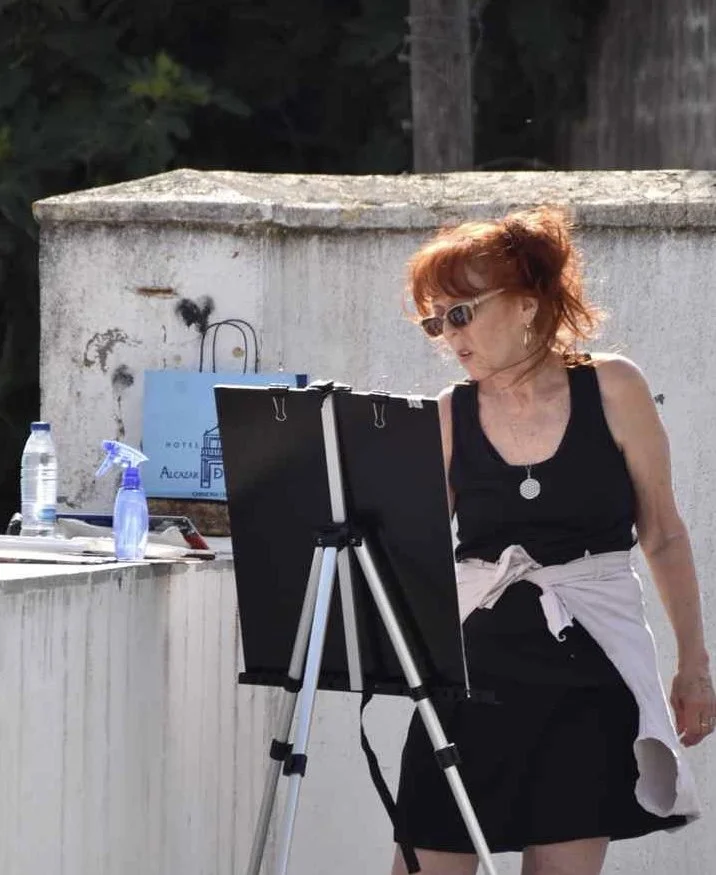
Patricia RAIN Gianneschi: Artist, Musician, Teacher, Gardener, Thinker, Activist, Mother, Wife, Sister, Daughter, Lover, Friend.
RAIN was born and raised in Chicago, and is an artist working across Poetics. In her multimedia work, whether music or visual art, the intersection of social justice and spirituality is a thread that runs through all the disciplines of her work. As an teaching artist with students, from the classroom to the stage at the Art Institute of Chicago, she weaves a pedagogy with the same threads of spirituality and social justice. Her paintings, prints and drawings going back over 35 years represent an artistic practice rich in ideas, content, creativity and authenticity.
RAIN is currently a founding member of the art collective: MOTHER ART: REVISITED and Creative Director of the Evergreen Art Group.
In the summer of 2018, I began a journey that has turned has led to the life- long study of Giotto, particularly Rothko’s relationship with the ‘Rebel of the Renaissance.”
Giotto & Rothko
Giotto di Bondone
Born: c.1266; Florence, Italy
Died: January 8, 1337; Florence, Italy
Active Years: 1295 - 1337
Influenced: Mark Rothko & other modern artists
“GIOTTO’S ROBES I” 2018 oil on canvas, graphite, oil pastel
My journey following the steps of Mark Rothko, began while conducting research for my MFA Thesis. I stumbled upon a book; “Rothko & Giotto”. I thought, what….?
And so began an investigation of Giotto’s revolutionary painting style, and that journey continues to influence my work, and the work of many modern and contemporary artists.
Part of the journey that continues is to find the paintings, and frescoes that exist of the master’s work around Italy, mostly Tuscany.
My methodology is to study the work first, understand the message he is speaking of, through this work of art. And then I focus in on the robes themselves. The different folds, values, hues of color of which Giotto was a master. I Begin with oil and pastel, graphite pencil, and I work from the photographs, and images taken of these robes of Giotto, and I begin to abstract the robes. These small works are then brought back to the studio and larger abstract versions are now in process. The journey has lead me to learn much more about Rothko’s summers in Italy, like William DeKooning, Italy became a focus for many years, and Greece. Many of the great Modern Artists took something away from the great masters and reinterpreting the masters in a contemporary more constructive way is still the focus of many contemporary artists today.
In the painting, “Giotto’s Robes I” The Giotto painting was found in the Museum of Duomo in Florence. This was the very beginning of the journey, and represents the process of abstracting the images I chose in the folds and colors of Giotto’s robes. This painting stands alone as a study in abstraction, of line, form, and color, inspired by the hand of the rebel of the Renaissance, Giotto!
Your practice persistently inhabits what might be described as a charged liminal zone between prophetic utterance and civic address. I am curious how you theorize this tension between social justice and spirituality not as a thematic pairing, but as a structural condition of the work itself. Does abstraction function for you as a mediating field in which the ethical and the transcendent are conjugated rather than reconciled?
The tension between social justice and spirituality is explicitly reconciled as one of the main threads running through my paintings, prints, and mixed media. I have described painting as a “spiritual practice” that uncovers hidden narratives paralleling silenced histories, and I use abstraction to invite the viewers into an imaginative space of transformation. If I was to express a core philosophy, my art practice emphasizes art’s power to foster new awareness amid injustice, with “secret messages” in textures, and text, evoking personal and collective healing. This conjugation appears in some of the works blending activism with portals for “imagination and spirit,” transforming viewers through visual and sensory engagement.
You have described yourself as a “conjugated artist,” a phrase that resists the taxonomies of medium specificity and instead implies grammatical inflection, relationality, and tense. Might we understand this conjugation as a refusal of the singular authorial voice in favor of a plural subjectivity, one that shifts across painting, music, pedagogy, and performance as though across pronouns?
Conjugated Artist is a definition I did not coin for myself, but one that clearly defines my artistic practice. It is a fluid description of my approach to my artistic practice, and one that allows me that artistic freedom of a plural subjectivity, “one that shifts across painting, music, pedagogy, and performance as though across pronouns”.
In my ‘conjugated artistic practice’, the artist does not fit within existing frameworks, or defined, unlike the Hybrid Artist, fusing many different technologies and mediums to create new work. I am creating new work in many different disciplines, including my actual voice sometimes, fusing them together as in the work, “Empty & Willin”, from my first album, “I & I”. This work includes Piano, Spoken Word Poetry, and the sounds of my Painting.
https://podcasts.apple.com/us/podcast/empty-n-willin/id1513779651?i=10004773563495.
In your sustained dialogue with Giotto and the afterimage of his robes, filtered through the modernist spirituality of Rothko, you appear to be staging a transhistorical conversation about color as revelation. How do you negotiate the risk of reverence becoming nostalgia, and instead activate these art historical inheritances as sites of contemporary urgency?
In that sense, the ethical and the transcendent stay conjugated: the work remembers, but it also insists on the present. It is never only about looking back; it is about making the past speak inside the new, the now. Color functions as revelation in my work acting as a portal to a desired spiritual practice using imagination, inviting viewers to “breathe in color, image and texture” to consider a personal narrative and new awareness. I am inspired by Giotto’s rebellious abstraction of line, form, and color, thus staging transhistorical dialogues that activate historical reverence for contemporary urgency, as an “act of spiritual practice,” where color emerges intuitively blending with hidden texts and textures to parallel silenced histories., and to create awe and transformation, as in works like “Giotto’s Robes I,” revealing forces of spirit without nostalgia.
The folds of Giotto’s drapery, which you abstract into chromatic atmospheres, seem to oscillate between material facture and metaphysical aura. Are these folds for you sites of incarnation, where history becomes tactile, or do they operate as thresholds through which painting approaches the condition of prayer?
Giotto’s folds, abstracted into color, are both: tactile incarnation of history and thresholds to prayer. They let the material lift into spirit. Giotto and Rothko inform color as revelation, filtered through a modernist ‘spirituality’ into minimal, monochromatic “un-paintings” that elicit response and insight. I am motivated by color’s power to induce “forces of imagination and spirit,” aligning ethical reflection with transcendent encounters
Your surfaces often bear scars, palimpsests, and occluded texts that hover between inscription and erasure. To what extent do you see the canvas as an ethical ground, a space in which the violence of silencing is both reenacted and contested through acts of layering and concealment?
In works such as PRAYER, PROTEST & PEACE IN PAINT and AFTER FALLEN BLACK STORM, the materiality of textured grids, etched scars, and tactile surfaces evoke trauma, silence, and resistance. The physical surface becomes both a site of inscription and erasure, with stories buried or exhumed beneath its layers. Sometimes, artists reveal a personal truth, while other times, a universal truth emerges. Like Robert Motherwell and the Symbolists, I am most concerned with the effect of the work on the viewer or listener—how it prompts emotional or intellectual responses. The political dimension of my abstract work inspires my search for meaning using automatic drawing, collage, and the Symbolist aim to invoke a response. The scars and lines may represent collective wounds, and hidden prayers become my private dialogue with the Divine within the artwork.
In works that reference fallen nations or destroyed temples, the political does not arrive as didactic statement but as atmospheric disturbance. How do you calibrate the balance between lamentation and hope, ensuring that the work neither collapses into despair nor retreats into decorative transcendence?
I think of the political less as iconography and more as atmosphere, think Turner, in the way a ruined temple or a fallen empire can still be felt through light, color, and space. I want the painting to hold lamentation and hope at once, so it does not become either a moral lesson or a decorative escape. Art historically, I am drawn to the language of fresco, icon, and altarpiece, but I move through it in a contemporary voice. The hidden messages, the fractured surface, and the chromatic field all allow the work to carry memory, spirit, and urgency without losing mystery.
The notion of unveiling recurs in your statements, suggesting a phenomenology of revelation. Yet revelation can imply both disclosure and vulnerability. What is at stake for you in this gesture of unveiling, particularly when addressing collective trauma or suppressed histories?
My artistic practice is rooted in ‘unveiling’—the bringing forth of the inner spirit, a concept described by, Abraham Joshua Heschel, as the intention to reach out to the ‘other.’ Through my work, I invite viewers to spend time with me and ponder an idea, a memory, or a world issue that demands attention. These artistic expressions carry both spiritual resonance and speak to social justice concerns. With each medium, I strive to lift the veil and reach out, offering new perspectives and moments in time.
My intention is for viewers and listeners to be moved toward social activism, regardless of scale, through their interaction with my work. My paintings often suggest narratives without explicitly telling them; figures emerge, dissolve, or become elemental, as seen in After Calvary or Rain Gone Wild. I conceptualize ‘narrative abstraction’ as a means to express stories that are personal, collective, ancestral, or imagined.
The Symbolist movement sought to depict not the thing itself, but the effect it produced, using symbols to emphasize meaning behind forms, lines, shapes, and colors. Symbolism, at the forefront of modernism, developed abstract means to express psychological truths and spiritual realities. I identify with Symbolist artists for their ability to give form to dreams and visions. My work emphasizes emotions, feelings, ideas, and subjectivity, rather than realism. After Calvary is a visual, abstract narrative, while Rain Gone Wild serves as a visual diary of collective feminine experience.
Your pedagogical practice spans decades within public education, a context often marked by systemic inequities. How has this sustained engagement with young bodies and voices informed your understanding of art as a site of social transformation rather than mere aesthetic contemplation?
Teaching is a calling for me. My most cherished years were spent teaching art at George Armstrong School of International Studies, where students spoke over 37 languages. This diversity created a rich tapestry for art education, with the Art program at the heart of the curriculum. Each summer, I traveled to the country of study for the upcoming school year, crafting curriculum based on direct cultural experiences. Artist residencies, performance art collaborations with students for The Art Institute of Chicago, and leading after-school Art & Drama Clubs were all part of my practice.
The students were my paintbrushes, their education my canvas, and teaching 900-1200 children annually was a joyful endeavor. Inspiring young children to love art means cultivating a lifelong appreciation. Lessons imparted to students have influenced my own art-making, and I now see former students passing on art to their own children. As a studio teacher in television and film, I incorporate the arts into my teaching, creating meaningful experiences for young actors.
The grid, when it appears in your work, carries the historical weight of modernist autonomy, yet in your hands it seems to fracture, to breathe, to absorb prayer. Are you consciously revising the modernist grid as a spiritual architecture, or does it emerge intuitively as a scaffold for ethical reflection?
In my work, the ethical and the transcendent are not separate forces but conjugated ones: the grid, when it appears, carries the historical weight of modernist autonomy, yet it fractures, breathes, and absorbs prayer, becoming both a spiritual architecture and a scaffold for ethical reflection. That is the point where social justice and spirituality meet—inside the form itself, not outside it.
In your movement toward monochrome and what you call un painting, there is a gesture of reduction that reads almost as asceticism. Do you experience this stripping back as a renunciation of excess, a critique of spectacle culture, or as a contemplative discipline akin to meditation?
In the paintings that comprise “Prayer, Protest , and Peace in Paint”, for example, there are three canvases, and each one speaks to injustice, and silencing the free speech of our citizens, calling for justice, and call for Freedom after years of confinement. It is a meditation, it is critique of our prison system, and a silent longing for change and a protest through the act of painting. In works such as PRAYER, PROTEST & PEACE IN PAINT and AFTER FALLEN BLACK STORM, the materiality of textured grids, etched scars, and tactile surfaces evoke trauma, silence, and resistance.
The physical surface becomes both a site of inscription and erasure, with stories buried or exhumed beneath its layers. Sometimes, artists reveal a personal truth, while other times, a universal truth emerges. Like Robert Motherwell and the Symbolists, I am most concerned with the effect of the work on the viewer or listener—how it prompts emotional or intellectual responses. The political dimension of my abstract work inspires my search for meaning using automatic drawing, collage, and the Symbolist aim to invoke a response. The scars and lines may represent collective wounds, and hidden prayers become my private dialogue with the Divine within the artwork.
Your multimedia works, particularly those combining voice, music, and image, complicate the hierarchy between the visual and the sonic. Does your use of your own voice destabilize the distance between artist and viewer, collapsing the contemplative space into something more immediate and embodied?
NO, I do not think my voice destabilizes the distance between me as the artist/performer and the audience. Quite the contrary, it only adds to the mystery created and emotion of the human voice, the fact that it is the artist expressing in one work of art several mediums and concepts, these are layered pieces.
The language of Becoming in your statement suggests a processual ontology rather than a fixed identity. How does this emphasis on becoming intersect with your commitments to activism, which often demand concrete positions and declarations?
We are constantly in a state of Becoming. Change is inevitable, in all ways.
You frequently invoke awe as a desired affect. In a contemporary art world often governed by irony and critical detachment, how do you defend awe as a legitimate and rigorous aesthetic category rather than a retreat into sentiment?
In my work as a multimedia artist I have attempted to engage the audience in a meaningful way. I express my art through these different mediums; visual art, poetry, performance, and voice. In each creative encounter, I employ an intuitive approach to my work, I sometimes wander through the page, or the canvas in search of the next image, poem, or creative thought. My artistic practice has focused on the ‘unveiling’, the bringing forth of the inner being, the inner spirit, as Abraham Joshua Heschel describes, “it is an intention to reach out to the ‘other’”. I am reaching out to the viewer through my work, inviting them to spend time with me, to ponder an idea, or a thought, or a memory, or to think about an issue in our world that needs our attention.
These works have both a sense of spirituality and speak to issues of social justice. With each art form, I have attempted to lift the veil, to reach out to the other, to the viewer, to the audience to create a different moment in time, a new perspective. When the viewer encounters these works, a new and different thought pattern is perceived, and it is my intention to move not only myself, but also the viewer, or the listener, to some form of social activism in their own lives, no matter how great or small that may be.
In your engagement with Symbolist strategies, there is a clear investment in the ineffable, the unseen. Yet you also address material injustices that are brutally visible. How do you prevent the spiritual dimension from abstracting away the specificity of political struggle?
Sometimes artists reveal a personal truth, and sometimes it is a truth that needs to be revealed to the whole world. Robert Motherwell embraced the Symbolists for this very reason; as do I, it was the effect of the work on the viewer that we are concerned most with. I am concerned with the effect of my work on the viewer, or the listener, however that work of art can cause the viewer or listener to feel or think in a different way, however that may manifest. It may be for a moment it may be for a lifetime.
The political aspect of this work, although created through abstraction inspires my search for meaning and truth using the formal elements of abstraction including automatic drawing and collage, and the Symbolist desire of Motherwell, Kandinsky, Rothko and others, to invoke a response in the viewer. For Motherwell it was to invoke an emotion in the viewer which is intellectual in nature and many times political in thought.
The hidden texts embedded within your paintings function almost as encrypted testimonies. Do you imagine the viewer as an archaeologist excavating meaning, or as a co conspirator entrusted with fragments of a private liturgy?
In the practice of working in paint and collage I find I can speak quietly through these hidden words, prayers, and symbols. These are encoded for personal reflection, but sometimes left with both; hidden and a way for viewer discovery, adding more meaning, which then makes the work a more interactive experience. The concept of 'un-painting' in my recent minimalist work is a powerful gesture amidst a noisy, saturated world.
Sometimes, art needs to be bold and vibrant; at other times, it calls for quietude and reduction. Retreating into monochrome is a personal reckoning, political commentary, and spiritual quietude. When the work is stripped down to monochromatic colors, the marks are reduced to pure expression, allowing both artist and viewer a silent conversation through line, form, and color. The simplicity of black and white—echoing the Zen nature of Yin and Yang—creates a space for deep spiritual thought and expression.
The ‘hidden’ allows the viewer to step outside the busy and over stimulating culture we find ourselves in, and stop for a moment to reflect. It is a similar need to evoke a response that is spiritual, intellectual, and political in thought. The scars and lines of this work may represent the scars we feel, we see, and we have the created upon our own citizens. The hidden prayers are my own private dialog within the artwork, with the Divine.
Your maritime and celestial motifs evoke vastness, migration, exile, and return. Are these archetypes rooted in personal biography, collective memory, or do they serve as metaphors for the soul’s navigation through historical turbulence?
I am a spiritual human being, and I sometimes express this in my paintings. The process of seeking these images to convey messages that remain abstract and dreamlike, allow the viewer, as Rothko teaches, to stop and reflect on what they are seeing and feeling through artwork. ‘FALLEN NATION’ acts as a narrative of our times, as we struggle for balance. It is a collage, and an oil painting that implies a nation in struggle, but in fact the light is there, and there is hope. Color becomes the metaphor for HOPE for our nation.
As a founding member of an art collective centered on motherhood and feminist revision, how do you situate your individual authorship within a communal framework? Does the collective amplify your notion of conjugation, extending it from medium to social structure?
Working with the collective, Mother Art: Revisited reinforces my desire to use make art, and work in collaboration with my fellow artists for many social justice issues, as well as the issues women artist face, and in particular the challenge that face m other artists, worldwide. Collaborative art making, allows the communal spirit to thrive, and the collaborative pieces we create harken back to the methodologies of our mentor collective, MOTHER ART from the 1970’s. This was the first wave of feminist artists.
Over four decades, you have sustained a practice that refuses both stylistic stasis and market driven branding. What forms of resistance have been necessary to maintain this integrity, particularly as an artist who insists on the inseparability of art, spirit, and justice?
From my early expressionist paintings in the 1980s to my current multimedia practice, certain truths have remained constant in my artistic ethos. The paradigm persists: inequality, silenced voices, misunderstood struggles, and continual crises leading to transformation. My journey has been long and determined, searching for the spiritual in art.
Storytelling is integral to my writing, music, and painting, with each work containing a narrative element. I work intuitively, believing that poems and words are waiting to be found by those who are open. Similarly, paintings and songs reveal themselves to me throughout the creative process. For me, creativity begins with the artist’s encounter—a necessity to bring forth an idea, emotion, or vision through creation.
The materials serve as the language and medium, secondary to this encounter. I have come to believe that creativity occurs through the artist's experience, bringing vision, thought, or emotion into the world. Critical, meaningful, and transformative art is the most basic manifestation of humanity fulfilling its own being. Ultimately, all creativity is the process of making or bringing something into being.
In your exploration of destruction and reconstruction, especially in works that recall cultural erasure, do you conceive of painting as an act of memorialization, or as a speculative rebuilding of what has been lost?
In my work, painting is both an act of memorialization and a speculative rebuilding of what has been lost. I don’t separate the ethical from the transcendent; I let them meet inside the work, where remembrance, repair, and prayer can occupy the same space.
If we consider your entire oeuvre as a long meditation on the possibility of transformation, where do you locate the moment of change: in the studio encounter, in the viewer’s reception, in collective action beyond the gallery, or in some indeterminate space where art and life become indistinguishable?
In answering this question I think honestly, for me, there is no separation between Art and Life, The moments of change happen in each encounter, whether alone in the studio, in collaboration, or on the stage. Each encounter with the Creative Spirit brings about a moment of change.
Having exhibited in monumental cultural spaces such as Times Square, Art Basel, and Venice, I also value the intimate, local, and pedagogical encounters. Balancing the global stage with a grassroots practice requires intention and humility. My teaching practice, encompassing all artistic disciplines, is where my most authentic voice is heard., and I see long lasting changes in the encounters I have with my students, for myself and for the students.
While international exhibitions connect me with diverse audiences, true fulfillment often arises from grassroots impact—working directly with students, film families, fellow artists in the SAIC community, and through Mother Art: Revisited. These interactions nourish creativity and keep me grounded, affirming that authentic expression thrives in both grand venues and everyday moments of connection and growth. Ultimately, my voice finds resonance across all realms, but it is in smaller, personal settings where I feel most deeply heard and understood. I look forward to combining all these disciplines with a new collective I have formed this year, the Evergreen Art Group.
www.evergreenartgroup.com
www.praingianneschiart.com
Patricia RAIN Gianneschi Portfolio Viewing Room
https://www.artworkarchive.com/rooms/patricia-rain-gianneschi/3803ba
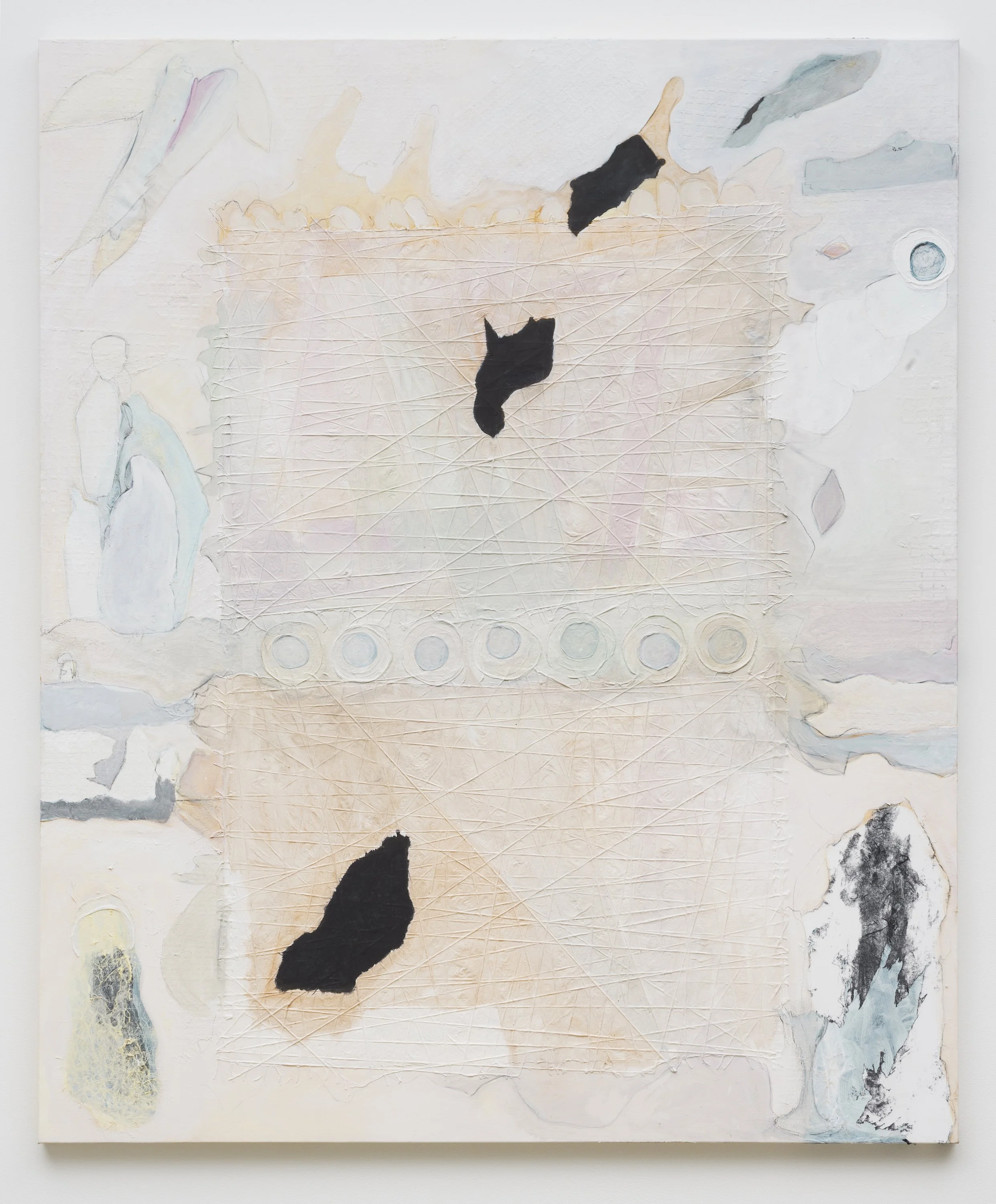
FALLEN, 2017 mixed media, oil on canvas, 182.88 cm X 152.4 cm
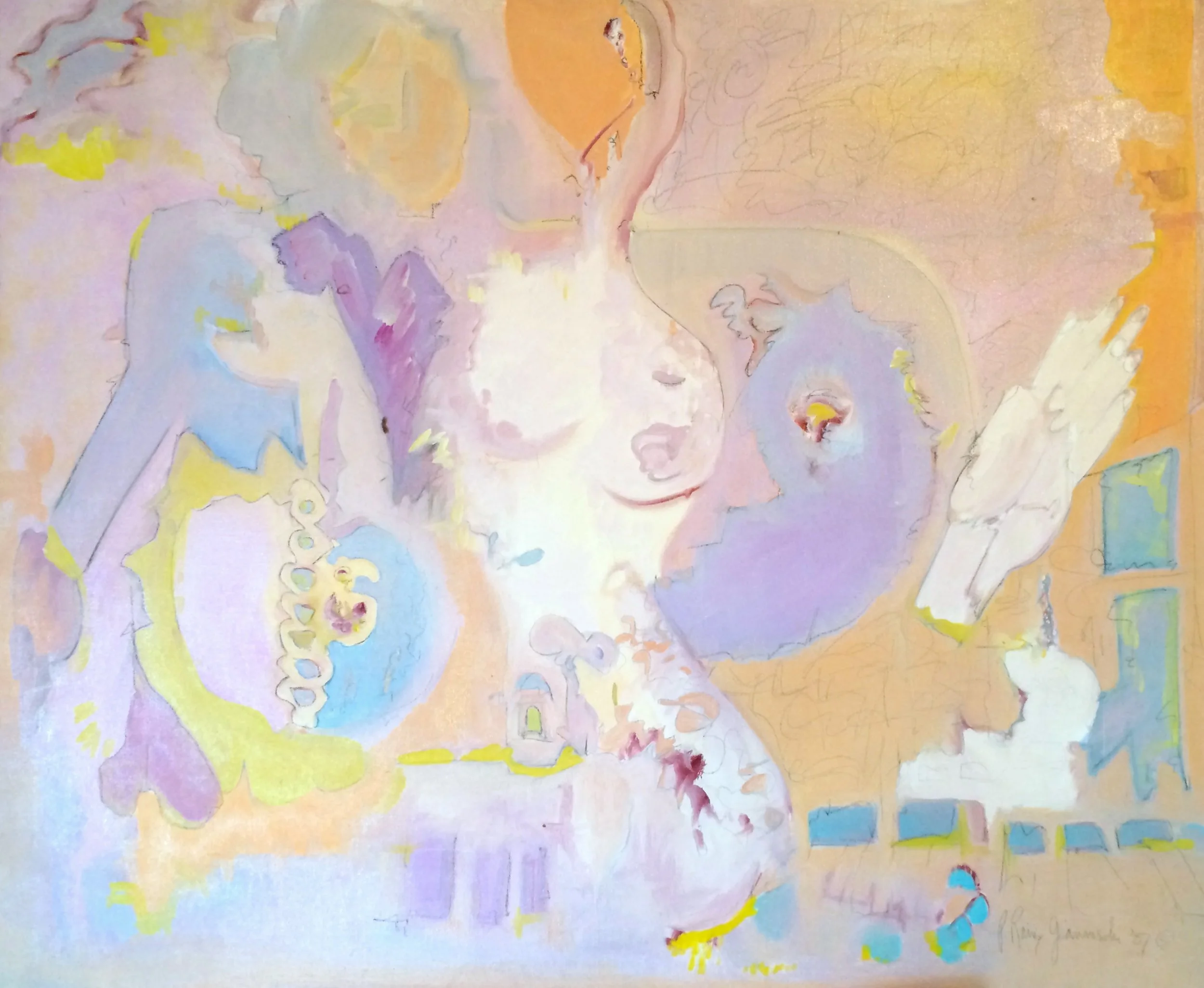
RAIN GONE WILD 1987, OIL on Canvas 91.4 cm x 121.92 cm
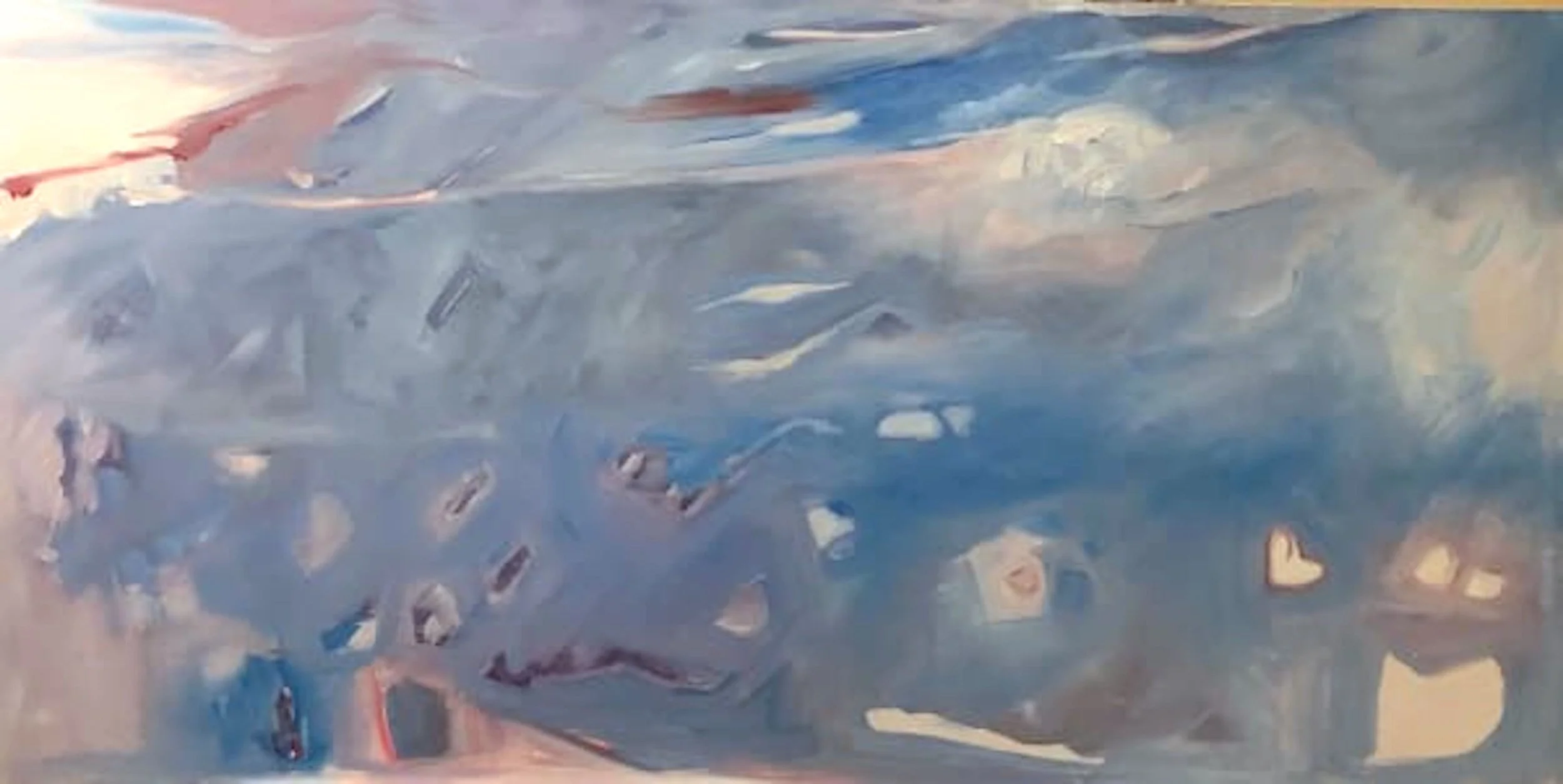
BLUE ON BLUE, 2023, oil on canvas, 213.26 cm X 212.92 cm
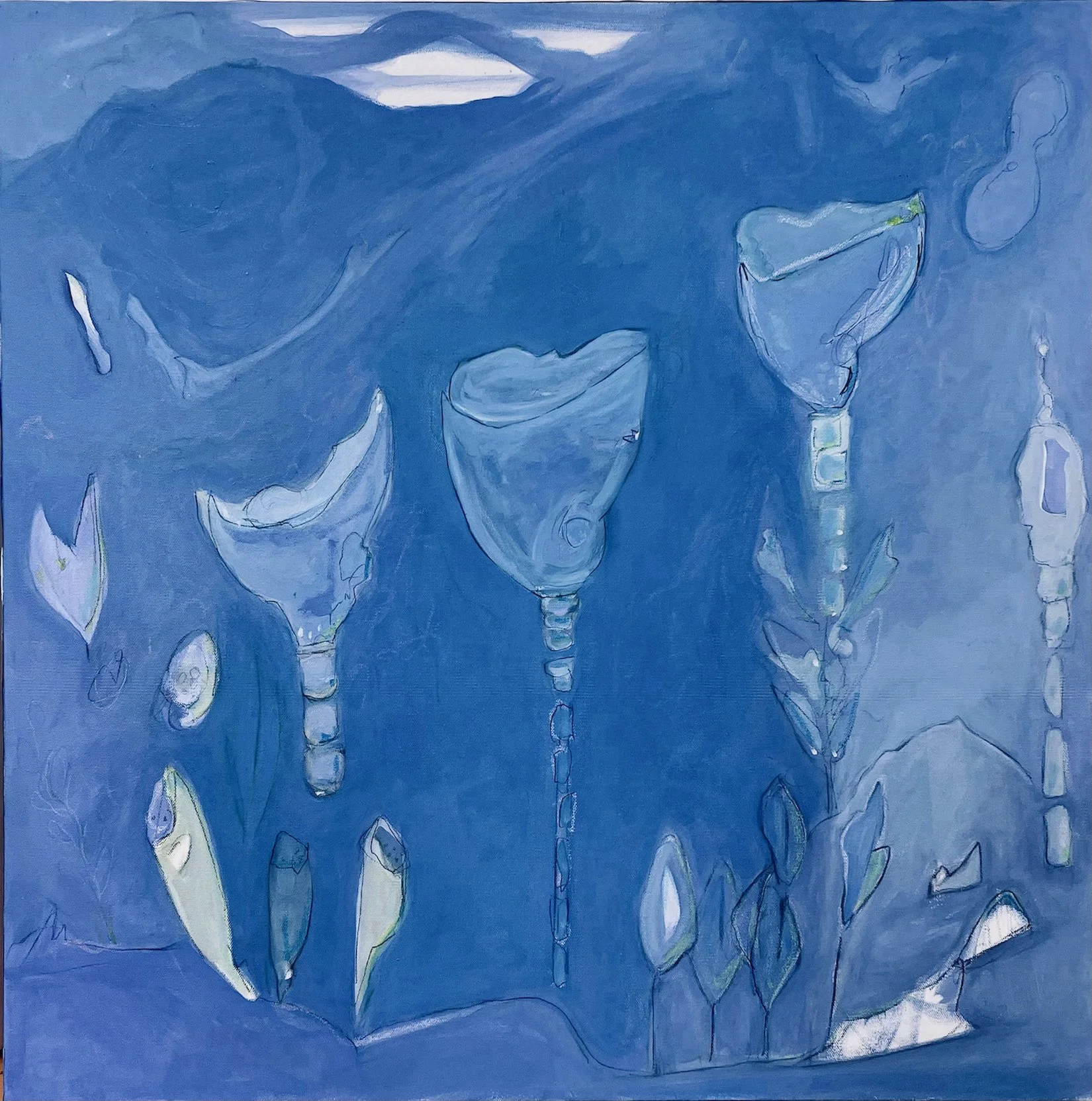
The Blue Seed Pods, 2024 oil on canvas, 91.44 cm x 121.92cm
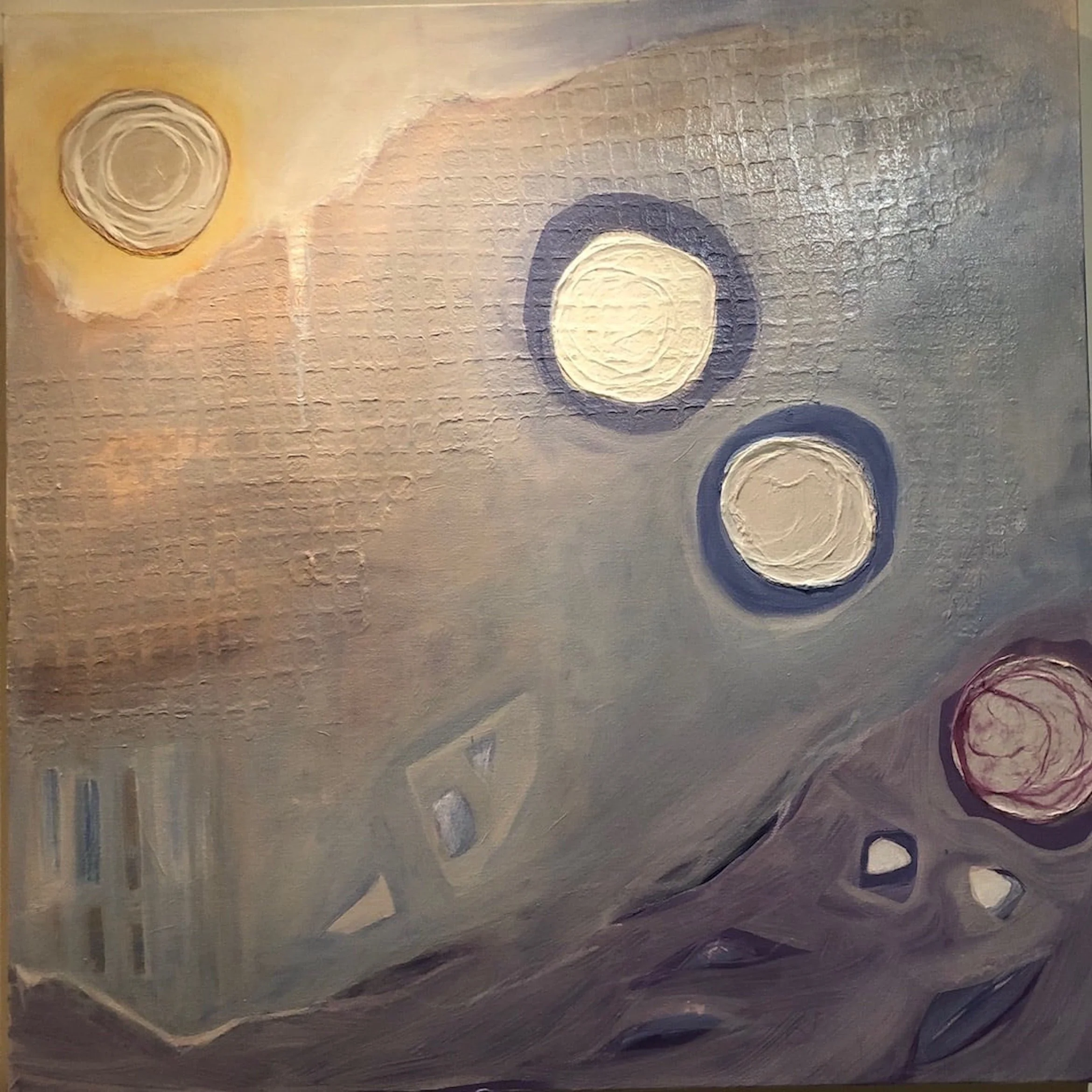
FALLEN NATION, 2022, mixed media, oil on canvas, 76.2 cm x 76.2 cm
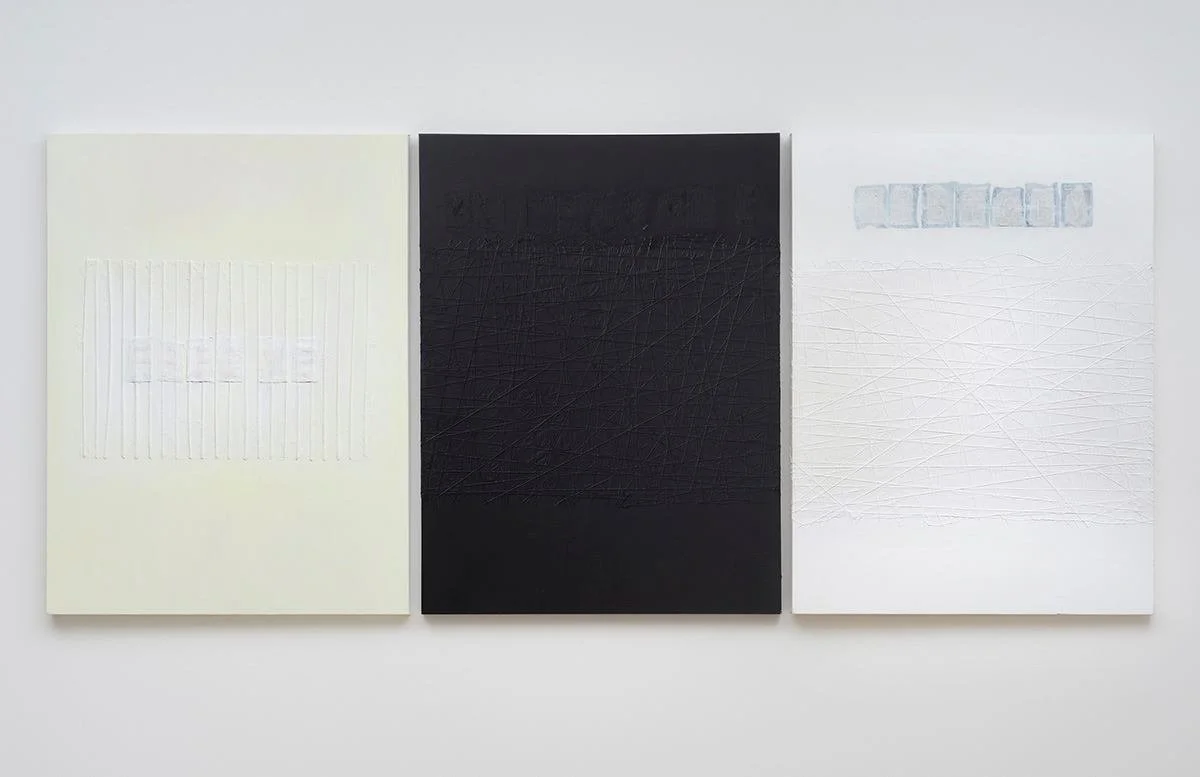
PRAYER, PROTEST & PEACE IN PAINT, 2017, mixed media, collage, oil on handmade paper, canvas, 121.92. cm x 274.32 cm

The Blue Visitors, 2024, oil on canvas, 76.2 cm X 76.2 cm
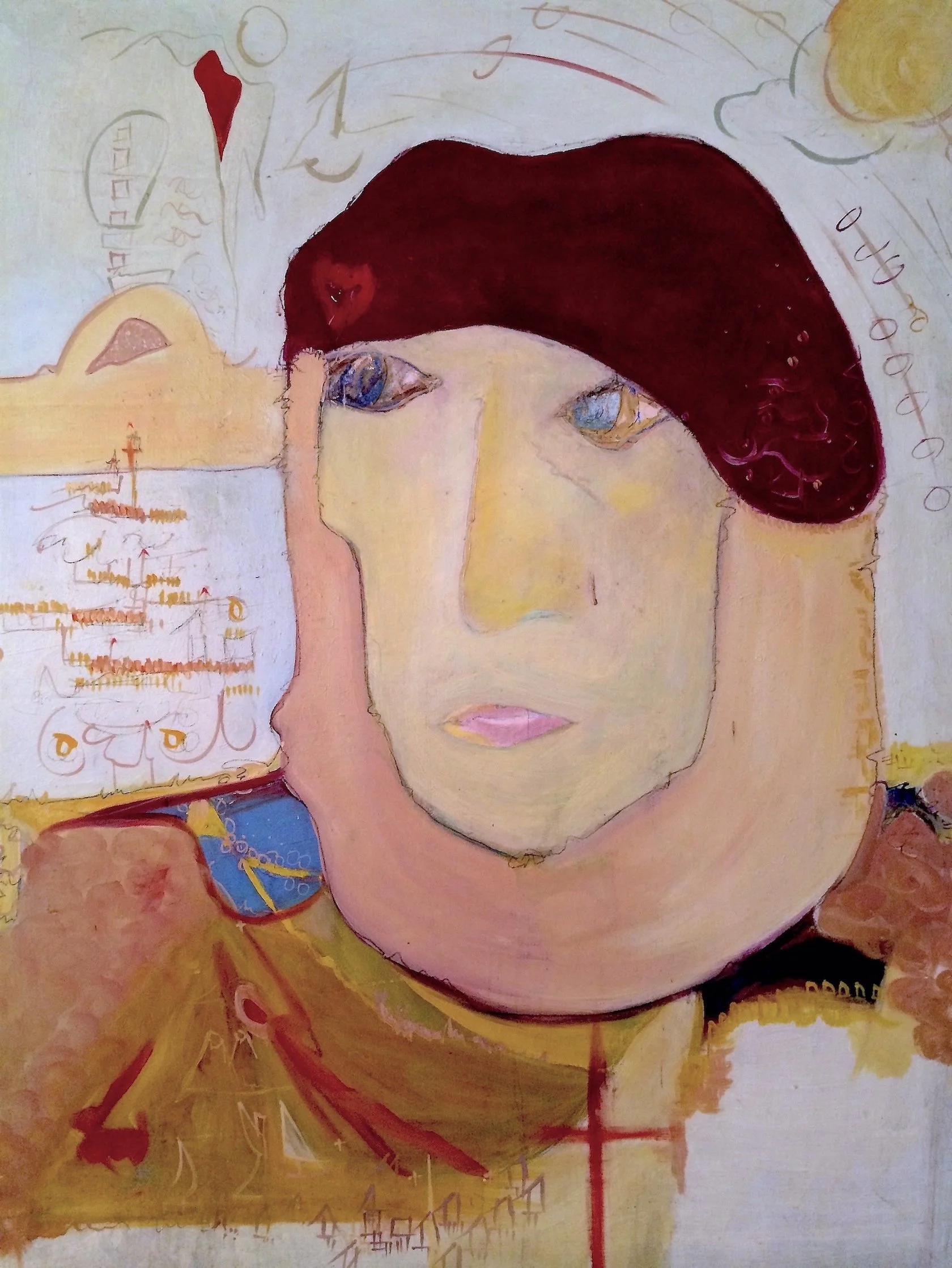
The Lady in the Red Beret, 1980, mixed media, oil on canvas, 91.4 cm x 121.92 cm cent.
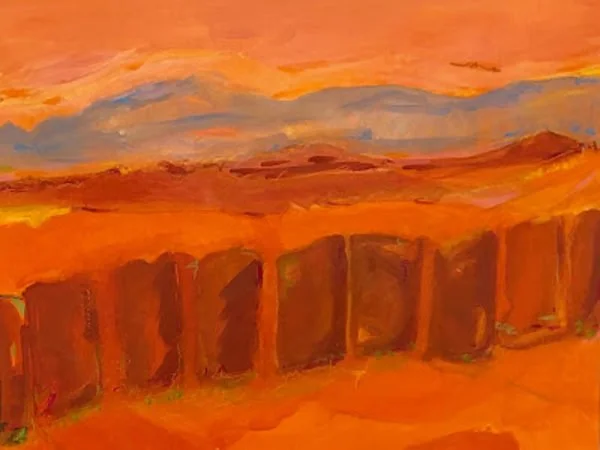
FEEL THE HEAT: CARMONA! 2018, oil on canvas, 91.4 cm x 121.9 cm (painted in SPAIN: gifted to city of Carmona, Spain)
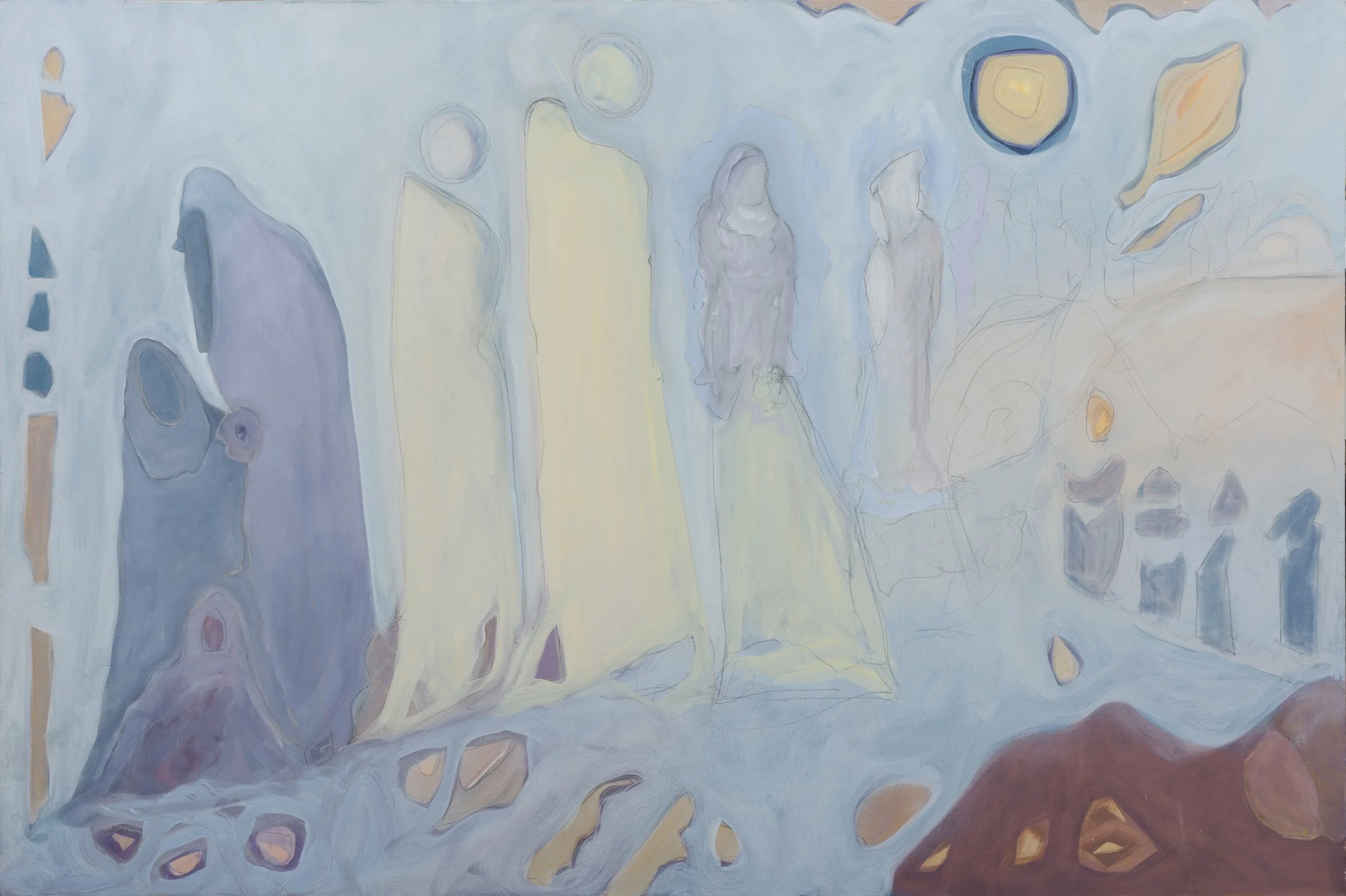
AFTER CALVARY; 2015-16, oil on canvas, 121.92 cm x91.44 cm
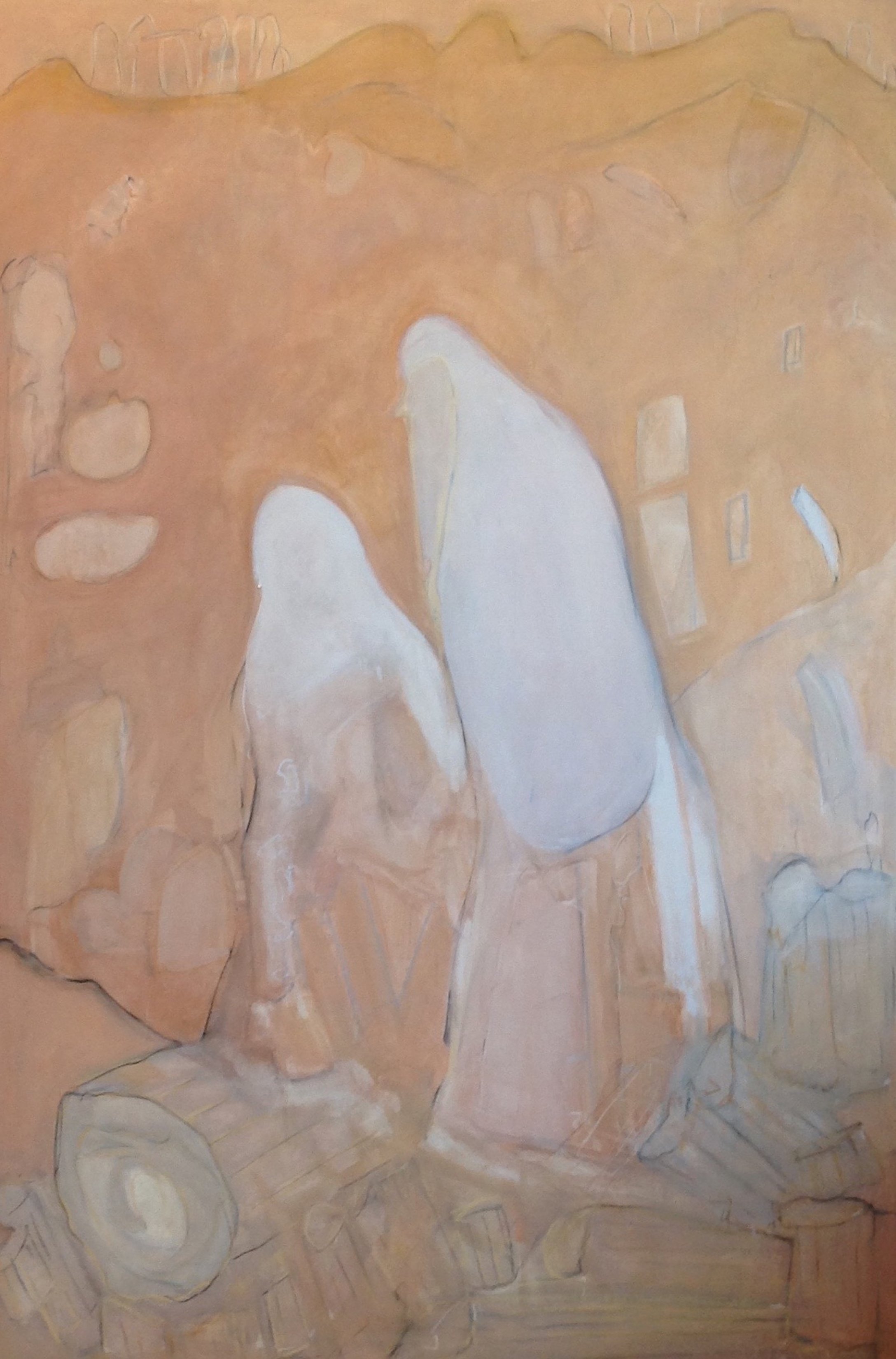
PALMAYRA, 2017, oil on canvas, 121.92 cm 91.44 cm
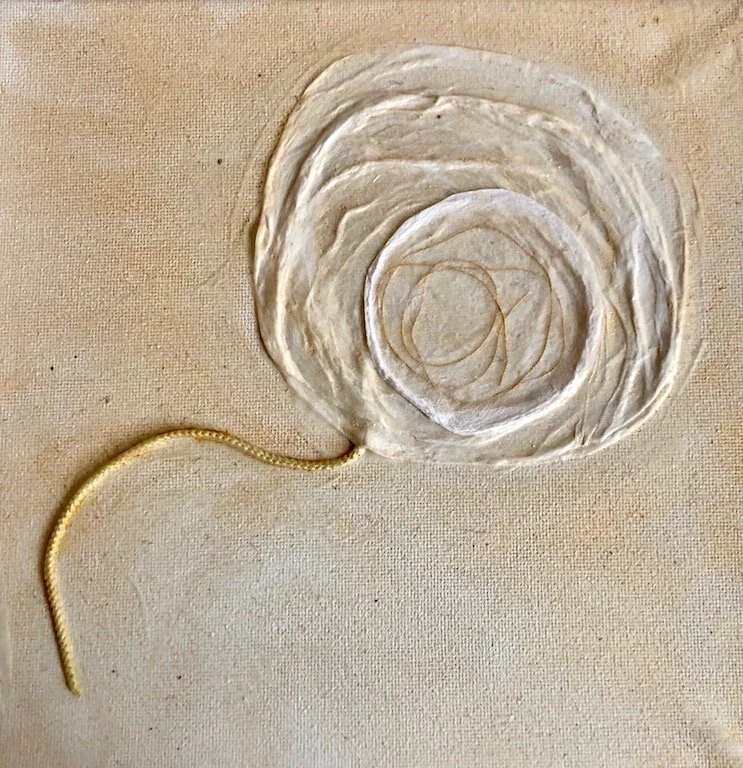
STAR SEED I 2020,mixed media, 76.2 cm x 76.2 cm
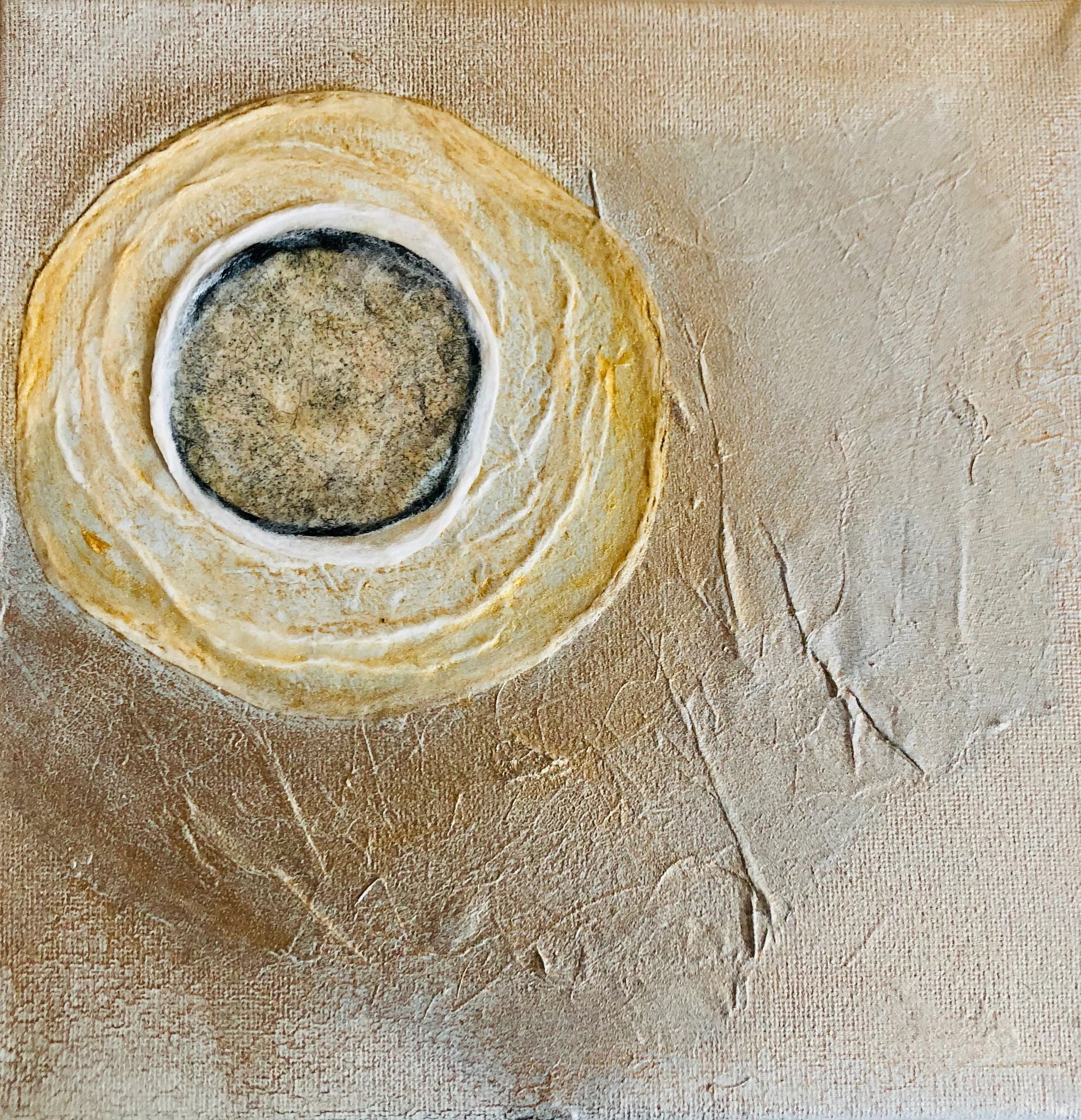
STAR SEED II, 2020, 76.2 cm x76.2 cm
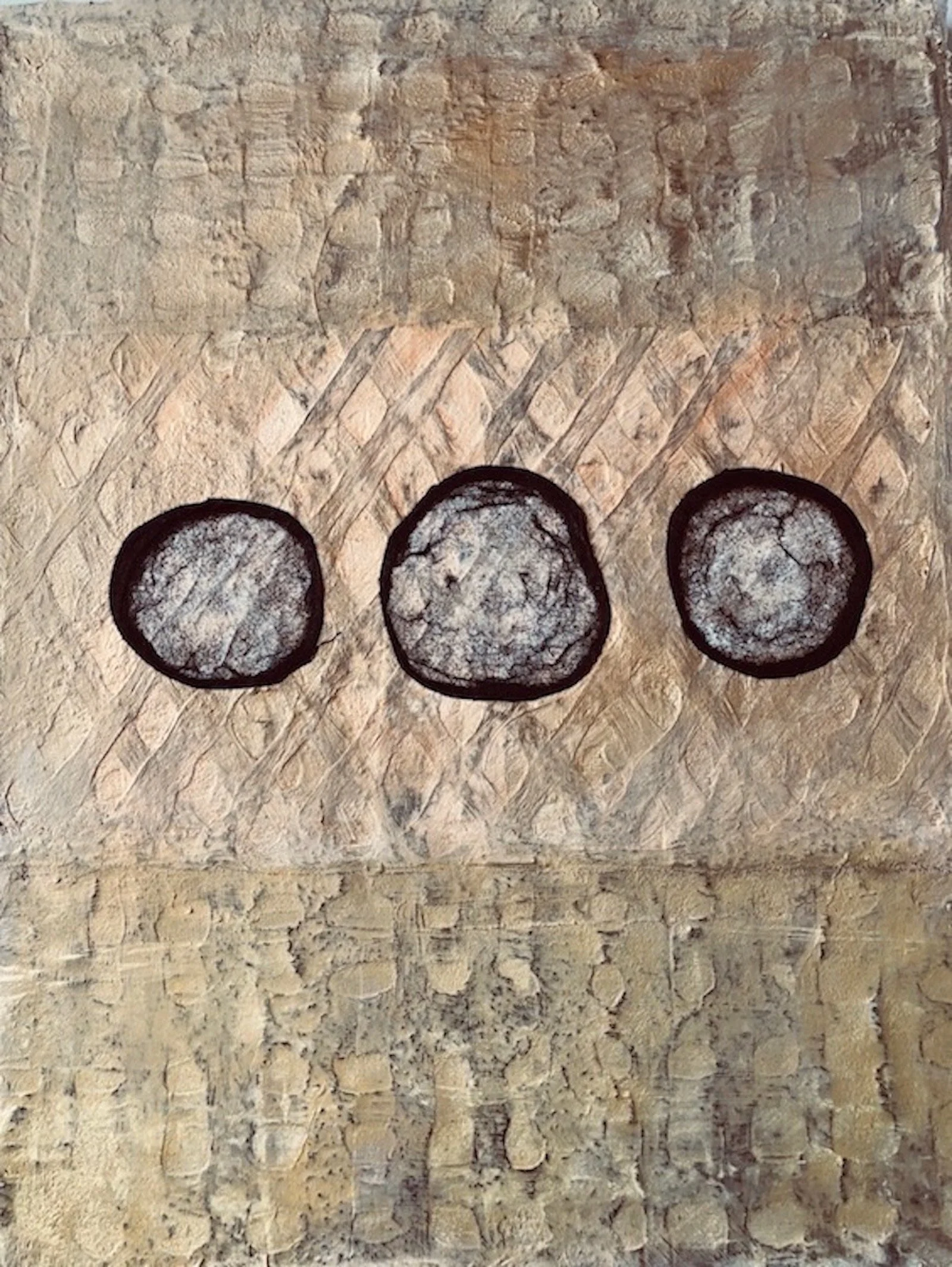
ORION'S BELT, 2019 mixed media, 22.86 cm x 30.48 cm
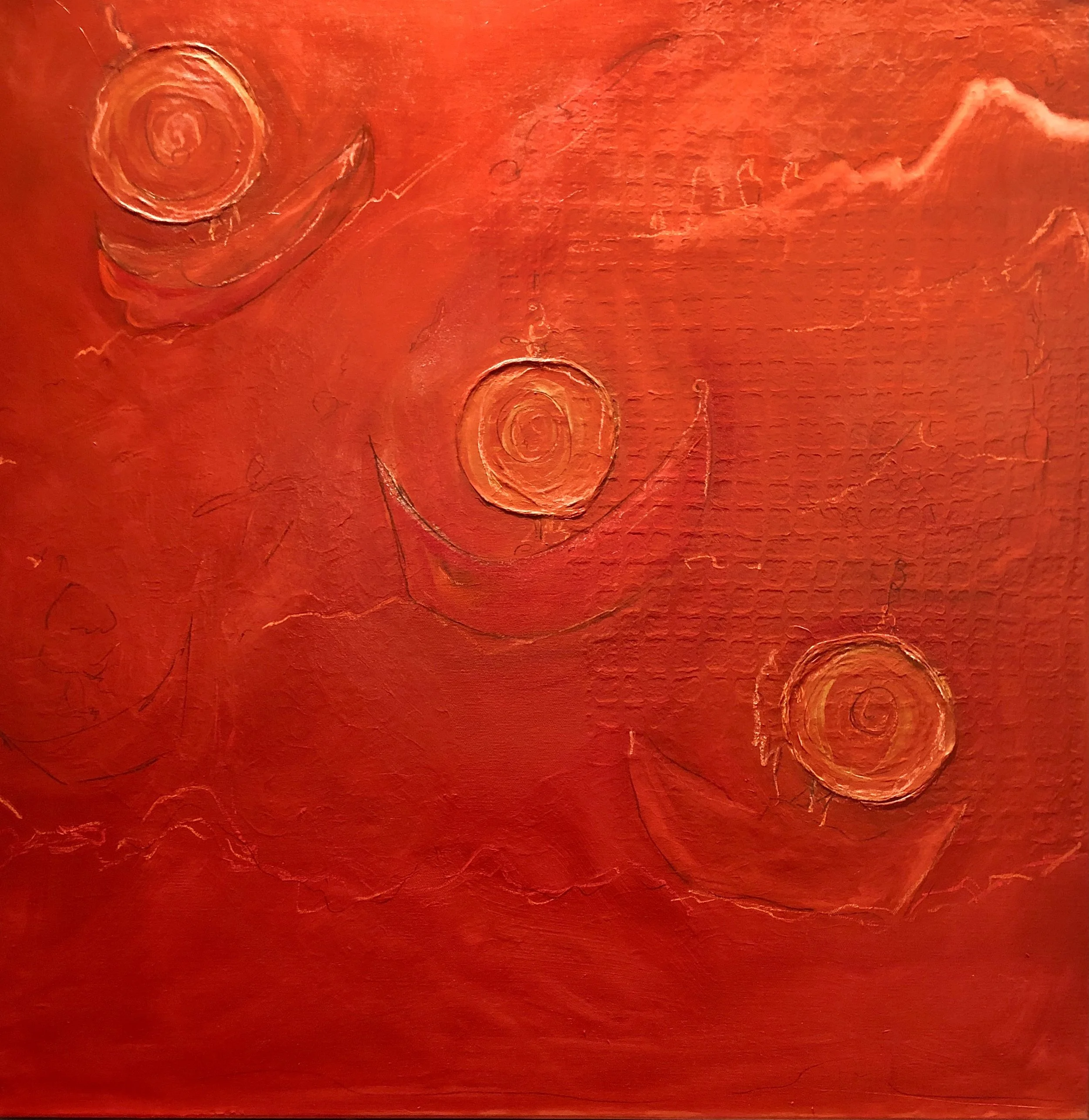
RED CHINA SAILS, 2021 oil on canvas, mixed media, 76.2 cm x72.6 cm
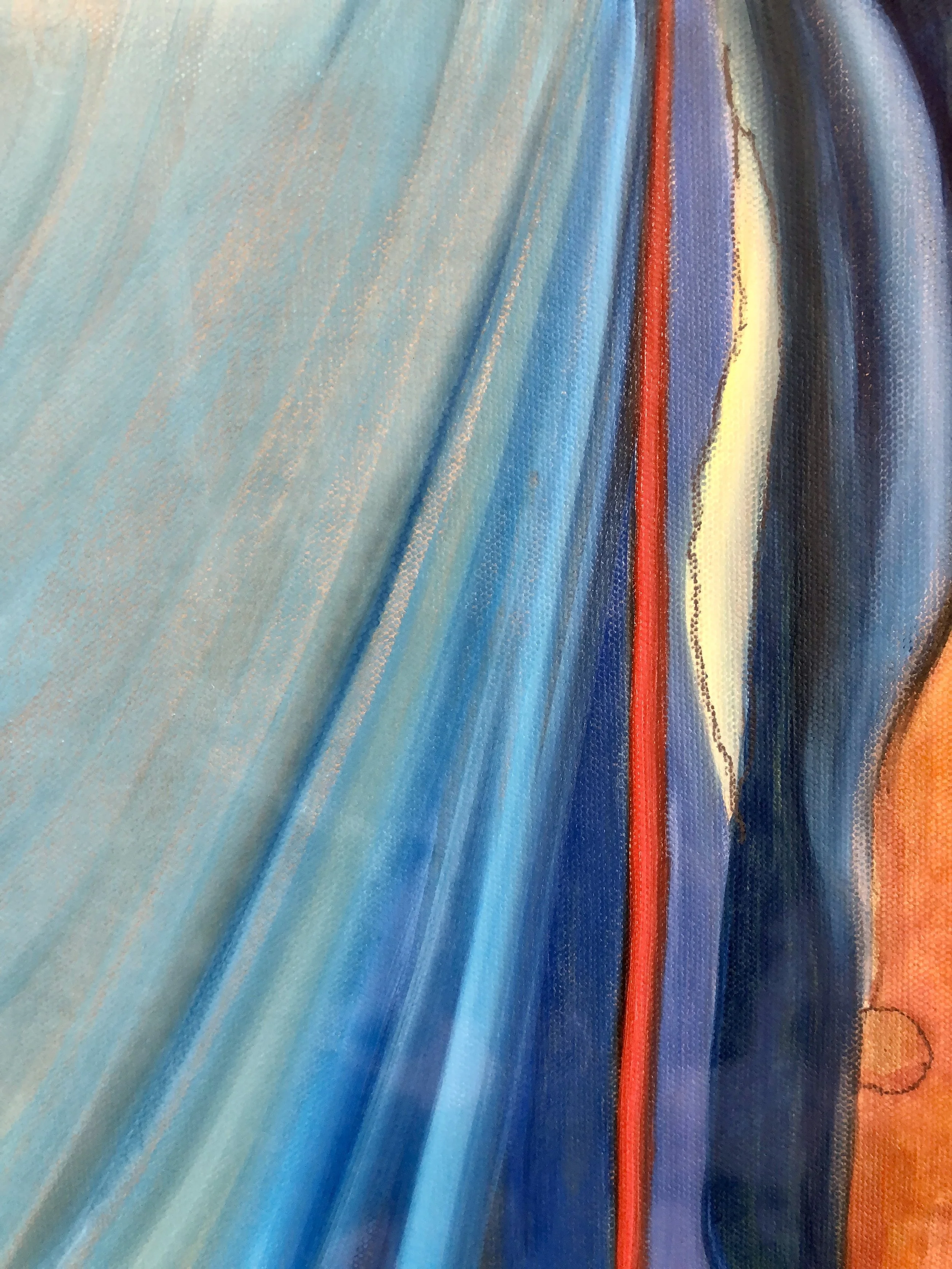
Giotto l, 2018, oil on canvas, 22.4 x 22.8
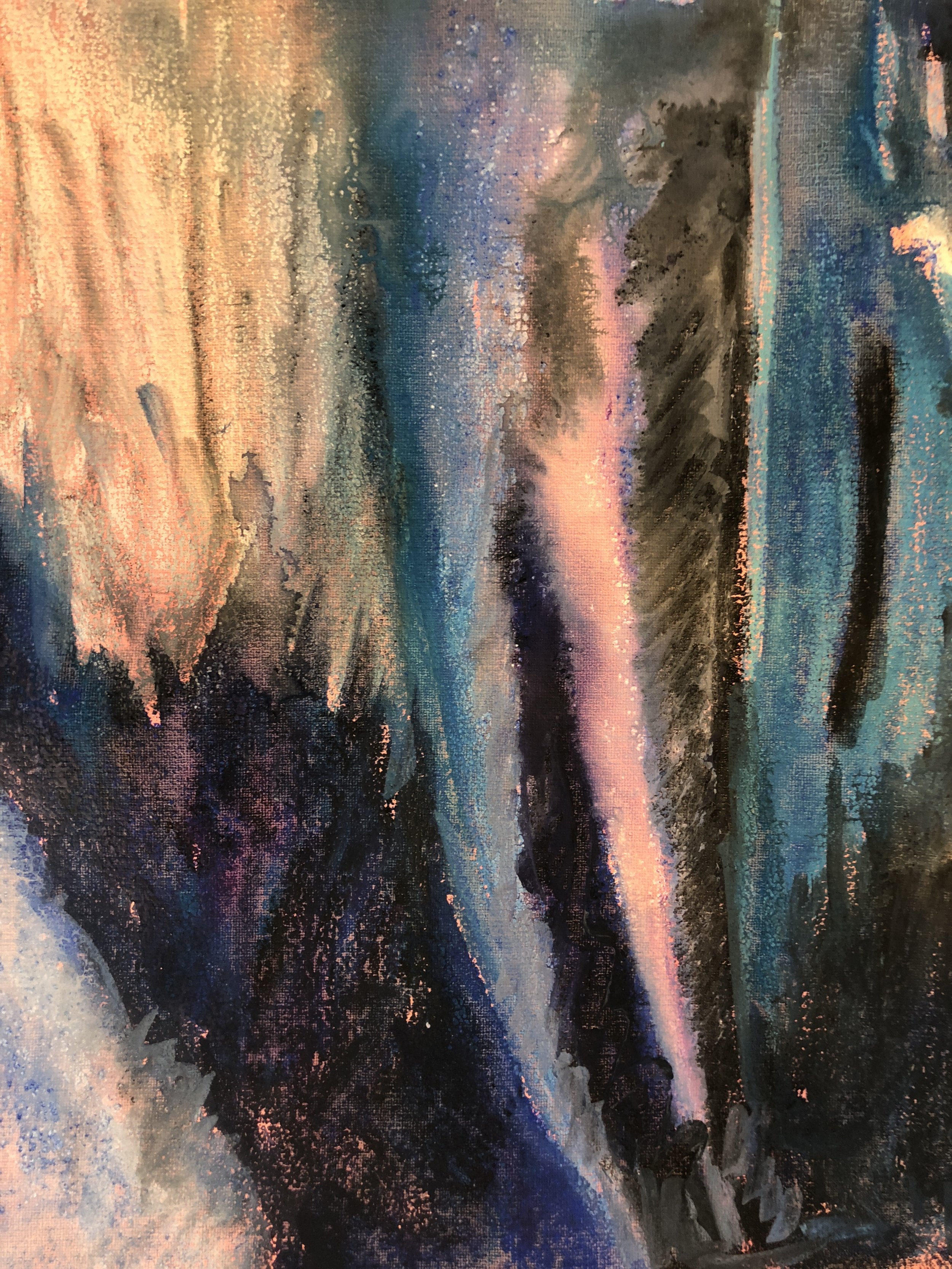
Giotto's Robe,ll 2018 oil on canvas 30.4 cm x 22.8 cm
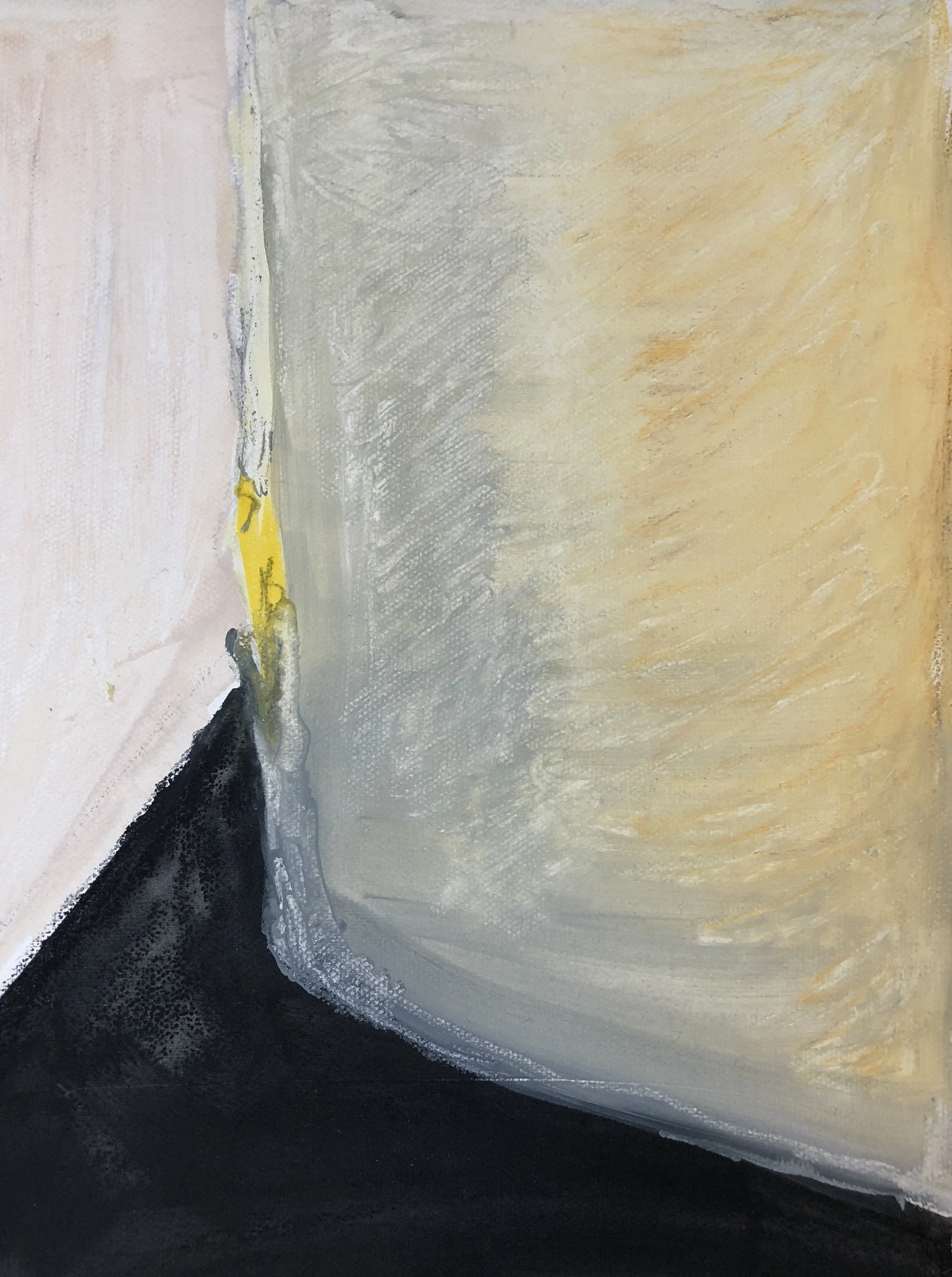
Giotto's Robe Ill, 2018, 30.4 cm x 22.8 cm
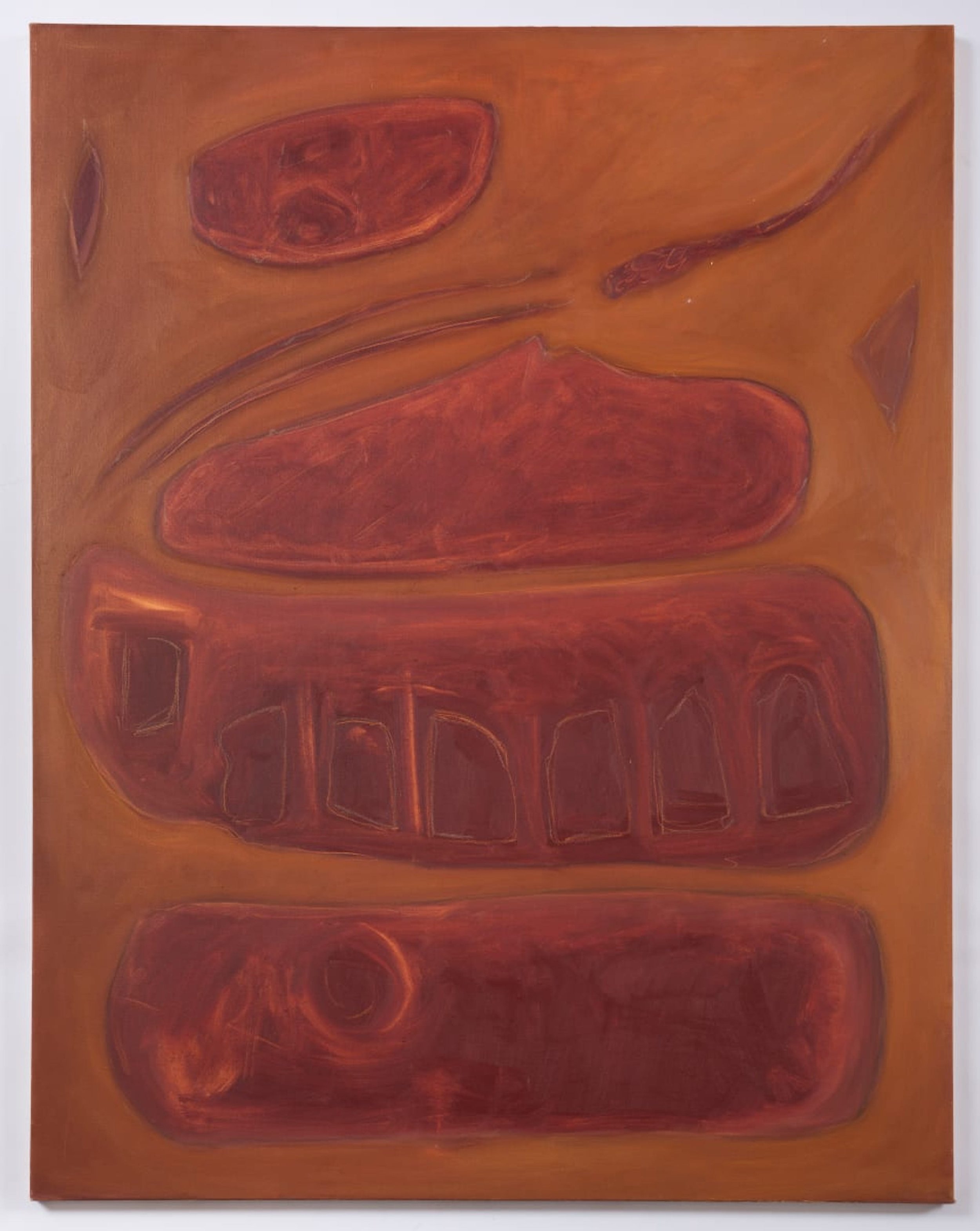
OXBOW SUNSET RED 2022, 121.92 cm x 91.44 cm