Anastasia Schipanova
Anastasia, your project Eternal Life, recently articulated in Paris, appears to situate itself at a complex intersection of metaphysics, biology, and aesthetic production. I am struck by how you mobilize abstraction not as a retreat from the world, but as a speculative instrument that proposes longevity as both a scientific hypothesis and an ontological condition. Could you elaborate on how you conceive of painting as a site of research, almost akin to a laboratory, in which color, vibration, and symbol operate as experimental variables within a broader inquiry into human perpetuity?
Thank you for such a deep observation of my work. Yes, I try to develop Energy Abstract as a meaningful and evolving concept. My scientific and psychological art project Eternal Life aims to unite different approaches around one optimistic idea of longevity, with a strong focus on the spiritual dimension. As I go deeper into this idea, I see more and more possibilities, and it gradually becomes a more structured vision. What once felt like a fantastic idea starts to feel closer to reality, especially today, when conversations around longevity and biohacking are becoming more visible.
For me, this project is also about respect for life, for the body, and for human potential. And I believe the future may be even brighter than we imagine.
The term you have coined, “Energy Abstract,” resists conventional formalist description, yet it simultaneously asserts a proprietary authorship and a structured philosophy. In the history of abstraction, from the spiritual aspirations of early modernism to the dematerialization of the art object in conceptual practices, abstraction has often carried utopian ambitions. How does your articulation of energy abstraction position itself in relation to this lineage, particularly in its insistence on measurable vibration and psychological transformation rather than purely optical experience?
I graduated as a psychologist, and I have spent around 15 years in the art world as an artist, almost 20 years of experience in total. What I can say, that psychological factors are always present in our lives, every day and every minute. And color is a language that artists use in painting. It is one of the most direct ways to express ideas and tell a story.
People naturally "read" paintings through color - this language is intuitive and easy to feel. That is why I prefer to approach it thoughtfully and deeply.
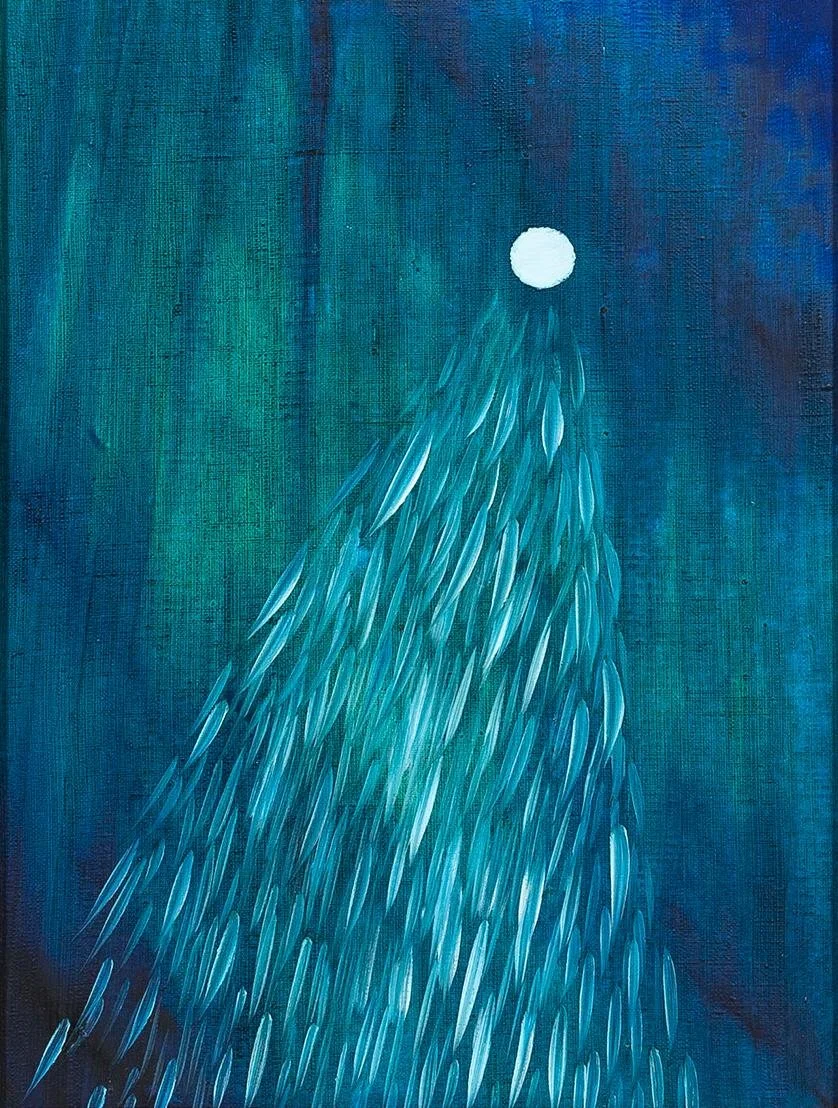
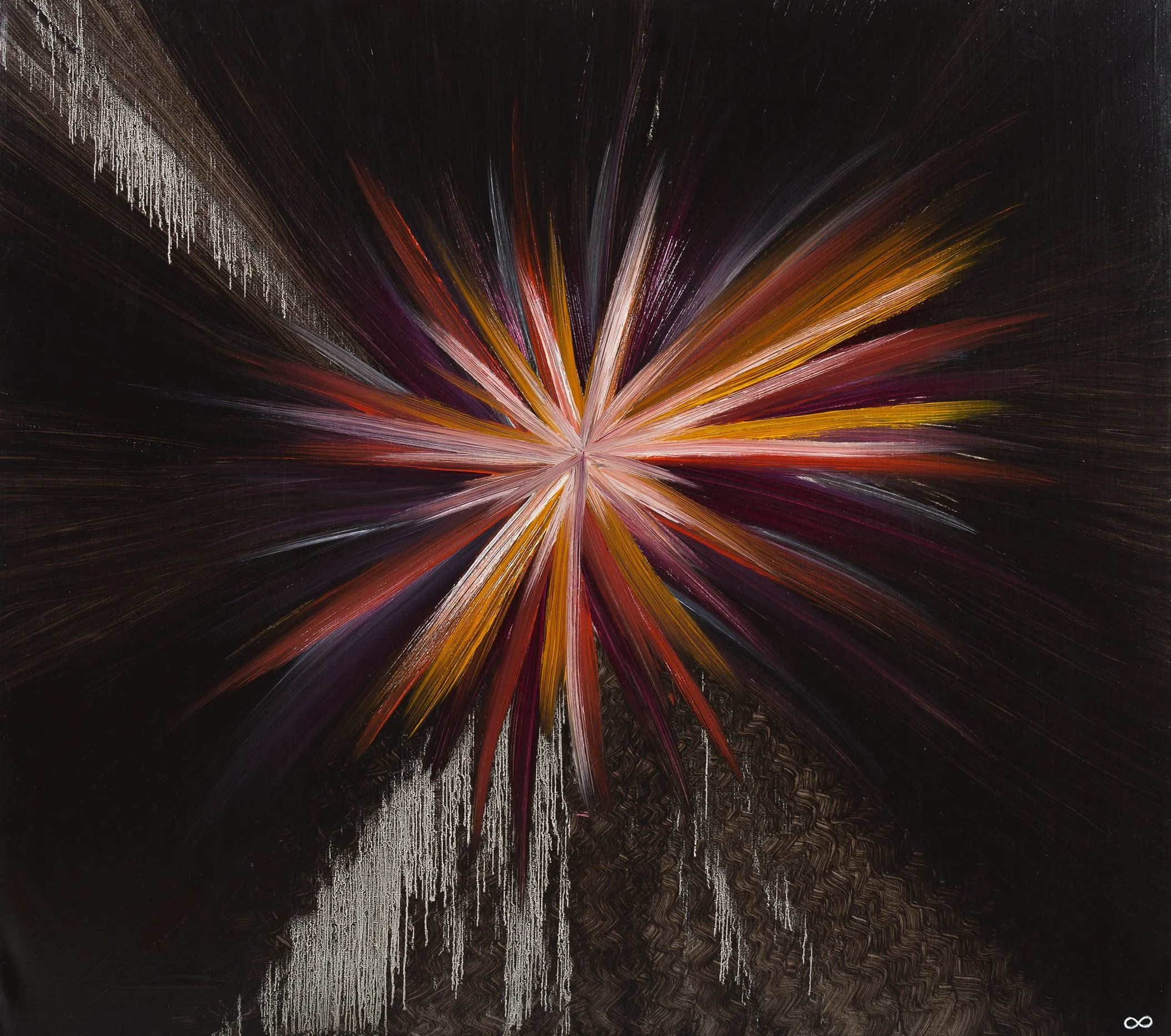
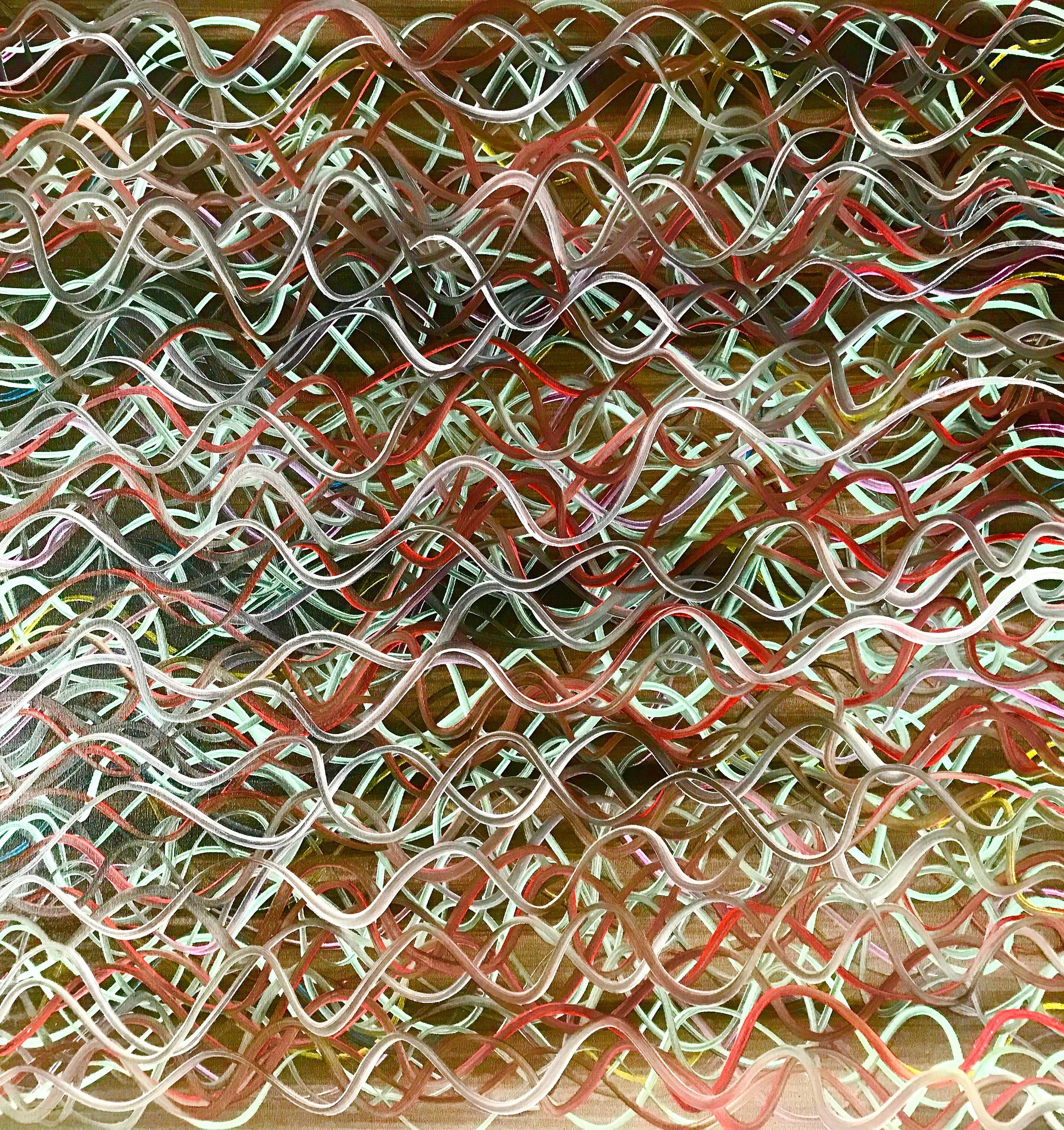
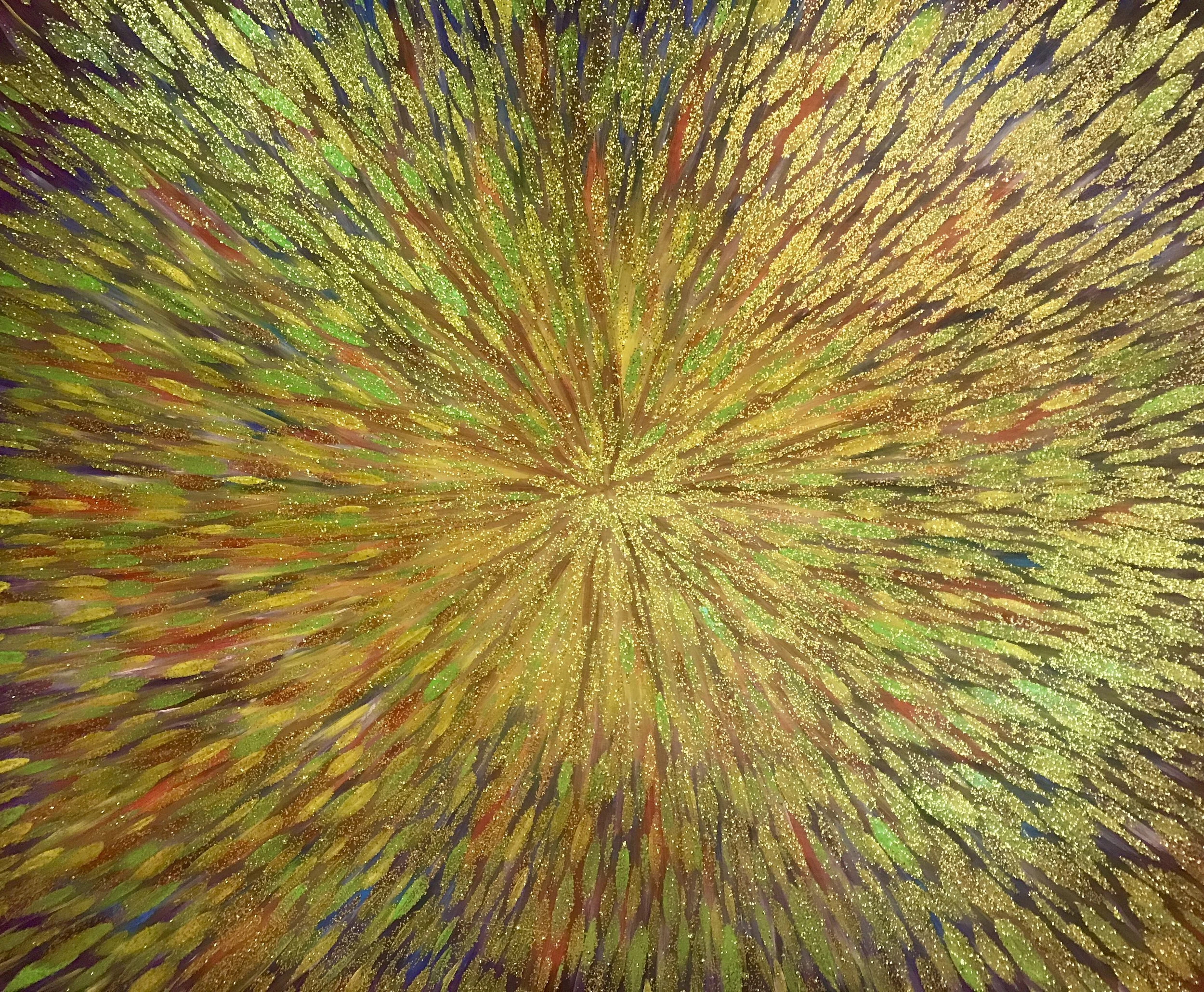
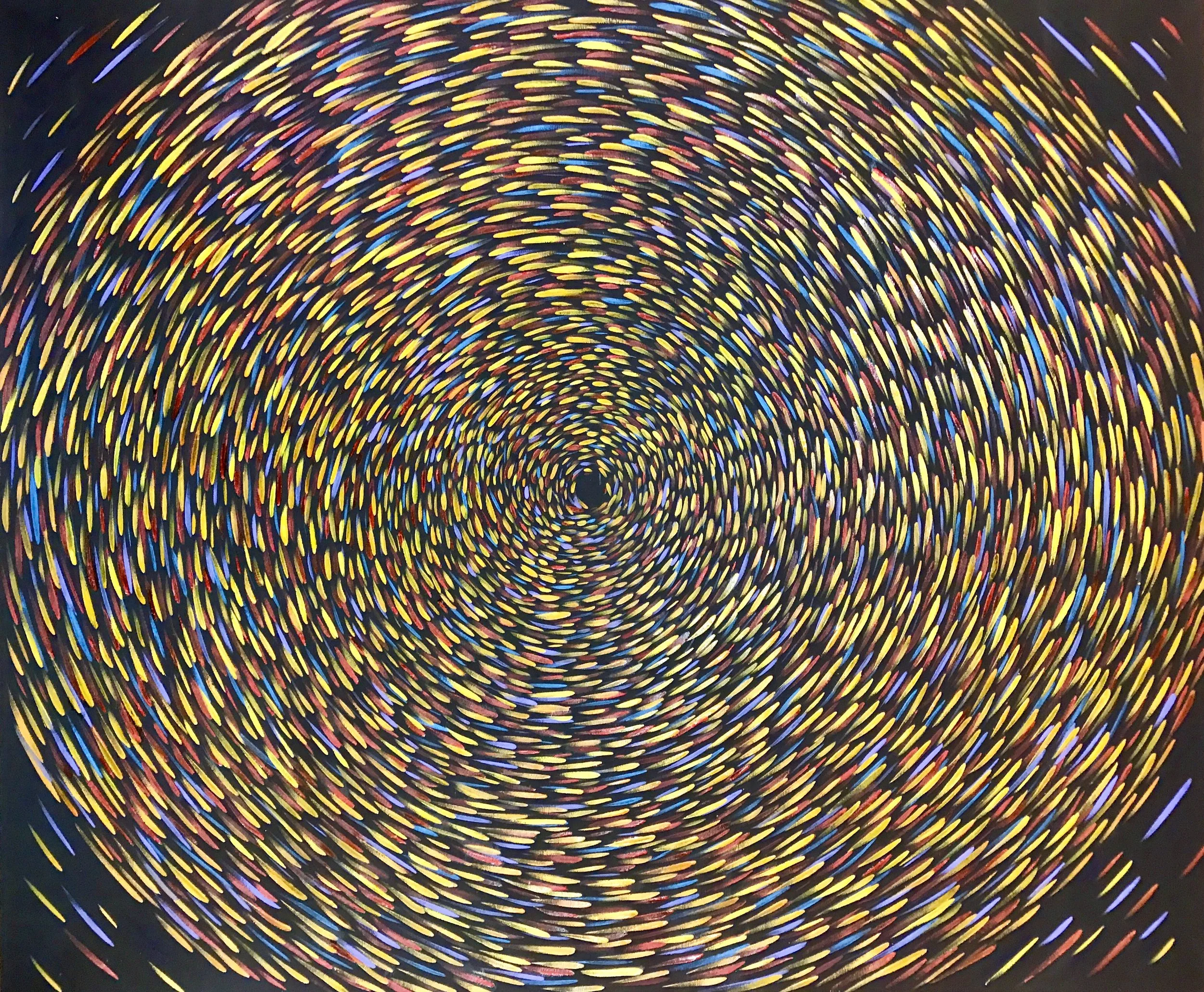
Energy Abstract is, for me, a door to another world - a new reality that brings emotions, perspectives, and imagination, and can activate personal memories. The viewer can become a co-creator of their own inner experience, like watching a personal film. It makes the experience more private and truly individual.
You frequently speak of movement in stasis, of canvases that appear inert yet reveal dynamism through prolonged viewing. This temporal demand placed upon the spectator suggests a phenomenological contract between artwork and viewer. Do you see the act of looking as a kind of initiation, a threshold experience that activates the dormant energies embedded within the work, and if so, how does this activation correspond to your belief in the possibility of eternal life?
Yes, I see it this way. I think looking at a painting can become a deeper experience if a person allows themselves more time and attention.
My works may appear still at first, but gradually they can reveal another inner movement. I am interested in this connection between the artwork and the viewer, when perception becomes more personal and intuitive. For me, it is important to create a strong connection between art and the human inner world.
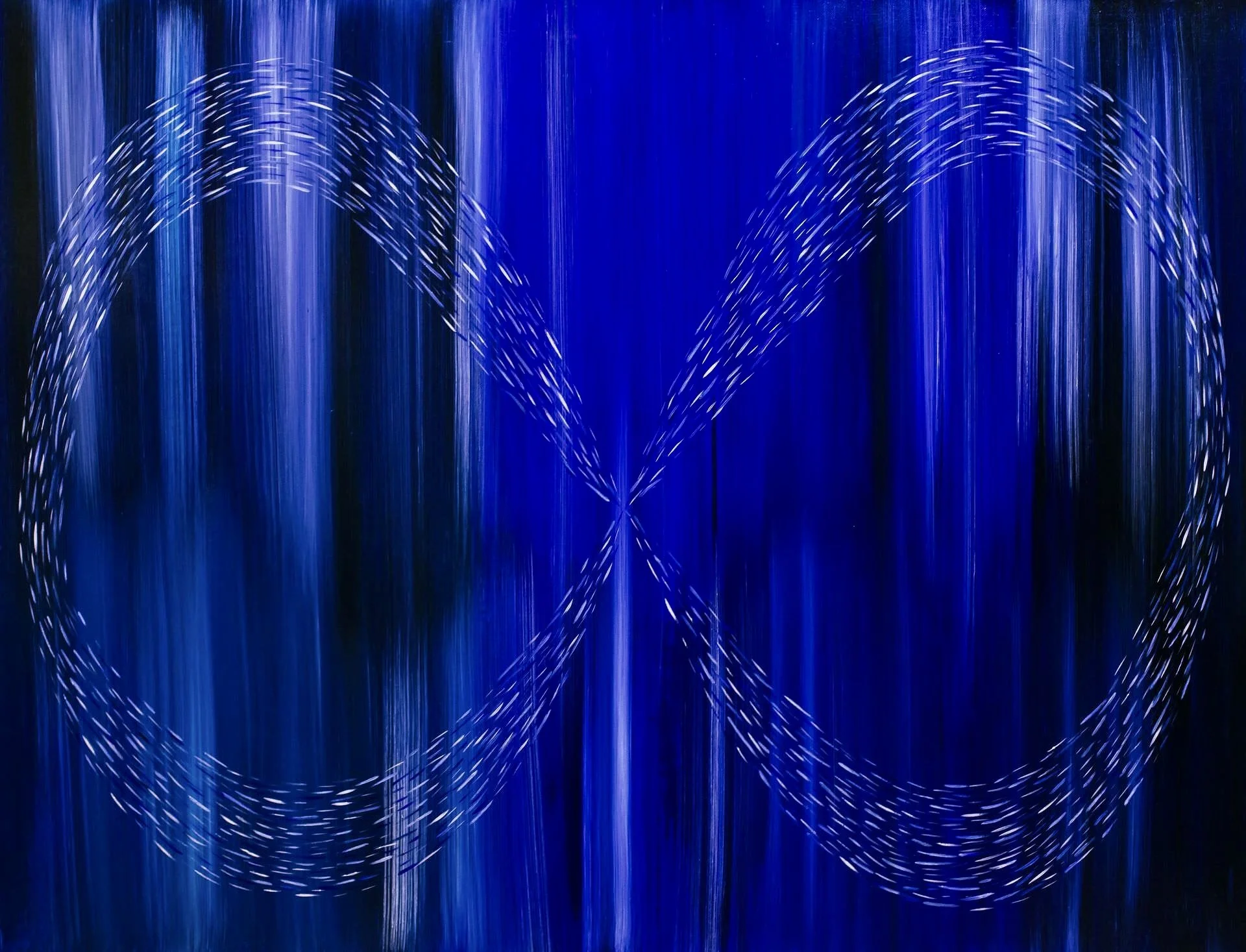
The infinity symbol, which you employ as both signature and philosophical marker, functions simultaneously as mathematical notation, spiritual emblem, and brand identity. Its multicolored reiteration introduces a chromatic multiplicity into what is traditionally a monochrome sign. Could you speak to this gesture as a negotiation between scientific rationality and transcendental desire, and how the symbol mediates the tension between finitude and boundlessness within your practice?
Of course, I spent many years searching for a personal symbol, and eventually it became the infinity sign. The universe is deeply connected to mathematics, and this idea has always resonated with me. As a painter, I also work within certain structures, even when the result feels intuitive.
The infinity sign felt like a natural extension of my artistic thinking.
Interestingly, I chose it as a personal symbol before fully developing my scientific and philosophical art project Eternal Life. Looking back, it feels like one continuous line - one idea unfolding through different stages.
For me, this symbol reflects the tension between finitude and boundlessness. It opens a space for reflection, where the viewer can move beyond the limits of ordinary perception and enter a more internal, expanded state. In a way, it becomes a point of transition — a quiet shift toward deeper awareness and inner transformation.
Your biography recounts a childhood spent at sea, under the guidance of a father who was a ship’s captain. The ocean, historically a metaphor for the sublime and for epistemological uncertainty, seems to reverberate through your cosmic and ecological imagery. To what extent does this maritime origin inform your conception of the canvas as horizon, as depth, or as navigable field, and how does it intersect with your later academic training in psychology?
My father was a captain on a river boat, and I spent most of my childhood on the river. It was an unforgettable journey, and water has remained very important to me. Oceans and seas always bring me back to that time - to a feeling of movement, depth, and openness.
For the past 15 years, I have also been working on my book Energy Abstract, which will be available on Amazon this year. It is about connecting with yourself, about transformation of consciousness, and about understanding the inner psychological processes we experience.
Psychology is a fundamental part of my life. It surrounds us everywhere - in our thoughts, emotions, and decisions. I believe we have the ability to understand certain patterns within ourselves and, to some extent, bring more clarity and balance into our lives.
Not to eliminate mystery completely, but to relate to it more consciously.
For me, life is a complex system of connections, where different elements come together and allow us to experience reality in a deeper and more meaningful way. And in many ways, this process is in our hands.
The experience of clinical death that you have chosen to disclose only after years of reflection introduces a profoundly autobiographical dimension into your discourse on eternity. In modern and contemporary art, transcendental claims often risk collapsing into spectacle or mystification. How have you negotiated the ethical responsibility of translating such an intimate, liminal event into visual language without reducing it to narrative illustration, and how does this experience recalibrate your understanding of materiality itself?
Thank you for this question. It is still a very personal experience for me, but I feel ready to speak about it more openly. I share it not to create a dramatic effect, but because it may resonate with others. It has influenced my perception of reality deeply. I still see the material world as fundamental, but not as the only dimension. This experience entered my work in a subtle way - through perception, sensitivity, and a deeper understanding of inner states.
Your practice extends beyond painting into fashion, modeling, digital authorship, and large scale international exhibitions, from Venice to New York. Rather than dispersing your identity, these multiple platforms seem to function as amplifiers of a singular energetic thesis. Do you consider this cross disciplinary visibility as an expansion of the artwork into lived performance, a kind of total aesthetic environment in which the artist’s body becomes both conduit and medium?
People use different languages to communicate with the world. My two favorite languages are art and fashion.
They may seem like parallel worlds, but very often they come together and become one. For me, life itself is a form of art.
We live in a world rich with visual impressions and connections, and we can use different mediums to express our ideas and realize our vision. I started modelling and painting at the same age, when I was 16. It was a very special time, and both directions became my passion from the very beginning.
In a way, I feel that I am connected to the world through these two languages, using them to express a broader picture and a more complete vision of what I want to communicate.
The ecological and evolutionary concerns embedded in Eternal Life suggest that immortality, in your formulation, is not merely individual but planetary. How do you reconcile the aspiration toward infinite human life with the fragility of ecosystems and the limits of earthly resources, and does your work propose a recalibrated ethics of coexistence as a prerequisite for any credible vision of perpetuity?
I see the first step on the path to longevity as a mental one. It begins with allowing yourself to think beyond habitual restrictions and to keep your mind open. I believe it is important to imagine a better future - not as something distant, but as something we can begin to shape through our perspective.
We are used to certain ideas about time and life, but I think it is possible to question these limits and expand them. When you allow yourself to think more freely, your perception begins to change. You become calmer, more focused, and more aware of your choices.
With this shift, your decisions also become more thoughtful and long-term. You start to see things differently - with more optimism, but also with more clarity. In this way, even a small change in mindset can gradually transform the way you experience life.
In your book Energy Abstract, you privilege dialogue over didacticism, proposing that authentic wealth lies in inner knowledge rather than external accumulation. This resonates with a long tradition of artists who have sought to reposition aesthetic experience as a catalyst for consciousness. How does the textual dimension of your practice complicate or deepen the silent rhetoric of your paintings, and do you perceive writing as another modality of abstraction, one that operates through semantic vibration rather than pigment?
Yes, I do. Paintings speak through color and form. Oil, for me, is a powerful medium that allows me to create a space for personal dialogue and individual interpretation.
Energy Abstract presents what I see as a new wave of modern art - one that can move the imagination into another inner dimension, with a special focus on the subconscious and personal experience. I want the viewer to feel safe and unique within this space, as if entering a quiet and personal art experience.
Even in a home environment, these works create a soft and subtle connection with the viewer. I receive many warm words from collectors who feel that the paintings change the atmosphere of a space and bring a certain emotional balance and energy.
My book explains the concept of t Energy Abstract more directly. I strongly believe in the inner power of consciousness - it is something we develop throughout our lives, and it is one of the strongest forces we have.
I prefer to speak with my audience as a friend, not as a teacher. We are all unique, and I respect the personal space of each reader and viewer. For me, it is important to create a sense of openness and freedom, because real knowledge can grow only in freedom.
Your assertion that “human can live forever” is both radical and disarmingly direct. Within the critical discourse of contemporary art, where irony often supplants conviction, such sincerity can be destabilizing. Is your insistence on eternity a strategic provocation aimed at unsettling prevailing narratives of decline and entropy, or is it, more profoundly, an ontological stance that demands we reconceive art itself not as an object bounded in time, but as an enduring energetic imprint that survives its material support?
Both points are correct. I believe we need to be more conscious and responsible in everything we do — every step in life has meaning.
Eternal Life can be understood in different ways. It has an element of provocation and directness, but at the same time it reflects a sincere intention to think beyond usual beliefs and to explore new possibilities. I understand that this idea may seem unrealistic or even extreme to some people, but art has always allowed us to question limits and imagine what lies beyond them.
If we begin to think more consciously, with optimism, care, and respect for life, it can already influence how we live and what kind of future we create.
I love life and value every moment, and I want to create something meaningful.
If you look closely, even small steps in the right direction have meaning.
Together, we can shape a better future - not only for ourselves, but for the next generations.
Clarity of mind, optimism, inspiration, and belief can already influence how we live, how we relate to others, and how we care for the world around us. In this sense, even a shift in perspective becomes important...
And for me, that is already a meaningful goal.